
Many students read the same textbook page ten times, yet remember almost nothing. Treat your brain like a muscle, not a passive sponge. With active recall, you train your mind during each study session.
This ultimate guide to studying shows how flashcards, blurting, and practice questions move facts into long-term memory. It helps you study smarter not harder by focusing on methods that work. These study tips for students can save hours of frustration.
Ready to master your learning? Read our free book, How to Become the Smartest Student in the Classroom. Get your copy at https://www.studyingmachine.com/free-books/ to discover more memory secrets.
Key Takeaways
- Active recall transforms passive reading into an effective brain workout.
- Self-testing is more powerful than re-reading notes.
- Techniques like blurting help identify knowledge gaps quickly.
- Consistent practice moves information into long-term memory.
- You can achieve better grades without spending more hours at your desk.
What Active Recall Does for Memory Retention
Have you wondered why your brain seems to dump information after you close your textbook? Many people lose 50% to 80% of new information within one day. Our brains cannot hold everything we see or hear.
To fight this loss, move beyond passive reading. With active recall, you make your brain search for answers instead of simply receiving information. This change in cognitive learning methods turns brief thoughts into lasting knowledge.
How Retrieval Strengthens Learning
When you retrieve information, you build a stronger mental bridge to the memory. Each fact you pull from your mind makes that path easier to use later. This is one of the most effective smarter studying techniques for students today.
Think of active recall like lifting weights at the gym. Watching someone exercise does not make you stronger; doing the heavy lifting does. Your brain builds its “memory muscles” when you retrieve what you learned.
Why Struggling to Remember Can Improve Long-Term Recall
That moment of mental struggle may feel frustrating, but it signals progress. When an answer feels hard to remember, your brain works to rebuild the information. This desirable difficulty helps cement the concept in long-term memory.
If you want to explore these strategies, the free book How to Become the Smartest Student in the Classroom shares practical routines that stick. Get your copy at https://www.studyingmachine.com/free-books/ to master these habits.
The Difference Between Familiarity and True Understanding
Many students mistake familiarity for true mastery. Recognizing a word on a page does not mean you can explain its concept from scratch. True memory retention happens when you recall information without external cues or prompts.
| Learning Method | Mental Effort | Retention Level | Outcome |
|---|---|---|---|
| Passive Reading | Low | Very Low | False Confidence |
| Highlighting | Low | Low | Surface Recognition |
| Active Recall | High | Very High | Deep Understanding |
| Practice Testing | High | High | Mastery |
Active Recall: The Ultimate Guide to Studying Smarter, Not Harder
Studying does not have to feel like a battle against your own brain. Many students spend hours highlighting textbooks, yet they struggle to recall information when it counts. This ultimate guide to studying focuses on a simple shift: stop consuming information and start producing it.
The Core Principles of This Smarter Studying Technique
The main idea is to make your brain retrieve information instead of rereading it. When you struggle to remember a concept, you are strengthening the neural pathways linked to that knowledge. This is how you truly study smarter not harder: your brain does the heavy lifting during practice.
How Active Recall Fits Into Effective Study Habits
Think of learning as a cycle: previewing, attending class, and reviewing. Active recall connects these effective study habits. Instead of reading notes, test yourself to check what you understand.
If you want to explore memory techniques, read our free book, How to Become the Smartest Student in the Classroom. It shares practical strategies that stick. You can grab your copy at https://www.studyingmachine.com/free-books/.
When to Use Active Recall During a Study Session
You do not need to spend all day at your desk to see results. Using retrieval at key moments can maximize your efficiency.
Before Learning New Material
Try to recall what you know about a topic before starting new chapters. This primes your brain to connect new information with existing knowledge.
After Reading or Watching a Lesson
Close your book or pause the video after finishing a section. Ask yourself to summarize the main points aloud to ensure you grasp the core concepts.
Before a Quiz, Exam, or Presentation
Use this time to simulate the testing environment. Practicing retrieval under pressure builds confidence for important moments. This proves you can study smarter not harder through effective study habits.
Why Rereading and Highlighting Often Fall Short
Highlighting every sentence can feel like learning, but it often is not. Color-coded notes may feel productive, yet this comfort can be a deceptive illusion. Simply looking at words does not make your brain store them deeply.
Passive Review Versus Active Learning Strategies
Passive review is like watching a workout video instead of going to the gym. You may understand the movements, but watching does not strengthen your muscles. By contrast, active learning strategies make you pull information from your brain.
These methods make you a participant in your own education. They build stronger neural pathways, making future retrieval easier. Knowing a path is different from walking it yourself.
Why Recognizing an Answer Is Not the Same as Recalling It
Have you ever read a paragraph and thought, “Yes, I know this,” then blanked when you closed the book? Your brain recognizes familiar information, but that does not show true mastery. This is a common pitfall in many cognitive learning methods that depend on repeated exposure, not effortful retrieval.
Recognition is a basic task and does not prove you can explain or apply a concept. True learning happens when you struggle to retrieve an answer from scratch. That “stuck” feeling means your brain is strengthening its connection to the material.
How to Turn Notes and Textbooks Into Retrieval Practice
You can make study materials powerful by changing how you use them. Turn a definition into a question instead of highlighting it. If you study a diagram, cover its labels and redraw it from memory on blank paper.
These cognitive learning methods turn static notes into a quiz. Explaining concepts in your own words takes you beyond memorization. For deeper study, the free book How to Become the Smartest Student in the Classroom shares memory techniques and practical active learning strategies that stick. Get your free copy at https://www.studyingmachine.com/free-books/.
| Study Method | Brain Effort | Retention Level |
|---|---|---|
| Rereading Text | Low | Temporary |
| Highlighting | Low | Temporary |
| Active Recall | High | Long-term |
| Self-Explanation | High | Long-term |
Practical Active Recall Techniques for Students
Studying can feel easier when you use the right tools. Using active learning strategies turns study time into focused practice that helps ideas stay with you. These methods make your brain do more work.

Close the Book and Explain the Main Ideas
Start by closing your textbook after reading a section. Summarize the main points aloud or on paper without checking the text. If you get stuck, that is a clear signal to review that part again.
Use Practice Questions Before Looking at the Answers
Many students read answer keys too early. Instead, create an answer first, even when you feel unsure. This struggle is where active recall happens.
Create Brain Dumps From Memory
Take a blank sheet and write everything you remember about the topic. This “blurting” method can show what you truly know, even when your notes look messy. Then compare your notes with the source material and fill the gaps.
Teach a Concept in Plain Language
If you can explain a topic to someone else, you understand it. Teach a complex idea to a friend or imaginary audience using simple, everyday words.
Use the Feynman Technique to Find Knowledge Gaps
The Feynman Technique is a classic way to master difficult subjects. Jargon or confusion shows a gap in your knowledge. Return to your source, simplify the explanation, and teach it again until it feels natural.
Predict Questions a Teacher or Professor Might Ask
Put yourself in your teacher’s shoes to create useful study tips for students. Ask yourself these questions while reviewing:
- What is the most important concept here?
- How does this relate to what we learned last week?
- If I were writing the exam, what would I ask about this topic?
Want to go deeper? The free book How to Become the Smartest Student in the Classroom shares memory techniques, study routines, and practical strategies that stick. You can grab your free copy at https://www.studyingmachine.com/free-books/.
How to Make Active Recall Flashcards That Work
To master smarter studying techniques, rethink how you build flashcards. Many students treat flashcards as simple fact lists. Designed well, they become a powerful tool for your brain.
Write One Clear Question on Each Card
Do not cram an entire paragraph onto one side. A busy card makes it harder to focus on the main idea. Ask one specific question on each card to test one piece of knowledge.
Focus on Application Instead of Simple Definition Recall
Do not only memorize definitions. Apply each concept to a new situation or explain how it works in real life. This deeper thinking supports smarter studying techniques.
Use Short Answers and Specific Prompts
Keep your answers short and direct. A long essay on the card’s back usually contains too much information. Divide the complex idea into three or four smaller cards.
Build Flashcards for Facts, Processes, and Comparisons
Flashcards can cover more than vocabulary. Ask questions about step-by-step processes or compare two similar theories. This variety keeps study sessions fresh and avoids boring repetition.
Example of a Weak Flashcard
A weak card might say: “Tell me about photosynthesis.” This question is vague and does not test specific knowledge of the process.
Example of a Strong Flashcard
A strong card would ask: “What are the three primary inputs required for the light-dependent reactions in photosynthesis?” This question requires a precise, verifiable answer.
| Strategy | Weak Approach | Strong Approach |
|---|---|---|
| Focus | Broad topics | Specific concepts |
| Answer Type | Long paragraphs | Concise facts |
| Goal | Recognition | Active retrieval |
Review Cards Without Guessing From Partial Recognition
You may see familiar words and think, “Oh, I know that.” True learning happens when you state the answer before flipping the card. If you cannot explain it clearly, mark it incorrect and review it later.
Want to go deeper? The free book How to Become the Smartest Student in the Classroom shares memory techniques, study routines, and practical strategies. Get a free copy at https://www.studyingmachine.com/free-books/.
Build an Active Recall Study Session Step by Step
Turn your daily work into focused progress with this simple, step-by-step plan. When you study smarter not harder, you avoid aimless reading and build lasting knowledge. Follow this repeatable flow to make each session count.
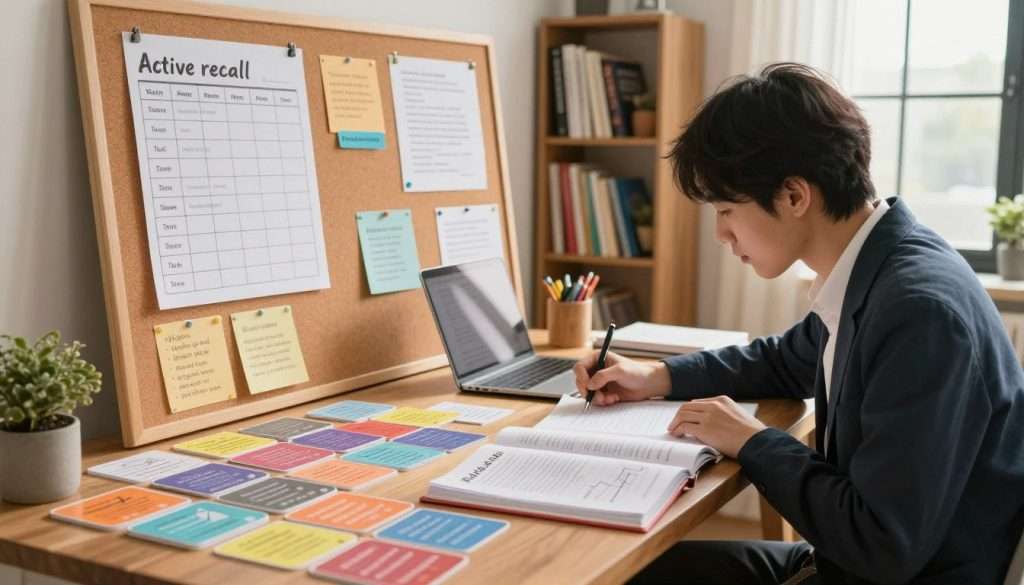
Set a Specific Learning Objective
Before opening a book, decide exactly what you want to master. Instead of saying “I will study biology,” say, “I will explain the process of photosynthesis.” A clear goal focuses your brain and prevents drifting.
Preview the Material and Identify Key Questions
Scan your headings, diagrams, and bold terms for a few minutes. Turn these elements into questions you must answer later. This shift builds effective study habits by making reading an information hunt.
Study in Short, Focused Blocks
Work in 30- or 45-minute bursts of focused concentration. Stay fully engaged with the material during each block. When the timer ends, take a short break so your brain can reset and consolidate learning.
Close Your Materials and Retrieve the Information
This is the heart of active recall. After each block, close your book or hide your notes completely. Make your brain retrieve information without help, because this creates real learning.
Check Your Answer and Correct Mistakes
Reopen your materials and check your work. Did you miss a detail or misunderstand a concept? Correct mistakes now, rather than discovering them during an exam.
Mark Knowledge Gaps for Later Review
If you struggled with a section, write it on a “gap list.” This list guides your next session and prevents you from reviewing material you already know.
End With a Brief Summary From Memory
Before packing up, spend two minutes summarizing the main ideas aloud or on paper. This final act of active recall strengthens connections in your brain. For deeper help, the free book How to Become the Smartest Student in the Classroom shares memory techniques and practical strategies that actually stick. Get your free copy at https://www.studyingmachine.com/free-books/.
| Study Phase | Passive Approach | Active Approach |
|---|---|---|
| Preparation | None | Set clear goals |
| Engagement | Rereading notes | Retrieval practice |
| Review | Highlighting text | Gap analysis |
| Completion | Closing the book | Memory summary |
Combine Active Recall With Spaced Repetition
To turn short study sessions into lasting knowledge, pair retrieval practice with a smart schedule. While pulling information from your brain helps, the timing of each effort decides how well it stays. These smarter studying techniques help your hard work pay off on the final test.
Why Spacing Reviews Improves Long-Term Learning
Your brain tends to forget information it sees as unimportant. Review material just before you forget it, and you signal that the information matters. This practice improves memory retention over time.
Use a Simple Review Schedule
You do not need a complex calendar to see results. Use this simple plan to keep your knowledge fresh and ready.
Review the Same Day
Take five minutes to summarize what you learned in class today. This quick review strengthens the brain pathways you just built.
Review After One or Two Days
Test yourself again one or two days after your first session. This review helps you find gaps before they become lasting blind spots.
Review After One Week
After one week, the information begins moving into long-term storage. A quick retrieval session shows whether you truly understand the concept.
Review Before the Exam
Use this final check to find any weak points. This is the perfect time to focus on topics that still feel unclear.
Adjust Review Timing Based on Difficulty
Not all facts are equally easy to learn. For a challenging concept, increase the frequency of your reviews. If you can explain a concept perfectly each time, space those reviews farther apart.
Balance Digital Flashcard Apps With Written Practice
Digital tools can automate your schedule, but do not rely on them alone. Writing answers by hand or explaining them aloud makes your brain work harder. Mixing both methods deepens understanding and supports memory retention.
Want to go deeper? The free book How to Become the Smartest Student in the Classroom shares memory techniques, study routines, and practical strategies that stick. You can grab your free copy at https://www.studyingmachine.com/free-books/.
Apply Active Recall to Different Subjects
You do not need to force every class into the same flashcard-shaped box. Active learning strategies let you match your study approach to each course’s demands.
Active Recall for Biology, Anatomy, and Other Sciences
In science, aim to understand how systems function rather than simply memorize labels. Draw a process from memory, like the Krebs cycle or skin layers, then check your work.
Explaining the “why” behind a biological process is far more effective than staring at a diagram. This builds a mental map that lasts longer than passive reading.
Active Recall for Mathematics and Problem-Solving Courses
Math requires practice, not just watching. Instead of reading solved examples, cover the solution and solve the problem yourself from scratch.
If you get stuck, find the exact step that confused you. Explaining each step out loud as you work is a powerful cognitive learning methods for mastering complex equations.
Active Recall for History, Government, and Social Sciences
These subjects connect events and ideas. Ask how a specific policy led to social change or how two historical figures differed in approach.
Write a short chapter summary without looking at your notes. Focus on the arguments and themes, not isolated facts.
Active Recall for Literature and Reading-Heavy Classes
Literature requires engagement with characters and their motivations. After finishing a chapter, pause and summarize the main conflict or the development of a character’s arc from memory.
Connect these details to the book’s broader themes. This practice turns reading from a passive activity into an active investigation of the text.
Active Recall for Learning a Foreign Language
Language learning thrives on steady, active use. Move beyond simple word lists to understand how a language works in the real world.
Practice Vocabulary in Context
Do not memorize isolated words. Create sentences using new vocabulary that relates to your daily life or interests.
Retrieve Grammar Rules Through Examples
Rather than reciting grammar rules, create examples that follow them. If you can create a correct sentence from scratch, you have mastered the concept.
Our free book, How to Become the Smartest Student in the Classroom, shares memory techniques and study routines. It also offers practical strategies that actually stick. You can grab your free copy at https://www.studyingmachine.com/free-books/.
Common Active Recall Mistakes That Reduce Results
You may think you understand a topic when you are only going through the motions. Even good intentions can create habits that hurt your memory retention. Learn to avoid these mistakes and use your study time well.
Looking at the Answer Too Quickly
The biggest mistake is flipping your flashcard or checking notes before trying to retrieve the answer. If you peek too soon, you recognize information instead of recalling it. True learning happens in the struggle to pull that information from your brain.
Memorizing Words Without Understanding the Concept
Rote memorization is a trap for many students. You may recite a definition perfectly without applying it to a new problem. Explain ideas in your own words to show that you understand their logic.
Creating Too Many Low-Quality Flashcards
Quality matters more than quantity in your study deck. If you create hundreds of cards, managing them may replace actual learning. Focus on the core principles that matter most for your exams.
Studying Only What Feels Easy
Reviewing familiar material feels good, but it may waste your energy. This is one of the most important study tips for students: practice the hard topics. Difficult material is often where your brain grows most.
Ignoring Mistakes Instead of Reviewing Them
Many people see a wrong answer as failure, but it provides useful information. A mistake reveals a specific gap in your knowledge. Use it to adjust your focus and strengthen weak areas.
“The struggle is not a sign of failure; it is the feeling of your brain building new connections.”
Replacing Sleep, Practice, and Breaks With More Study Time
You may think an all-nighter leads to success, but your brain needs rest to store new learning. Sleep moves memories from short-term to long-term storage. Never sacrifice recovery for extra passive review.
| Habit | Impact on Learning | Better Approach |
|---|---|---|
| Peeking at answers | Low retention | Force retrieval first |
| Rote memorization | Surface understanding | Explain in own words |
| Ignoring mistakes | Stagnation | Analyze and correct |
| Skipping sleep | Burnout | Prioritize rest |
Want to go deeper? The free book How to Become the Smartest Student in the Classroom shares memory techniques, study routines, and practical strategies that stick. Readers can get a free copy at https://www.studyingmachine.com/free-books/.
Make Active Recall Part of a Sustainable Study Routine
A sustainable study routine becomes easier when you know how to add retrieval to each day. Do not save this method for the night before an exam; make it a consistent habit. Add these effective study habits to your weekly schedule to avoid last-minute cramming.
Plan Weekly Retrieval Sessions Around Your Classes
Schedule short retrieval blocks after lectures or reading sessions. Reviewing material while it is fresh strengthens brain connections. This shift helps you study smarter not harder and shortens future review time.
Track Progress by What You Can Explain and Solve
Measure your growth by explaining concepts without checking your notes. Teach a topic to a friend or solve a problem from scratch to show real understanding. Tracking your progress this way shows what you know and what needs more work.
Use a Mix of Written, Spoken, and Practice-Test Retrieval
Variety keeps your brain engaged and stops study sessions from feeling repetitive. Write a summary, explain a process aloud, or take a quick practice quiz. These study tips for students test knowledge from different angles and improve retention.
Want to Go Deeper With Memory Techniques and Study Routines?
If you are ready to improve your learning, we have something special for you. Mastering these skills can change your entire academic experience.
Get the Free Book How to Become the Smartest Student in the Classroom
Our guide shares proven memory techniques, daily routines, and practical strategies that last. It helps transform studying from a chore into an enjoyable, effective experience.
Access the Free Copy at studyingmachine.com/free-books
You can get your free copy now at studyingmachine.com/free-books/. Start building your path to academic success today!
Conclusion
You now have the tools to change how your brain processes information. By choosing active recall, you leave behind passive habits that waste precious time. This shift helps you study smarter not harder and build a foundation for true mastery.
Remember, your brain grows stronger when it retrieves, explains, and applies what you learn. Keep sessions focused, space reviews, and prioritize quality sleep to lock in memory retention. These small, consistent actions create massive results over time.
Start your journey now by closing your notes and answering three questions about today’s material from memory. You will be surprised by how much sticks when your mind does the heavy lifting.
Want to go deeper into these powerful habits? Our free book is titled How to Become the Smartest Student in the Classroom. It shares a complete system of memory techniques and study routines that work.
Grab your free copy at https://www.studyingmachine.com/free-books/ to take your academic performance to the next level.