

Have you ever walked into a room, only completely blanking on why you went there? We’ve all had that frustrating moment when knowledge slips away like sand through fingers.
Hermann Ebbinghaus found that humans lose nearly 90% of new information within a week. This decline happens unless we actively reinforce what we learn.
Understanding this pattern helps us beat forgetting curve challenges effectively. By using smart memory improvement strategies, we can turn those leaky brain moments into long-term retention wins.
Key Takeaways
- Ebbinghaus proved that most new information vanishes quickly without review.
- Active recall serves as a powerful tool for locking in facts.
- Spaced repetition helps maintain knowledge over extended periods.
- Small, consistent study sessions outperform last-minute cramming.
- You possess the power to train a sharper, more reliable mind.
Understanding the Science of Memory Decay
The human brain is wired to forget, and understanding why is key to improving memory. To grasp how we can improve our memory retention, we first need to understand the science behind memory decay.
The process of memory involves several stages: encoding, storage, and retrieval. Encoding is the initial step where information is processed and interpreted. The brain decides what information is worth storing based on factors like attention and emotional connection.
Once encoded, information is stored in either short-term or long-term memory. Understanding this distinction is crucial for developing effective memory retention strategies.
How the Brain Encodes and Stores Information
When we encounter new information, our brains process it in various ways. For instance, visual information is handled differently than auditory or textual information. The brain’s ability to encode information effectively determines how well it can be retrieved later.
The Difference Between Short-Term and Long-Term Memory
Short-term memory has limited capacity and duration, typically holding information for just a few seconds unless it’s rehearsed or repeated. On the other hand, long-term memory can store vast amounts of information over extended periods.
- Short-term memory is like a mental “sticky note” where information is temporarily held.
- Long-term memory is more like a filing cabinet where information is stored for later retrieval.
Why We Forget: The Biological Basis of Memory Loss
Forgetting occurs due to several biological factors, including synaptic pruning and the natural degradation of neural connections over time. Ebbinghaus’s forgetting curve illustrates how memory retention decreases exponentially unless the information is reinforced.
By understanding these processes, we can develop targeted strategies to combat memory loss and improve retention.
The Forgetting Curve Is Destroying Your Memory — Here’s How to Beat It
The forgetting curve is a silent memory killer, erasing information from our brains at an alarming rate. Hermann Ebbinghaus first discovered this. He found that our memory retention declines over time if we don’t actively work to retain it. Understanding and combating the forgetting curve is crucial for effective learning.
Analyzing Hermann Ebbinghaus and the Forgetting Curve
Hermann Ebbinghaus, a German psychologist, was the first to study memory and forgetting. His research in the late 19th century laid the foundation for our understanding of how memory works. Ebbinghaus discovered that the brain forgets information at a rapid pace unless it is reinforced through repetition.
Ebbinghaus’s work showed that forgetting is not random; it follows a predictable pattern. Initially, the loss is steep, but the rate of forgetting slows down over time. This pattern is what we now refer to as the forgetting curve. By understanding this curve, we can develop targeted strategies to combat memory loss.
Identifying the Critical Windows for Review
One of the key insights from Ebbinghaus’s research is the importance of timely review. By identifying the critical windows for review, we can reinforce our memories before they fade away. This involves reviewing material at increasingly longer intervals to help solidify it in our long-term memory.
To implement this effectively, it’s essential to space out your study sessions. Instead of cramming all your study into one session, break it up into manageable chunks, reviewing the material just before you’re about to forget it. This technique is known as spaced repetition.
Shifting from Passive Reading to Active Engagement
Simply re-reading material is not enough to combat the forgetting curve. Active engagement with the material is crucial. This can involve summarizing what you’ve read, creating concept maps, or testing yourself on the material.
By actively engaging with the information, you’re not just passively re-reading it; you’re reinforcing your understanding and retention. Techniques like self-testing and active recall can significantly improve your ability to remember information over time.
Implementing Spaced Repetition for Long-Term Retention
To beat the forgetting curve, use spaced repetition. This method reviews material at longer intervals to solidify it in your memory. It’s not just memorizing; it’s learning and retaining information over time.
The Mechanics of Spaced Repetition Systems
Spaced repetition systems (SRS) optimize review by using algorithms. They’re based on the psychological spacing effect, showing spaced learning is more effective. Tools like Anki and Quizlet make it easy to use this technique.
At its core, SRS starts with short intervals and increases them as material becomes familiar. This uses the psychological spacing effect to improve memory retention.
Creating a Personalized Review Schedule
Spaced repetition is adaptable to individual needs. Start by identifying what you want to retain. Then, use an SRS tool to review at recommended intervals. The system will adjust based on your performance.
For example, with Anki, create flashcards and let the algorithm handle the rest. Be consistent and adjust difficulty settings as you understand the material better.
Adjusting Intervals Based on Difficulty
Adjusting review intervals based on difficulty is key. If something’s hard to remember, it’s reviewed more often. Easy information is reviewed less.
This ensures you focus on what you need most. Tailoring your review schedule improves memory retention. By doing this, you make learning more efficient and enjoyable.
Implementing spaced repetition is a big step towards enhancing memory retention. It makes learning more effective and fun.
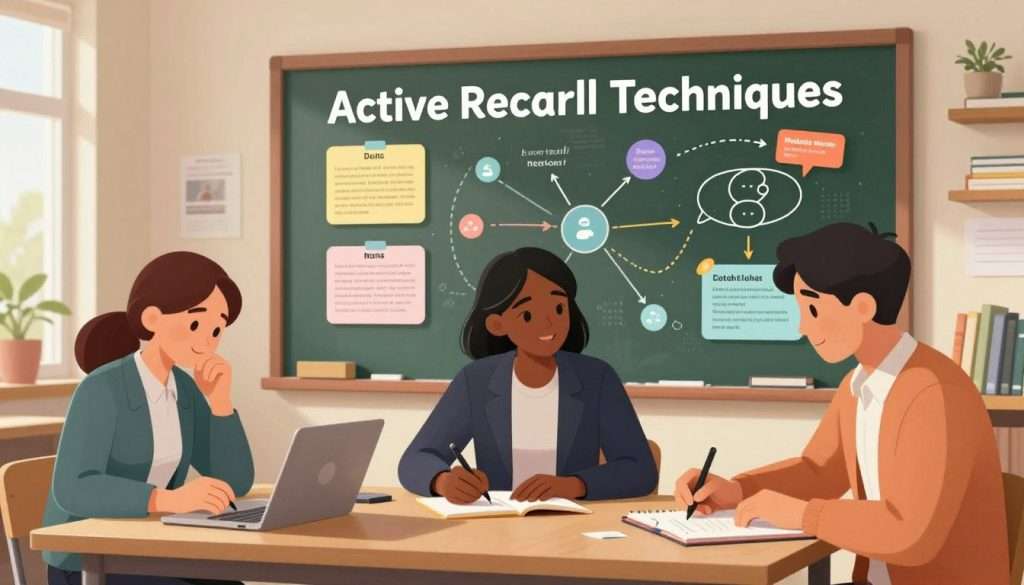
Active Recall Techniques to Strengthen Neural Pathways
Active recall is a great way to improve memory and fight the forgetting curve. It involves recalling information from memory instead of just reading it again. This method strengthens your brain’s pathways and boosts long-term memory.
Self-Testing and Retrieval Practice
Self-testing, or retrieval practice, is a top active recall method. It means recalling information from memory without looking at the original material. Studies show self-testing can boost retention by up to 50% compared to just re-reading.
To practice self-testing, take quizzes or tests on what you’re learning. You can also use flashcards or make your own test questions.
Using Flashcards Effectively with Anki or Quizlet
Flashcards are a powerful tool for active recall. They have key terms or questions on one side and answers on the other. Apps like Anki and Quizlet make creating digital flashcards easy and add spaced repetition for better retention.
To get the most from flashcards, review them often and focus on the ones that are hard. You can also use mnemonics or other memory aids to help remember tough info.
| Flashcard App | Key Features | Benefits |
|---|---|---|
| Anki | Spaced repetition, customizable decks | Highly effective for long-term retention |
| Quizlet | Large user-generated content library, various study modes | Easy to find and use pre-made flashcard decks |
The Feynman Technique for Deep Conceptual Understanding
The Feynman Technique helps deepen your understanding of complex ideas. It involves explaining a concept in simple terms, as if teaching it to someone else. This way, you can spot where your knowledge is weak and strengthen it.
To use the Feynman Technique, pick a concept you want to learn. Then, try to explain it in simple terms, using examples and analogies. This method not only improves retention but also enhances practical application of the knowledge.
Utilizing Mnemonic Devices and Visualization Strategies
Explore the world of mnemonic devices and visualization strategies to boost your memory. These methods are not just for memory champions. They’re useful tools for daily learning, helping you absorb and retain information better.
Building a Memory Palace with the Method of Loci
The Method of Loci, or “memory palace,” is an ancient technique. It uses locations to encode information in memory. Start by picturing a familiar place, like your home or school. Then, imagine walking through it, linking new information to specific spots.
For example, to remember a shopping list, picture walking through your house. Link each item on your list to a room. This method uses your brain’s spatial memory, making recall easier.
Creating Vivid Mental Imagery for Association
Creating vivid mental images is another powerful technique. The goal is to link new information to something memorable. The more unusual or emotional the image, the better it sticks in your memory.
To remember a historical figure, associate their name with a distinctive feature or event. Picture them in a memorable scenario. This creates a strong connection between the new information and what you already know.
Using Acronyms and Chunking to Simplify Complex Data
Acronyms and chunking are simple yet effective for complex information. An acronym is a word from the first letters of a phrase or name. For example, “ROY G BIV” helps remember the colors of the rainbow.
Chunking breaks down large information into smaller units. Phone numbers are a good example, divided into groups (e.g., 123-456-7890). This makes it easier to remember.
Here are some tips for using these techniques:
- Create acronyms for lists or phrases you need to remember.
- Break down complex information into smaller chunks.
- Use visualization to associate new information with memorable images or locations.
By using mnemonic devices and visualization strategies, you can improve your memory recall. Try different techniques to find what works best for you. Be creative!
Optimizing Lifestyle Factors for Cognitive Health
Boosting your memory isn’t just about techniques. Your lifestyle plays a big role too. Daily habits greatly affect your brain health and memory. Let’s explore how to make your lifestyle better for your brain.
Sleep: The Foundation of Memory Consolidation
Sleep is essential for memory consolidation. It turns short-term memories into long-term ones. Your brain replays and processes what you’ve learned during sleep, making connections stronger.
Getting 7-9 hours of sleep each night is key. A consistent sleep schedule also helps. Sleep deprivation hurts memory formation and recall, so make sleep a priority.
Creating a bedtime routine signals to your brain it’s time to sleep. This improves your sleep quality. It’s a simple yet effective way to boost memory retention.

Nutritional Strategies for a Healthy Brain
Your diet is crucial for brain function and memory. Eating foods rich in antioxidants, omega-3 fatty acids, and essential vitamins helps your brain. Blueberries, salmon, and nuts are great for your brain and taste good too.
Adding these foods to your diet is easy. Try oatmeal with blueberries and walnuts for breakfast or a salmon salad for lunch. These changes can help improve memory retention over time.
Physical Exercise: Boosting Neuroplasticity
Regular exercise is also key for brain health. It boosts neuroplasticity, the brain’s ability to make new connections. This is important for learning and memory. Exercise increases blood flow to the brain, supporting its health.
Make exercise a habit by finding something you like and doing it daily. Even a short walk can help. Combining exercise with good sleep and a balanced diet can greatly improve your brain function and memory.
Digital Tools and Apps to Support Memory Improvement
Digital tools and apps are key in fighting the forgetting curve. They help us keep information in our minds better. Technology gives us many ways to organize, review, and strengthen what we learn.
Leveraging Note-Taking Apps
Apps like Notion and Obsidian change how we take and keep notes. They let us link notes together, making it simpler to connect and remember information. By organizing your notes well, you can remember things better.
Key Features of Effective Note-Taking Apps:
- Tagging and categorization for easy search
- Linking between notes to create a knowledge graph
- Customizable templates for different types of information
Using Task Managers for Consistent Review Cycles
Task managers are more than just to-do lists. They help us keep up with regular review cycles. This ensures we check in on information at the right times, helping it stick longer.
| Task Manager Feature | Application in Memory Improvement |
|---|---|
| Recurring Tasks | Schedule regular review sessions |
| Reminders | Prompt timely reviews of material |
| Prioritization | Focus on the most challenging material first |
Brain Training Software and Its Limitations
Brain training software has games to boost memory and thinking. But, it’s important to know its limits. Not all programs work the same, and results can differ.
When selecting brain training software, consider the following:
- Look for programs backed by scientific research
- Be wary of exaggerated claims of cognitive improvement
- Understand that transfer of skills to real-life situations may be limited
By using these digital tools wisely and knowing their strengths and weaknesses, we can make a strong plan to improve our memory.
Troubleshooting Common Memory Retention Pitfalls
The journey to better memory retention is filled with challenges. These include procrastination, too much information, and feeling overwhelmed. It’s key to know and tackle these common issues.
Overcoming Procrastination in Your Study Routine
Procrastination hinders learning and memory. To beat it, split your study time into smaller parts. Make a study plan that fits your life. Remember, “You don’t have to be great to start, but you have to start to be great.”
The Pomodoro Technique is a great tool. It means studying in 25-minute blocks, then taking a 5-minute break. After four blocks, take a 15-30 minute break. This keeps you focused and prevents burnout.
Managing Cognitive Overload and Burnout
Cognitive overload happens when you try to handle too much at once. This leads to mental exhaustion and poor memory. To avoid this, focus on the most important info and break it down.
It’s also vital to take breaks and do things that relax you.
“The mind is not a vessel to be filled, but a fire to be kindled.” – Plutarch
This quote shows the importance of not overloading your mind. Let it rest and recover.
Dealing with Information Overload in the Digital Age
In today’s world, information is everywhere. But this can cause information overload. It’s hard to know what’s important and what’s not. To deal with this, use tools and strategies to sort and organize info, like note-taking apps and task managers.
By using these methods, you can cut through the noise. Focus on what’s truly important. As shown in the image below, managing information well is crucial for better memory.
Knowing these common pitfalls and how to overcome them can greatly improve your memory. This will help you reach your learning goals.
Conclusion
The forgetting curve is a big problem for your memory, but you can fight it. By learning how your brain works and using good memory tricks, you can do better in school.
We’ve looked at many ways to help your memory, like spaced repetition and making memories with words. You can make your brain stronger and keep information longer by using these methods.
Being consistent is very important. Make it a habit to practice these memory tips every day. With effort, you’ll see how much better you can remember things and learn new stuff.
It’s time for you to take charge of your memory and learning. Start using these memory tips today. You’ll see your knowledge and confidence grow.