
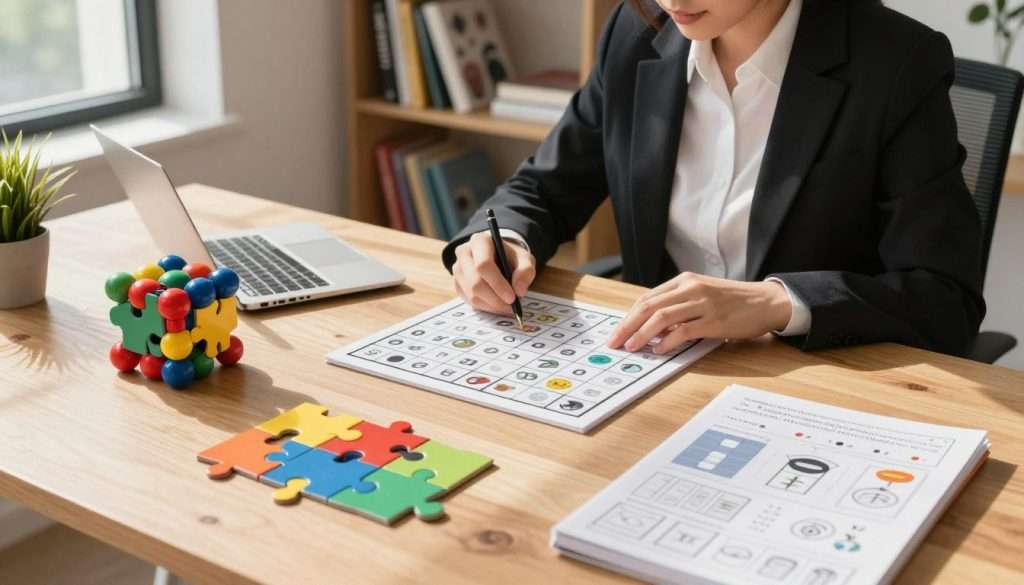
Ever feel like your focus is stuck in low gear? We’ve all been there, staring at a page while our minds wander. The good news is that brain training exercises that improve thinking and memory are like a workout for your brain. They sharpen your focus, boost your reasoning, and keep your mind quick.
Think of these brain health exercises as a daily routine, not a quick fix. Just like eating well, they work best with regular practice. Whether you’re a student or always learning, your mind can grow at any age. Small, daily challenges make studying feel less like a burden.
Want to dive deeper? If this article struck a chord, my free book How to Become the Smartest Student in the Classroom offers a complete system. It includes memory techniques, study routines, and strategies that really work. No cost, no catch. Get your free copy here.
Key Takeaways
- Cognitive challenges boost focus, reasoning, and language skills.
- Consistency is more effective than quick fixes.
- The mind can learn new skills at any age.
- Small daily habits reduce mental fatigue during study sessions.
- These activities work best with a healthy lifestyle.
Brain Training Exercises That Improve Thinking and Memory
We often think of our brains as fixed, but they are actually dynamic systems. Engaging in brain training exercises that improve thinking and memory is like giving your mind a workout. This practice sharpens your mental edge and builds lasting habits.
What Cognitive Training Can and Cannot Do
It’s key to know what cognitive training can do. These exercises are great for boosting skills like recall or focus. But, they’re not a magic fix for all mental issues. You’ll see the biggest gains in the skills you practice most.
Think of it like learning to play a musical instrument. Practicing the piano improves your piano skills, but not your violin skills. Mental drills make you better at processing information and staying sharp in daily life.
How Neuroplasticity Supports Mental Skill Development
Your brain is incredibly adaptable, thanks to neuroplasticity. This means it changes as you learn and practice. When you do neuroplasticity exercises, you’re strengthening your brain’s connections.
This is how we build new skills and improve old ones. Every time you try a new puzzle or memory game, you’re helping your brain create stronger pathways. It’s a beautiful way of saying you can teach an old dog new tricks!
Why Consistent Practice Matters More Than Quick Results
Many people look for quick fixes, but real growth comes from daily effort. Quick, sporadic sessions rarely offer lasting benefits. Your brain does best with predictable, appropriately challenging practice.
To see real progress, practice every day. I’ve created a system in my free book, How to Become the Smartest Student in the Classroom. It includes memory techniques and study routines that stick. Get your free copy here.
| Feature | Sporadic Practice | Consistent Practice |
|---|---|---|
| Brain Adaptation | Minimal and temporary | Strong and lasting |
| Skill Retention | Quickly fades away | Deeply ingrained |
| Mental Fatigue | High due to intensity | Low due to rhythm |
| Overall Progress | Stagnant over time | Steady improvement |
Working Memory Exercises for Holding and Using Information
Think of your brain as a mental workbench. It holds information while you work on it. This “workbench” is your working memory. It’s key for tasks like following a recipe or solving math problems.
By doing specific neuroplasticity exercises, you can improve your brain’s ability to handle these tasks.
Reverse Digit and Word-Sequence Recall
Challenging your brain is a great way to keep it sharp. Try writing down five numbers and then reciting them backward. Once you get the hang of it, try words or longer sequences.
Chunking Long Information Into Meaningful Groups
Our brains find it hard to remember long, unconnected data. To solve this, group information into smaller, meaningful chunks. For example, break a ten-digit number into three smaller sets. This makes complex data easier to handle.
Mental Updating With Multi-Step Instructions
Real-life tasks often require updating our mental lists as new details come in. Practice this by listening to instructions and then adding a new step while removing an old one. These cognitive exercises for memory help you stay flexible in changing environments.
How to Increase Difficulty Without Sacrificing Accuracy
It’s tempting to rush through these drills, but accuracy is far more important than speed. If you start making mistakes, slow down. Focus on getting the sequence right every time. You’re building strong neural pathways, not just practicing speed.
If you want to dive deeper into these strategies, check out my free book How to Become the Smartest Student in the Classroom. It offers memory techniques and study routines that really work. No cost, no catch. Get your free copy here → https://www.studyingmachine.com/free-books/.
Memory Enhancement Techniques for Stronger Recall
Are you tired of staring at your notes without understanding them? It’s time for a change. Many of us keep reading the same page, hoping to remember it. But this method is not effective.
To improve, you need memory enhancement techniques that challenge your brain. By actively engaging with the material, you can change how you remember and recall information.
Spaced Repetition for Facts, Names, and Vocabulary
Spaced repetition is a game-changer for remembering things long-term. Instead of cramming, review material at longer intervals. For example, review it one day later, then three days, then a week, and a month later.
This method works because it helps your brain remember information before it fades. For example, use a new word five times in a day. This simple habit makes the word stick in your memory.
Active Recall Instead of Passive Review
Active recall means testing yourself instead of just reading your notes. When you try to explain a concept out loud, you’re doing one of the best cognitive exercises for memory.
“The mind is not a vessel to be filled, but a fire to be kindled.”
This method shows what you know and what you need to study. It turns a boring review into a challenge that keeps your brain sharp.
The Method of Loci for Ordered Information
The Method of Loci, or “memory palace,” is a classic way to remember lists or sequences. Place the items you need to remember along a familiar route, like your walk to school or your bedroom layout.
Creating Vivid and Reliable Mental Associations
To make this work, your mental images must be vivid, surprising, or even a little bit funny. Imagine a giant, dancing banana wearing a top hat in your hallway if you need to remember a grocery list. The more bizarre the image, the easier it is for your brain to remember it.
If this article resonated with you, my free book How to Become the Smartest Student in the Classroom offers a full system. It includes memory techniques, study routines, and strategies that actually work. No cost, no catch. Grab your free copy here.
Attention and Concentration Workouts
Your attention span can grow with the right mental workouts. Many think focus is a trait you’re born with. But it’s actually a skill that needs practice.
Changing how you see your mind can help. Instead of blaming yourself for distractions, focus on building better habits. My free book How to Become the Smartest Student in the Classroom can help you master focus. Get your free copy here → https://www.studyingmachine.com/free-books/.
Single-Task Reading With Distraction Tracking
Begin by focusing on one thing at a time. Choose a short article or chapter and read it without distractions.
Keep a notepad to track when your mind wanders. Don’t feel bad; just note the distraction and go back to reading.
This method helps you spot what distracts you. You might find that certain sounds or digital alerts are big culprits.
Selective Attention Through Sound and Visual Filtering
Our world is full of noise, but you can learn to tune it out. Selective attention means focusing on one thing while ignoring others.
Use white noise or instrumental music to block out background sounds. Also, clear your space of visual clutter to reduce distractions.
Timed Focus Sessions With Deliberate Breaks
Timed work sessions are a great mental workout. Work in 25-minute blocks, focusing on one task.
After each block, take a five-minute break. This breaks helps prevent burnout and keeps your mind sharp.
How to Handle Wandering Thoughts Productively
It’s normal for your mind to wander during these sessions. When it does, acknowledge the thoughts without judgment.
“The mind is a wonderful servant but a terrible master.”
Adding a five-minute meditation session daily can help calm a busy mind. Meditation reduces stress and improves how you process information.
Logic and Reasoning Exercises for Cognitive Function Improvement
Improving your mind is more than just memorizing facts. It’s about using your brain actively. Cognitive training teaches your brain to handle complex information better. This skill helps you make smarter choices in school and work.
Pattern Recognition and Sequence Completion
Your brain enjoys finding patterns in chaos. By practicing pattern recognition, you improve your ability to spot trends. Solving puzzles or identifying sequences strengthens your higher-level thinking.
Deductive Reasoning Puzzles and Conditional Thinking
Deductive reasoning tests “if-then” scenarios. Logic puzzles help you learn to check if conclusions are right based on evidence. This skill is key for avoiding quick, emotional decisions.
Comparing Evidence Before Reaching a Conclusion
It’s easy to rush to the first answer. But true critical thinkers take time to weigh evidence. By comparing different data, you make sure your decision is based on facts, not guesses.
Using Written Explanations to Strengthen Reasoning
Writing down your thought process changes everything. Explaining why an answer is correct reveals any logic flaws. This habit helps you slow down and check every step of your argument.
| Exercise Type | Primary Benefit | Best For |
|---|---|---|
| Pattern Puzzles | Speed of recognition | Daily mental warm-ups |
| Logic Grids | Deductive accuracy | Complex problem solving |
| Written Analysis | Deep understanding | Academic and work tasks |
If this article struck a chord, check out my free book How to Become the Smartest Student in the Classroom. It offers memory techniques, study routines, and strategies that work. No cost, no catch. Get your free copy here → https://www.studyingmachine.com/free-books/.
Language-Based Mental Workouts for Thinking Flexibility
Why settle for boring vocabulary drills when you can turn language into a fun, cognitive challenge? Engaging in mental workouts centered on language helps you process information faster. It also improves your overall cognitive flexibility. By treating words as tools for play, you can recruit different areas of your brain involved in both visual and auditory processing.

Word Association and Category-Switching Drills
To keep your brain sharp, try switching between categories as quickly as you can. For example, list five types of fruit, then immediately switch to five types of musical instruments, and finish with five types of furniture.
This rapid shifting forces your brain to break old patterns and create new neural pathways. It is a fantastic way to keep your thinking fluid and responsive.
Summarizing Complex Ideas in Plain Language
Can you explain a difficult concept, like quantum physics or a complex legal theory, to a five-year-old? This exercise is one of the most effective mental workouts you can perform.
- Identify the core message of the topic.
- Strip away all technical jargon.
- Use simple, everyday metaphors to bridge the gap.
Learning and Using New Vocabulary in Context
Don’t just memorize definitions from a list. Instead, try to use a new word in at least three different sentences throughout your day.
When you place a word in a natural context, your brain stores it much more effectively. This method helps you move beyond rote memorization and builds a deeper understanding of how language functions in real life.
Practicing Verbal Fluency Without Relying on Memorized Answers
It is easy to fall into the trap of using scripted responses, but that turns your brain into a robot wearing a tie. Challenge yourself to answer questions with original phrasing every time you speak.
By avoiding canned answers, you force your brain to stay present and engaged. If this article resonated with you, my free book How to Become the Smartest Student in the Classroom gives you a full system — memory techniques, study routines, and strategies that actually stick. No cost, no catch. Grab your free copy here → https://www.studyingmachine.com/free-books/.
Visual-Spatial Brain Fitness Activities
Visual-spatial skills help us understand our surroundings. They are key to knowing where things are and how they relate to each other. By improving these skills, you can make your mind sharper and better at navigating the world.
Mental Rotation and Shape-Transformation Tasks
Think of your brain as a 3D modeling software. Practicing mental rotation and shape transformation upgrades your brain. Jigsaw puzzles are a great example of this.
Research shows puzzles work on many brain skills at once. They require you to look at edges, colors, and patterns. This is a fun way to keep your brain sharp.
Reconstructing Routes and Maps From Memory
Ever tried drawing a map of your neighborhood from memory? It’s a great way to improve your spatial recall. It helps your brain remember landmarks and distances.
Try to remember your walk to the grocery store or work. Think about every turn and the buildings or trees you see. This habit makes your mental map stronger.
Spot-the-Difference and Visual Scanning Challenges
Visual scanning trains your eyes and brain to notice small details. Spot-the-difference games improve your attention to detail. This makes you better at processing visual information.
You can find these games in puzzle books and apps. The goal is to look at the whole image carefully. This focused attention is key to brain fitness activities.
Connecting Visual Practice to Everyday Navigation
These exercises help you in daily life. They make it easier to find your way, whether in a new classroom or a busy city. You’ll be more confident with maps and adjusting your route.
If you liked this article, check out my free book How to Become the Smartest Student in the Classroom. It offers memory techniques, study routines, and strategies that work. No cost, no catch. Get your free copy here → https://www.studyingmachine.com/free-books/.
Numerical and Mental Math Exercises
Let’s explore how simple math tasks can boost your brain power every day. You don’t need to be a math whiz to enjoy these exercises. By working with numbers, you can keep your mind sharp and quick.

Estimating Totals, Percentages, and Distances
Start by guessing totals, percentages, and distances when you’re out. At the grocery store, try adding up your items before you check out. It’s a fun challenge that makes your brain work harder.
Also, practice calculating percentages when you see sales or figure out travel times during your commute. These small habits help improve your brain’s ability to handle numbers. Over time, you’ll find it easier and more natural.
Calculating Without a Calculator in Small Daily Tasks
Next time you need to do math, try to do it in your head first. Whether it’s splitting a bill or figuring out how much time you have left, give it a shot.
This simple change turns everyday tasks into brain exercises. If it’s hard at first, start with simple numbers and gradually increase them. You’ll be amazed at how quickly your brain adapts.
Number Patterns, Puzzles, and Strategy Games
For more fun, try logic grids, Sudoku, or strategy games. These activities are great for improving your brain because they require pattern recognition and planning. Variety is key to keeping your brain engaged and excited.
Checking Work to Balance Speed and Accuracy
While it’s good to be fast, accuracy is more important. Always double-check your mental math. This habit helps you train your brain correctly, not just guess.
If this article struck a chord, check out my free book How to Become the Smartest Student in the Classroom. It offers memory techniques, study routines, and strategies that really work. No cost, no catch. Get your free copy here → https://www.studyingmachine.com/free-books/.
Movement, Sleep, and Lifestyle Habits That Support Brain Health
Think of your brain as a garden that needs the right environment to grow. Your daily habits are like the soil that lets your brain health efforts grow. Without the right foundation, even the best mental training won’t work well.
Why Aerobic Activity Complements Cognitive Exercises for Memory
Physical movement boosts blood flow to your brain. This brings oxygen and nutrients for peak performance. So, your brain is ready to adapt and grow when you do neuroplasticity exercises.
Try dance or tai chi for a boost. Dance improves processing speed, and tai chi helps with memory. These activities mix physical and mental skills, offering a double benefit.
How Sleep Helps Consolidate Learning and Recall
Sleep organizes what you learned during the day. It moves information from short-term to long-term memory. Without sleep, your brain forgets the progress you made with cognitive exercises for memory.
Think of sleep as the “save button” for your brain. Without it, your day’s work is lost. A consistent bedtime is as important as any mental exercise.
Nutrition, Hydration, and Stress Management for Mental Performance
Your brain needs steady fuel to function. Stay hydrated and eat nutrient-rich foods to keep your focus sharp. Chronic stress makes learning and recalling hard.
Take short breaks to lower stress. These calming pauses help you reset. A relaxed brain learns better than a stressed one.
Building Brain-Supportive Habits Without Overcomplicating Your Routine
You don’t need a long wellness list for improvement. Focus on small, lasting changes. A daily walk, consistent sleep, and mindfulness can make a big difference.
| Lifestyle Habit | Primary Benefit | Impact on Memory |
|---|---|---|
| Aerobic Exercise | Increased Blood Flow | High |
| Quality Sleep | Memory Consolidation | Very High |
| Hydration | Cognitive Clarity | Moderate |
| Stress Management | Improved Focus | High |
Want more? My free book How to Become the Smartest Student in the Classroom offers a full system. It includes memory techniques, study routines, and strategies that work. No cost, no catch. Get your free copy here → https://www.studyingmachine.com/free-books/.
How to Build a Practical Weekly Cognitive Training Routine
Creating a habit for your mind needs strategy and consistency. You don’t need to spend hours daily to improve your mental sharpness. By making a structured plan, you can make cognitive training a part of your daily routine.
Choosing Exercises Based on Your Primary Goal
Not all mental workouts are the same. Choose activities that match your goals. For memory enhancement techniques, use recall drills and visualization. For cognitive function improvement in logic, focus on puzzles that need deductive reasoning.
- For better recall: Use spaced repetition and the method of loci.
- For sharper focus: Try single-task reading and distraction tracking.
- For faster math: Practice mental estimation during your grocery runs.
Creating Short Sessions for School, Work, or Home
You don’t need a lot of free time to train your brain. Many exercises take less than five minutes. You can fit these into your day while waiting for the bus, during a short break at work, or before studying.
If you want to dive deeper, my free book How to Become the Smartest Student in the Classroom offers a full system. It includes memory techniques, study routines, and strategies that stick. No cost, no catch. Get your free copy here.
Progressing From Basic Drills to More Challenging Tasks
Start with the basics to build confidence before moving to harder levels. Only increase difficulty when your accuracy is steady and predictable. Trying too hard, too fast, can lead to frustration.
Tracking Accuracy, Recall, Focus, and Mental Fatigue
Keep a simple log of your performance to see your progress. Note your accuracy rates, recall, and focus. It’s also key to track mental fatigue; if your brain feels overheated, it’s time to stop.
When to Change an Exercise or Take a Recovery Day
Variety is great for your brain. If an exercise becomes too easy or boring, switch it for something new. Remember, recovery days are as important as training days for cognitive function improvement.
Listen to your body and mind. If your performance drops, take a break and come back refreshed. Smart memory enhancement techniques should challenge you but not drain you.
Conclusion
You now have a complete toolkit for mental growth. By mixing memory drills, attention practice, and reasoning puzzles with good sleep and exercise, you build a strong base for your brain’s future.
These brain training exercises improve thinking and memory best when done regularly. Real progress comes from small, daily habits, not big, one-time efforts. See these exercises as a lifelong journey of curiosity.
Try just one activity today. See how your focus changes and celebrate the small victories as you build your routine. You have the power to improve your mental performance right now.
Want more? If this article struck a chord, my free book How to Become the Smartest Student in the Classroom offers a full system. It includes memory techniques, study routines, and strategies that really work. There’s no cost and no catch. Get your free copy here at Studying Machine.