
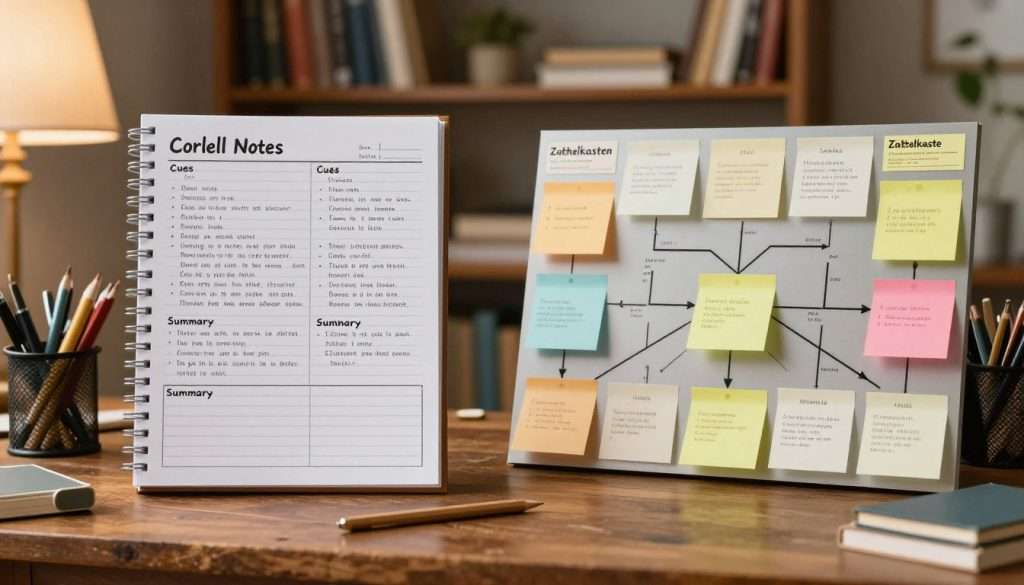
Have you highlighted textbooks for hours, then found the information gone a week later? This frustrating cycle can leave many students feeling defeated. We can help you break it with brain-friendly note-taking strategies that stick.
Choosing between cornell notes vs. zettelkasten does not have to be a headache. The first offers a structured review system for exams, while the second builds connected ideas for long-term mastery. We will help you choose the path that fits your study habits and goals.
Try my free book: How to Become the Smartest Student in the Classroom. It provides a complete system of memory techniques and routines for effective study. Get your free copy here and start your journey today!
Key Takeaways
- Understand the core differences between structured review and connected knowledge networks.
- Identify which system aligns best with your personal learning style.
- Learn how to stop the cycle of forgetting what you study.
- Discover how to build a system that supports long-term retention.
- Access professional resources to master your academic performance.
Cornell Notes vs. Zettelkasten: Which Note-Taking Method is Right for Your Brain
You may wonder whether your notes should be a tidy filing cabinet or a wide web of ideas. When you compare cornell notes vs. zettelkasten, you choose between two different ways to handle information. One keeps information neat for tests, while the other builds a living library of your thoughts.
The central difference between structured review notes and connected knowledge notes
Cornell Notes act like a structured filter for new information. You capture, summarize, and review material, making this method useful for mastering specific course material. They turn a lecture into a clear summary for your next study session.
In contrast, the Zettelkasten method treats every note as a building block for a larger, interconnected system. Rather than only recording what a professor said, you create permanent notes that link to ideas already stored. The goal is less about passing a test and more about building a long-term knowledge base that grows with you.
What this comparison reveals about attention, memory, and learning goals
This comparison of cornell notes and zettelkasten shows how different note-taking methods affect your brain. Cornell Notes make you practice active recall, a gold standard for memory retention. This practice trains your brain to retrieve information on command.
“The secret to learning is not just in the intake of information, but in the active struggle to organize and connect it to what you already know.”
Zettelkasten, however, shifts your attention toward association. Linking notes makes your brain find patterns across different subjects. This process helps you build a deeper, more creative understanding of complex topics over time.
How to choose based on the way you study, work, and think
Your current goals should guide your choice. If you are a student with a heavy exam schedule, Cornell Notes can save your sanity. If you are a researcher or writer developing original ideas, Zettelkasten offers a powerful way to manage your intellectual growth.
We believe the best system is the one you actually use. My free book How to Become the Smartest Student in the Classroom is a full system. It covers memory techniques, study routines, and strategies that stick, with no cost or catch; grab your free copy here.
- Cornell Notes: Best for lectures, exams, and structured learning.
- Zettelkasten: Best for research, creative projects, and long-term knowledge building.
- Hybrid Approach: You can often use both to balance immediate needs with long-term goals.
Why Your Brain Needs More Than a Record of Information
Most people treat note-taking like stenography, but your brain dislikes being a passive recorder. When you transcribe a professor or copy textbook lines, you bypass the mental skills needed for deep learning.
True brain-friendly note-taking makes your mind select, reshape, and connect information. Do not act like a photocopier; act like an architect building with raw materials.
How active processing improves memory retention through note-taking
Active processing turns static data into personal knowledge. This shift supports improving memory retention through note-taking because your brain must work for the information.
For deeper study, get my free book How to Become the Smartest Student in the Classroom. It gives you a full system of memory techniques and study routines that stick. You can grab your free copy here → https://www.studyingmachine.com/free-books/
The roles of retrieval, elaboration, organization, and connection
To master effective note-taking techniques, add four behaviors to your study routine. These actions turn simple notes into a powerful tool for long-term memory:
- Retrieval: Testing yourself on what you just read instead of just re-reading it.
- Elaboration: Explaining a new concept in your own words or connecting it to something you already know.
- Organization: Structuring your notes to show how different ideas relate to one another.
- Connection: Linking new information to your existing knowledge base to create a web of understanding.
Why copying lectures or books produces weak learning results
Verbatim copying is a trap. It feels productive because your hand moves, but your brain runs on autopilot. This passive approach fails because it lacks the mental effort needed to store information in long-term memory.
“Learning is not a spectator sport. You must actively manipulate the information to make it your own.”
Verbatim notes leave you with information you have not processed. Summarizing and rephrasing make study time focus on improving memory retention through note-taking instead of filling notebooks.
How Cornell Notes Turn Class Material Into a Review System
The Cornell method turns messy scribbles into a clear review system. With effective note-taking techniques, you learn instead of copying every word like a stenographer.
The page layout: cue column, notes section, and summary area
This simple system divides your page into three zones. Use a narrow left column for cues, a wide right section for notes, and a bottom summary area.
The layout organizes information as you learn. It turns a blank page into a clear map for later review.
How to capture ideas without transcribing every word
Many students try to record every word a professor says. Instead, focus on capturing the core concepts, supporting evidence, and real-world examples.
If you miss a detail, do not panic. Use shorthand or bullet points to maintain your flow. Record the meaning, not an audio transcript.
Turning cue questions into active-recall prompts
After class, review your notes and write questions in the left cue column. Match each question with information in the right section.
During review, cover the main notes and answer each cue question. This is one of the most effective note-taking techniques for long-term retention.
Using the summary section to consolidate the main concept
Use the bottom section to combine the main ideas. Write a two-to-three sentence summary of the page in your own words.
This step helps you see the big picture. It tests whether you truly understand the lesson.
Example: transforming a biology lecture into review-ready Cornell Notes
Imagine a biology lecture about cellular respiration. In the main column, record stages like glycolysis and the Krebs cycle with simple diagrams.
In the cue column, write, “What are the three main stages of respiration?” and “Why is ATP important?” In the summary, write, “Cellular respiration converts glucose into ATP through three main stages, providing energy for the cell.”
| Section | Purpose | Best Practice |
|---|---|---|
| Cue Column | Active Recall | Write questions, not just keywords. |
| Notes Section | Information Capture | Use bullet points and shorthand. |
| Summary Area | Synthesis | Keep it under three sentences. |
Where Cornell Notes are strongest and where they become restrictive
This method works well for exam-focused courses that require memorizing facts and processes. It creates a clear path for review.
However, it can feel rigid during brainstorming or non-linear projects. For deeper study, my free book How to Become the Smartest Student in the Classroom offers memory techniques, study routines, and strategies that stick. It costs nothing, with no catch. Grab your free copy here.
By enhancing learning with cornell notes and zettelkasten, you can balance structured review with creative knowledge building. The best system is one you use consistently.
How the Zettelkasten Method Builds a Connected Knowledge Network
Think of your notes as a living web of insights, not a static pile of paper. By enhancing learning with cornell notes and zettelkasten, you move from passive recording to active knowledge creation. Each note should stand alone, stay clear, and connect deeply with your existing thoughts.

The difference between fleeting notes, literature notes, and permanent notes
Your system starts with fleeting notes, quick reminders or thought sparks captured on the fly. These are temporary and should be processed quickly. After reading a book or watching a lecture, create literature notes in your own words.
Finally, distill these into permanent notes. These polished, standalone ideas form the core of your knowledge base. They remain understandable even years later.
Writing one clear idea per note in your own words
Keep each note focused on one single concept. Too much information makes it harder to link a note to related topics. Writing in your own words makes you process information deeply instead of copying text.
Linking related notes instead of relying only on folders and tags
Folders can limit ideas because they force you to choose one “home” for each note. Use links instead, connecting notes through their content. One idea can point to five others, making your knowledge base feel like a personal brain.
Using unique identifiers, references, and meaningful note titles
Every note needs a clear title that tells you exactly what it contains. Unique identifiers help track notes as the collection grows. Always include a source reference so you can trace ideas back to their starting point.
Example: developing a network of ideas from several psychology sources
Imagine studying cognitive bias. You might have one note on “Confirmation Bias” from a textbook and another on “Availability Heuristic” from a podcast. Linking them creates a higher-level note about how the brain simplifies complex decisions. This process builds a network of claims, questions, and arguments that are far more valuable than isolated facts.
| Note Type | Purpose | Lifespan |
|---|---|---|
| Fleeting | Capture quick thoughts | Short (delete after processing) |
| Literature | Summarize sources | Medium (reference for permanent notes) |
| Permanent | Build long-term knowledge | Long (the core of your system) |
Where Zettelkasten excels and why it requires more patience
This method is a long-term investment. It requires more patience than traditional methods because its real value appears only after you build a critical mass of linked notes. The payoff is a system that supports original thinking and deep understanding.
If you want to explore these strategies, my free book How to Become the Smartest Student in the Classroom gives you a full system. It covers memory techniques, study routines, and strategies that actually stick. It costs nothing and has no catch. Grab your free copy here.
Cornell Notes and Zettelkasten Compared at a Glance
The cornell notes vs. zettelkasten debate depends on your goals. Both systems organize thoughts, but they serve different needs. One favors speed and clarity; the other supports deep, long-term growth.
Comparison table: purpose, structure, workflow, and time commitment
To help you decide, we created a quick breakdown of how each system works. This comparison of cornell notes and zettelkasten shows how each method may shape your study time.
| Feature | Cornell Notes | Zettelkasten |
|---|---|---|
| Primary Purpose | Lecture capture & review | Knowledge synthesis |
| Structure | Fixed page layout | Networked individual notes |
| Workflow | Linear & scheduled | Iterative & associative |
| Time Investment | Low to moderate | High & ongoing |
How each method handles lectures, textbooks, research, and creative projects
Cornell Notes help during fast lectures or dense textbook chapters. They offer a structured safety net for capturing main points without losing focus. Your record stays clear and ready for exam prep.
Zettelkasten is built for long-term use. It excels in complex research or creative projects that connect ideas across months or years. You build a web of knowledge that grows more valuable with each addition.
Differences in review, retrieval, linking, and long-term knowledge building
Reviewing Cornell Notes means using the cue column to trigger active recall. This method supports short-term retention and memory testing before a deadline. You are reviewing a fixed snapshot of one topic.
Zettelkasten focuses on linking. Each note connects to others, so you retrieve and rethink old ideas with new ones. This living archive supports deep understanding, not only memorization.
Pros and cons of Cornell Notes for short-term academic performance
Its biggest strength is predictability. You know what to do, and it suits academic tasks requiring quick mastery. It offers a simple way to stay organized.
However, the system can feel restrictive. After class, notes may sit in a binder instead of joining your broader worldview. It suits the sprint, not the marathon.
Pros and cons of Zettelkasten for long-term understanding and original thinking
Zettelkasten is a powerful tool for original thinking. Writing ideas in your own words and linking them to concepts helps you understand them. It turns study time into a creative process.
The trade-off is a high barrier to entry. You need patience and discipline to maintain your network of notes. You must also spend time keeping it current.
To go deeper, my free book How to Become the Smartest Student in the Classroom offers a full system. It covers memory techniques, study routines, and strategies that actually stick. There is no cost or catch. Grab your free copy here.
Which Method Better Supports Memory Retention and Exam Preparation
Improving memory retention through note-taking starts with understanding how your brain processes new ideas. Recording facts alone is not enough; you must engage with them to make them stick. Using effective note-taking techniques transforms passive listening into an active mental workout that prepares you for any exam.

Why Cornell cue questions are effective for scheduled review
Writing cue-column questions creates a ready-made study guide. It forces you to retrieve information instead of rereading notes.
This active recall is the gold standard for learning. Covering your notes and answering cue questions builds the mental effort tests require. It makes review sessions efficient and focused.
How Zettelkasten connections strengthen understanding and recall across subjects
Zettelkasten builds a web of ideas. Instead of isolated pages, you link concepts, helping your brain see the bigger picture across subjects.
These connections act as mental hooks. You can recall facts by following paths among related ideas. This method supports deep understanding that lasts after the final exam.
Matching each method to memorization-heavy and concept-heavy courses
If your course requires memorizing dates, formulas, or vocabulary, the Cornell system is your best friend. Its structure helps drill facts into long-term memory.
On the other hand, Zettelkasten shines for complex subjects like philosophy or sociology. It maps arguments and theories, making it one of the optimal note-taking strategies for essays and original insights.
Combining note-taking with spaced repetition and practice testing
No matter which system you choose, pair it with spaced repetition. Reviewing notes at increasing intervals prevents the forgetting curve from erasing your hard work.
Combine this approach with regular practice tests to make your knowledge durable. My free book How to Become the Smartest Student in the Classroom gives you a complete system. It covers memory techniques, study routines, and strategies that stick. It is free, with no catch. Grab your free copy here.
Choosing the Best Note-Taking Method for Your Brain
Finding the right note system is like choosing shoes for a long hike. You need support without painful blisters. Many people seek the best note-taking method for your brain, but your needs can change with each season of life.
Choose Cornell Notes if you prefer structure, prompts, and clear review cycles
If you value clarity and need exam preparation, this system may suit you. It offers a predictable framework that keeps your thoughts organized during fast lectures. Its built-in review cycle makes studying feel like a simple recall game.
Choose Zettelkasten if you think associatively and enjoy developing ideas
Some people prefer growing ideas naturally instead of following a strict outline. Writers and researchers may value connecting thoughts more than summarizing one page. This method creates a living network of knowledge that changes as you learn.
Consider your attention span, workload, and tolerance for setup
Be honest about the time you can invest in your system. Complex note-taking methods can distract you when they need too much maintenance. Start with a simple approach you can follow every day.
“The secret to mastery is not in the complexity of your tools, but in the consistency of your practice.”
Match the method to your dominant learning challenges instead of a personality label
Do not assume you must be a “structured person” or a “creative person.” You can use optimal note-taking strategies to solve current problems, whatever your personality type. If memorization is hard, use Cornell; if concepts are hard to connect, try Zettelkasten.
Decision checklist for students, researchers, writers, and lifelong learners
- Deadlines: Do you have an exam in two weeks? Go with Cornell for speed.
- Goal: Are you building a long-term knowledge base? Zettelkasten is your winner.
- Energy: How much time can you dedicate to filing notes? Choose the path of least resistance.
- Complexity: Does your material require deep synthesis or quick retrieval?
If this article resonated with you, my free book How to Become the Smartest Student in the Classroom offers a complete system. It includes memory techniques, study routines, and strategies that actually stick. It costs nothing, has no catch, and lets you grab your free copy here.
Applying Cornell Notes to Classes, Meetings, and Dense Reading
Master study sessions with a routine that turns raw information into clear, useful insights. By focusing on improving memory retention through note-taking, you make a passive chore an active skill for years.
Preparing the Cornell page before a lecture or meeting begins
Before the speaker starts, set up your page. Draw lines for the cue column, main notes area, and summary section at the bottom. Preparation is half the battle, because it clears your mind and keeps your focus on the content.
Capturing concepts, evidence, examples, and unanswered questions in real time
Do not transcribe every word. Listen for core concepts and supporting evidence that make an argument clear.
If something confuses you, write it as a question in the cue column right away. These effective note-taking techniques keep you engaged instead of making you a human recorder.
“The secret of getting ahead is getting started.”
Completing the cues and summary within twenty-four hours
Your brain starts losing information soon after a session ends. Within twenty-four hours, fill in the cue column and write a brief summary while ideas remain fresh. This step supports improving memory retention through note-taking by making you synthesize what you learned.
Reviewing Cornell Notes with cover-and-recall practice
After completing your notes, cover the main section and use your cues to test yourself. Explain the concept aloud before checking your work. This is one of the most effective note-taking techniques for long-term mastery.
Adapting the format for technical subjects, humanities, and professional training
This system is flexible. For technical subjects, use the main area for equations and diagrams, and the cue column for process steps. In humanities, use the cue column for key themes or historical arguments.
This free book How to Become the Smartest Student in the Classroom covers memory techniques, study routines, and lasting strategies. Get your free copy here → https://www.studyingmachine.com/free-books/
Applying Zettelkasten to Research, Writing, and Long-Term Learning
If you want to turn reading and research into original thought, you need a system that connects ideas. Enhancing learning with cornell notes and zettelkasten moves you from passive reading to active creation. By building a web of ideas, you keep knowledge useful after finishing a book or lecture.
Creating source-based literature notes without copying passages
Highlighting or copying long passages can feel useful when you read. Yet this can block you from understanding the material. Instead, summarize the author’s argument in your own words and note your reaction.
These are your “literature notes.” Keep them brief, focused, and clear for your future self. Avoiding direct quotes makes your brain process the information deeply.
Converting source notes into standalone permanent notes
After writing literature notes, distill them into “permanent notes.” A permanent note holds one atomic idea and stands alone. Years later, you should understand it without the original source.
This is where the real magic happens. You are not storing information; you are refining your own thinking. Keep each note clear, concise, and focused on one specific concept.
Building useful links between theories, examples, questions, and arguments
A Zettelkasten gains power from the connections between notes. When you write a new note, ask how it relates to what you already know. Does it support an existing theory or challenge an argument you recorded earlier?
By linking these ideas, you create a dynamic network of knowledge. You can see patterns and clusters that static folders would hide.
Finding ideas through backlinks, note titles, and emerging clusters
Use meaningful titles so you can find notes later. Backlinks create a trail from one thought to another. Over time, related ideas form clusters that can support your writing projects.
Preventing a Zettelkasten from becoming an unsearchable digital archive
A Zettelkasten can quickly become a graveyard if you do not maintain it. You must regularly review, edit, and link notes to keep the system alive. Dumping information into a folder creates an archive, not a thinking partner.
| Note Type | Purpose | Action |
|---|---|---|
| Fleeting Notes | Capture quick thoughts | Discard or process daily |
| Literature Notes | Summarize sources | Rewrite in your own words |
| Permanent Notes | Store atomic ideas | Link to existing network |
If this article resonated with you, my free book How to Become the Smartest Student in the Classroom gives you a full system. It includes memory techniques, study routines, and strategies that actually stick.
No cost, no catch. Grab your free copy here → https://www.studyingmachine.com/free-books/. By enhancing learning with cornell notes and zettelkasten, you prepare for long-term academic and professional success.
How to Combine Cornell Notes and Zettelkasten Without Creating Extra Work
Combining these two powerhouses does not have to mean double the work. You can build a system that balances classroom structure with personal freedom. By enhancing learning with cornell notes and zettelkasten, you get the best of both worlds without feeling overwhelmed.
Using Cornell Notes for first-pass capture and immediate course review
Think of your Cornell notes as your front-line defense during a lecture or dense reading session. This format helps you capture information in real time and focus on main ideas, not every word. It provides structure while you process new concepts.
Transferring only durable insights into a Zettelkasten
You do not need to move every note into your Zettelkasten. Treat your Cornell summary as a filter. Move only the durable insights—core arguments worth keeping for the long haul—into your permanent system. This selective process supports enhancing learning with cornell notes and zettelkasten without creating a digital graveyard of useless information.
Turning Cornell cue questions into permanent questions and linked notes
The cue column in your Cornell notes is a goldmine for your Zettelkasten. Turn high-level questions into titles for permanent notes. Link these questions to related ideas in your network, creating a dynamic connection that reveals the bigger picture across subjects.
Creating a weekly workflow that preserves efficiency and depth
Set aside time each week to review your Cornell pages. During this session, identify key concepts that deserve a permanent home in your Zettelkasten. This weekly rhythm supports consistently enhancing learning with cornell notes and zettelkasten while keeping study time manageable and focused.
When a hybrid system adds value and when it creates unnecessary complexity
A hybrid system helps balance exam performance with deep, long-term understanding. However, avoid duplicating every note. If organizing takes more time than learning, simplify your process.
If this article resonated, my free book How to Become the Smartest Student in the Classroom offers a full system. It includes memory techniques, study routines, and strategies that actually stick. It costs nothing, with no catch.
Grab your free copy here → https://www.studyingmachine.com/free-books/
Conclusion
Choose a system that matches your current goals. Cornell Notes guide class material toward active review, while Zettelkasten links ideas into a growing knowledge network. The best note-taking method for your brain depends on the task before you.
Run a small experiment this week. Use the Cornell layout during your next lecture to test its structure. Try Zettelkasten with one research topic, watch for new connections, and notice how your needs shift by subject.
Finding the best note-taking method for your brain takes trial and error. Do not feel pressured to choose only one forever. Mix these strategies to build a system that feels natural and supports your unique thinking style.
For deeper study, read my free book, How to Become the Smartest Student in the Classroom. It covers memory techniques, study routines, and strategies that actually stick. Grab your free copy here → https://www.studyingmachine.com/free-books/