
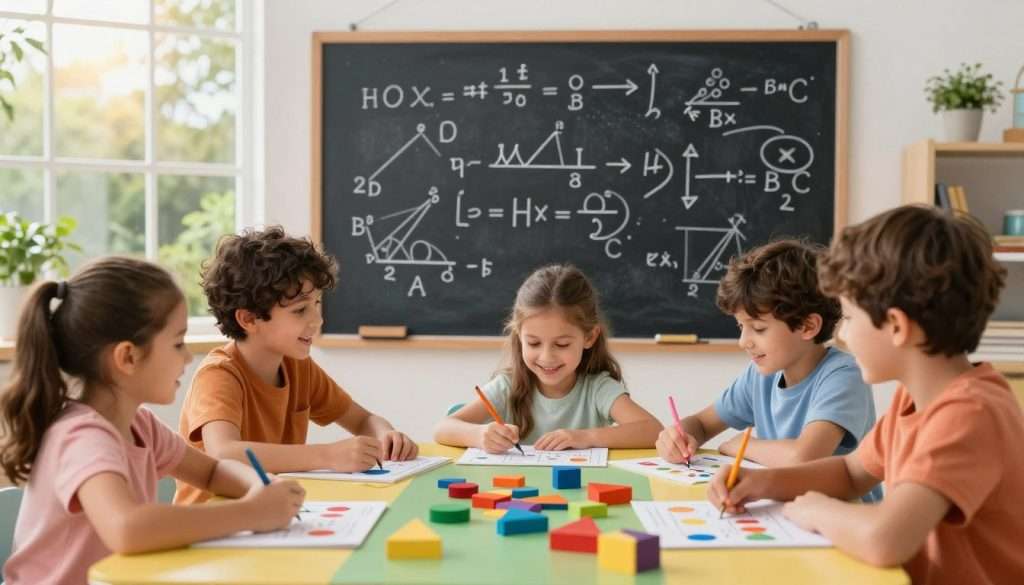
Have you ever thought that numbers could actually be exciting? Many of us grew up seeing equations as chores. But it’s time to change that. When you mix logic and patterns with things you love, you find that math can be a hobby that brings joy.
You don’t need to be a genius to enjoy this journey. Solving puzzles, creating geometric designs, or playing strategy games are all fun ways to use your brain. It’s all about curiosity, not feeling you must be naturally gifted.
In this guide, we’ll show you how to make numbers fun. We’ll look at creative projects, technology, and social activities that make learning rewarding. Let’s find the fun in the numbers around us!
Key Takeaways
- Shift your mindset to view numbers as a source of play rather than a chore.
- Integrate logic and patterns into your existing interests and daily routines.
- Use puzzles and strategy games to sharpen your skills without the pressure of homework.
- Focus on your natural curiosity instead of worrying about being “good” at subjects.
- Explore creative projects and technology to make learning feel like a fun pastime.
Why Math Can Be a Hobby for Anyone
Many people think math can be a hobby that brings joy. We often see numbers as only for school. But, without the stress of exams, math reveals a beautiful world.
Replace the “Good at Math” Mindset With Curiosity
Believing you’re either “born with it” or not is a big barrier. We suggest dropping that idea. Instead, embrace pure curiosity.
Seeing math as a detective’s work changes everything. You focus on understanding, not just being right. This turns math into a fun, personal journey.
Find Enjoyment in Questions, Patterns, and Discovery
Math explores patterns, found everywhere. Look at flowers, music, or traffic flow. Asking “why” or “what if” is real math.
Discovering answers is rewarding. It lets you test your ideas freely. You don’t need a textbook; just curiosity and a keen eye.
Explore Math as Leisure Without Grades or Pressure
Seeing math as leisure means embracing mistakes. In a hobby, mistakes help you understand better. There’s no fear of failing here, just the joy of exploring.
Whether you’re a student, worker, or lifelong learner, this keeps your mind active. It removes fear, allowing creativity to grow.
| Feature | Traditional Math | Math as a Hobby |
|---|---|---|
| Primary Goal | Passing Exams | Personal Discovery |
| Environment | High Pressure | Relaxed Leisure |
| Mistakes | Seen as Failures | Seen as Learning |
| Motivation | External Grades | Internal Curiosity |
Choose Your Personal Math Hobby Path
Ready to dive into the world of math? There are many ways to make numbers fun and personal. You don’t need to be a math genius to find a hobby that suits you. Whether you enjoy quiet moments or exciting challenges, there’s something for everyone.
Recreational Mathematics for Puzzles and Brain Teasers
Do you love solving tough puzzles? Recreational mathematics is perfect for you. It’s all about the joy of finding answers through logic puzzles, Sudoku, and games like chess. These activities make complex ideas feel real and rewarding.
“Mathematics is the music of reason.”
Visual Mathematics for Shapes, Designs, and Patterns
Are you a visual thinker who loves symmetry and structure? Visual mathematics lets you explore geometry through art and nature. You can draw fractals or study the golden ratio in photos.
Practical Mathematics for Money, Cooking, and Everyday Decisions
Want to use math in real life? Practical math is your best bet. It helps you manage money, improve your cooking, or organize your day better. It makes everyday tasks more efficient and clear.
Competitive Mathematics for Challenges and Timed Problems
Do you perform well under pressure? Competitive math is for you. It involves solving problems quickly or joining online leagues. It’s a thrilling way to test your speed and accuracy.
Try out different paths to find what works best for you. You might mix and match styles to create your perfect routine. The key is to keep it fun and uniquely yours.
Start With a Simple Math Hobby Routine
Building a math hobby doesn’t need to be hard. You can make numbers and logic fun by keeping it short and easy. Make this time a treat, not a chore.
Step 1: Set a Small, Enjoyable Goal
Choose a Ten- to Twenty-Minute Practice Window
Being consistent is more important than being intense. Committing to just ten or twenty minutes makes it manageable. This short time helps you stay focused and keeps your math hobby exciting.
Define Success as Exploration Rather Than Perfect Answers
Don’t worry about getting every answer right. See it as a chance to explore and play with new ideas. Success is found in the curiosity you bring, not in being perfect.
Step 2: Select One Activity That Matches Your Interests
Use Puzzles, Games, Data, Geometry, or Number Patterns
Choose something that really interests you to stay motivated. You might enjoy:
- Solving complex logic puzzles or brain teasers.
- Analyzing personal data, such as your daily step count or spending habits.
- Creating geometric proofs or sketching patterns found in nature.
- Writing your own word problems based on real-life scenarios.
Step 3: Record Questions, Insights, and Progress
Keep a Math Journal or Digital Notes File
Writing down your thoughts shows how much you’ve grown. Whether it’s a notebook or a digital app, tracking your math hobby journey is rewarding. Try to write down one question or “aha!” moment after every session to track your progress.
Try Math Activities That Feel Like Games
Math doesn’t have to be boring. You can make it fun by seeing numbers as a game. This way, you can build skills without feeling like you’re in school.
Play Strategy Games That Require Logical Thinking
Strategy games are great for thinking ahead. They make you think about choices and outcomes.
Analyze Chess Positions, Sudoku Grids, and Nim Strategies
Playing chess is like solving a puzzle. Sudoku and Nim also challenge your brain in different ways. They make learning fun and exciting.
Challenge Yourself With Number Puzzles
If you love solving mysteries, try number puzzles. They’re fun and help you think logically.
Work With Magic Squares, KenKen, Nonograms, and Cryptarithms
These puzzles improve your math skills. KenKen and cryptarithms are like puzzles that make math exciting. They’re better than just memorizing facts.
Turn Mental Math Into a Daily Game
You don’t need special tools to practice math. Simple challenges can keep your mind sharp.
Estimate Totals, Compare Rates, and Look for Efficient Shortcuts
Guess your grocery bill or compare prices. These activities make math a part of your daily life. Even card games like Blackjack can help with math.
| Game Type | Primary Skill | Difficulty Level |
|---|---|---|
| Sudoku | Logical Deduction | Medium |
| Chess | Spatial Strategy | High |
| KenKen | Arithmetic Logic | Medium |
| Blackjack | Probability | Low |
Make math a part of your daily life. It’s a fun way to learn. Stay curious and enjoy the journey!
Use Patterns to Make Learning Math More Enjoyable
Math is often seen as a chore, but finding patterns can turn it into a thrilling detective game. When you stop memorizing formulas and start looking for the hidden rhythms in the world, you unlock a new way to experience math for enjoyment. You become an investigator, uncovering the secrets that hold our universe together.
Search for Patterns in Number Sequences
Numbers are rarely just random digits on a page. They often follow a specific logic, like the famous Fibonacci sequence where each number is the sum of the two before it. By playing with these sequences, you can discover how they relate to the world around you.
“Mathematics is the art of giving the same name to different things.”
Investigate Visual Patterns in Nature and Art
Nature is a master mathematician. You can find the Golden Ratio, approximately 1.618, hidden in the spiral of a seashell or the arrangement of petals on a flower. This ratio acts as a beautiful bridge between simple numbers and the complex beauty of visual design.
Explore Symmetry in Snowflakes, Leaves, Buildings, and Quilts
Symmetry is everywhere if you know where to look. Whether it is the delicate six-sided structure of a snowflake or the balanced geometry of a historic building, these shapes provide a perfect entry point for math for enjoyment. Try sketching these patterns to see how repetition creates harmony.
Ask What Changes and What Stays the Same
To truly understand a pattern, you must ask the right questions. Focus on identifying which elements remain constant while others shift. This simple habit helps you see the underlying structure of any problem you encounter.
Turn Observations Into Conjectures You Can Test
Once you spot a pattern, turn your observation into a conjecture. A conjecture is just a fancy word for an educated guess that you can test. If you notice that every third leaf on a branch follows a specific angle, write it down and see if it holds true for other branches. Testing your own ideas is the best way to make math for enjoyment a personal adventure.
Build Fun Math Projects From Real-World Questions
Why not turn your life into a math lab? Looking at your daily life through math reveals fun math projects everywhere. You don’t need fancy tools to start; just curiosity.

Track and Analyze Personal Data
Data surrounds us, telling a story of our daily lives. By tracking your activities, you uncover patterns you might miss.
Measure Sleep, Exercise, Reading Time, or Spending Habits
Keep a log for a week. Track sleep, coffee, or anything else. Then, find the average or make a chart. You’ll be amazed at what your data shows!
| Activity | Measurement | Goal |
|---|---|---|
| Sleep | Hours per night | 8 hours |
| Reading | Pages per day | 20 pages |
| Spending | Dollars per week | Under $50 |
Design a Probability or Statistics Experiment
Probability is all about chance, making it super fun to test. It’s a great way to see if your guesses match reality.
Test Predictions With Coins, Dice, Cards, or Simple Surveys
Flip a coin fifty times. Does it land on heads half the time? You can also ask friends about snacks and see the percentages. These fun math projects show how randomness affects us.
“Mathematics is the music of reason.”
Create a Geometry or Construction Project
Geometry is more than just shapes; it’s the basis of all we build. Design something for your space to bring these concepts to life.
Use Scale, Area, Angles, and Measurement in a Practical Design
Sketch a room plan or build a shelf. Use scale and area to make sure it fits. Mastering these fun math projects boosts your confidence beyond grades.
Explore Math Through Technology and Creative Tools
You can turn your screen into a playground for numbers and logic. Technology makes abstract concepts visible, interactive, and much easier to experiment with during your daily math activities.
Visualize Equations With Desmos
Desmos is a fantastic tool that turns static equations into dynamic visual experiences. It helps you see the “why” behind the math rather than just memorizing formulas.
Change Coefficients and Observe How Graphs Respond
By adjusting sliders for coefficients, you can instantly see how a line shifts or a curve bends. This immediate feedback helps you build a deep, intuitive understanding of how variables influence outcomes.
Build Interactive Models With GeoGebra
GeoGebra acts as a digital laboratory for geometry and beyond. It allows you to construct complex shapes and watch them move in real-time.
Experiment With Transformations, Circles, and Geometric Constructions
You can drag points to see how reflections, rotations, and translations work. These interactive models make geometry feel like a creative art project rather than a chore.
Use Spreadsheets to Discover Relationships in Data
Spreadsheets are not just for accounting; they are powerful engines for discovery. They allow you to organize information and find hidden patterns in your own data.
Create Tables, Charts, Formulas, and What-If Scenarios
You can test different outcomes by changing variables in your formulas. This “what-if” approach is a great way to practice math activities that mirror real-world decision-making.
Learn From Reliable Math Videos and Online Resources
The internet is full of great teachers, but you must choose your resources wisely. Look for content that pushes you to think rather than just showing you the answer.
Choose Explanations That Encourage Active Problem-Solving
Avoid videos that just lecture. Instead, pick channels that pause to ask questions, giving you a chance to solve the problem before the host reveals the solution.
| Tool | Best For | Key Benefit |
|---|---|---|
| Desmos | Algebra & Functions | Visualizing changes |
| GeoGebra | Geometry & Calculus | Interactive construction |
| Spreadsheets | Data & Statistics | What-if modeling |
As you get comfortable with these tools, you might even find yourself diving into coding. Whether you are exploring binary math, statistics, or linear algebra, technology bridges the gap between theory and creative application.
Make Math a Social and Collaborative Hobby
Numbers become more fun when you share them with friends. Problem-solving is often seen as a solo task. But, sharing your journey with others makes it exciting and keeps you motivated. Connecting with math enthusiasts turns a hobby into a community experience.
Join Math Enthusiasts in Clubs or Online Communities
Finding your tribe is easier than you think. Look for local meetups or join digital forums. Interacting with other math enthusiasts gives you fresh views on problems. These groups are a safe space to ask questions and celebrate successes together.
Host a Casual Puzzle or Game Night
Bring the fun home with a game night focused on logic and strategy. Create a relaxed setting where everyone can explore new concepts. It’s a great way to bond and keep your brain sharp.
Mix Different Difficulty Levels So Everyone Can Participate
The best social math events are inclusive. Offer puzzles from simple patterns to complex brain teasers. Variety is key to keeping the energy high and the conversation flowing.
Explain a Solution Without Taking Away the Discovery
It’s tempting to just give the answer when helping a friend. But, the joy of math is in the process of discovery. Guide them toward the solution instead of giving it away.
Use Hints, Questions, and Multiple Approaches
Think of yourself as a coach rather than a teacher. Use open-ended questions to spark curiosity. Offer small hints and share different ways to solve problems. This helps your friends build mathematical confidence.
Develop Better Study Habits While Learning Math for Fun
Want to keep your brain sharp? Try these simple study habits that make learning math for fun easy. Instead of cramming, we focus on steady progress and low stress. By working with your brain, every session becomes rewarding.

Use Spaced Practice to Help Ideas Stick
Our brains love variety. Try spreading your practice sessions over several days. When you revisit a topic, your memory works harder, making the information stick better. Use silly rhymes or catchy acronyms to remember tricky sequences or formulas.
Retrieve Solutions Before Checking Examples
It’s tempting to look at the answer key right away. But try to resist! Retrieving the solution from your memory first builds stronger neural pathways. Even if you get it wrong, trying creates a deeper connection than just reading the steps.
Review Mistakes as Evidence About Your Thinking
See every mistake as a clue, not a failure. When reviewing your work, try to find where things went wrong.
Identify Whether the Problem Involves a Concept, Process, or Calculation Error
Ask yourself if you misunderstood the idea, missed a step, or made a simple arithmetic slip. Identifying the root cause helps you fix the issue without feeling like you need to relearn everything. This detective work is key to learning math for fun.
Alternate Challenge With Reflection
Balance is key for a sustainable hobby. After tackling a tough puzzle, take a moment to step back and breathe.
Write What You Learned and What You Want to Try Next
Take a few minutes to jot down what you learned. Writing your thoughts helps you celebrate your wins and sets a clear goal for your next session. This habit ensures you always feel accomplished.
Overcome Common Obstacles to Enjoying Math
Sometimes, the biggest hurdle to enjoying math is the ghost of past classroom stress. When you view math as leisure, it should feel like a playground rather than a test. If you find yourself feeling tense, it is time to reset your approach.
Restart After Years of Frustration or Avoidance
If you have spent years avoiding numbers, jumping back in can feel intimidating. You might feel the urge to start where you left off, but that often leads to burnout.
Begin Below Your Assumed Level to Rebuild Confidence
Start much easier than you think you need to. By choosing problems that feel almost too simple, you allow your brain to relax and rediscover the joy of solving. This builds a foundation of success that makes future challenges feel manageable.
Manage Difficulty Without Losing the Fun
When a puzzle stops being fun, it is usually because the difficulty has spiked too quickly. You do not need to suffer through a problem to prove your worth.
Use Hints, Simpler Versions, and Short Breaks
If you get stuck, look for a hint or try a smaller version of the same problem. Taking a short break is also a powerful tool. Stepping away allows your subconscious to work on the solution while you recharge your batteries.
Protect Your Hobby From Perfectionism
Perfectionism is the enemy of creativity. If you believe there is only one “right” way to reach an answer, you will miss out on the beauty of exploration.
Value Creative Strategies and Partial Progress
Every step you take toward a solution is a win. Even if you do not reach the final answer, the creative strategies you developed are valuable evidence of your growing skills. Celebrate the process, not just the result.
Know When to Stop or Switch Activities
Not every session will result in a breakthrough, and that is perfectly okay. Forcing yourself to finish a task when you are frustrated will only turn math as leisure into a chore.
Keep Curiosity Alive Instead of Forcing an Unproductive Session
If you feel stuck, simply switch to a different activity. You might move from a complex logic puzzle to a visual pattern project. Keeping your curiosity alive is far more important than finishing one specific task.
| Obstacle | Immediate Strategy | Long-term Mindset |
|---|---|---|
| Frustration | Take a break | Start at a lower level |
| Perfectionism | Value partial progress | Focus on the process |
| Stagnation | Switch activities | Keep curiosity alive |
Turn Your Math Hobby Into Long-Term Growth
Let’s explore how to turn your occasional math interest into a lasting passion. The key is to keep things exciting and make your routine feel rewarding, not like a chore.
Create a Flexible Weekly Math Menu
Try making a weekly math menu to keep things fresh. This way, you can switch between different activities based on your mood.
One day, focus on fun math projects. Another day, tackle a tricky puzzle. And spend a third day reflecting on something that caught your interest. This rotation prevents boredom and keeps your mind active with new challenges.
Increase Challenge Gradually as Your Interests Develop
Grow by stepping outside your comfort zone. Start with tasks that feel easy, then gradually add more complex ones as you gain confidence.
If you like number puzzles, try logic games next. This gradual progression helps you learn without feeling overwhelmed.
Connect Recreational Mathematics to New Subjects
Once you’re comfortable with the basics, apply your skills to other areas. Recreational mathematics opens doors to understanding the world in new ways.
Explore Coding, Physics, Economics, Music, or Architecture
Math is the hidden language in many fields. It helps you grasp how algorithms work or how geometry shapes buildings. Your hobby is a great way to dive into these subjects.
Want to Go Deeper? Get the Free Book How to Think Like a Mathematician
If you enjoyed this article, check out my free book, How to Think Like a Mathematician. It provides a practical system for learning math more effectively.
Learn Memory Techniques, Smarter Study Routines, and Thinking Strategies
Inside, you’ll find proven methods to make learning stick. These strategies aim to make your learning process smoother and more rewarding.
Invite Readers to Grab the Free Copy at https://www.studyingmachine.com/free-books/
There’s no cost or catch. Just get your free copy here: https://www.studyingmachine.com/free-books/ and start using these ideas today!
Conclusion
You now have a new way to see the world. You can dive into puzzles, analyze data, or create models with GeoGebra. This shows that math can be fun for everyone. It’s time to break the myth that math is only for school.
Real fun with math starts with your curiosity. Allow yourself to make mistakes and play with patterns. By doing this, you create a lifelong passion that goes beyond school.
If you liked this article, check out my free book, How to Think Like a Mathematician. It offers a system for learning math better. You’ll find memory tricks, study tips, and strategies to keep your knowledge strong.
There’s no cost or catch. You can start using these ideas today to make learning math fun forever. Get your free copy here at https://www.studyingmachine.com/free-books/ and keep the excitement alive.