

Do you feel overwhelmed by your lecture notes? Real learning isn’t just about writing down everything. It’s about creating a system that helps you think, remember, and review well.
Finding the best note-taking method for college students might seem hard. But it’s key to doing well in school. The Cornell system is a good start, but you might also like outlining, charting, or mapping for certain classes.
This guide will show you a practical system to turn your notes into study tools. We’ll cover everything from getting ready for class to making your notes stick in your memory. For more, check out my free book, How to Become the Smartest Student in the Classroom. It’s full of memory techniques and routines. You can get it here for free.
Key Takeaways
- Notes should focus on active thinking, not just writing down words.
- The Cornell system is a good base for most students.
- Other methods like mapping or charting are great for certain subjects.
- A good study system includes getting ready, engaging actively, and reviewing.
- Sticking to routines is more important than finding the perfect method.
Why Your Current Notes May Not Be Helping You Learn
If your notebook is full but your head is empty, you might be falling into the trap of passive note-taking. Many students believe that capturing every single word spoken in a lecture is the key to success. But this habit often leaves your brain on the sidelines.
Recognizing Notes That Are Too Passive
Copying every word without processing the meaning
When you focus on transcribing, you act more like a human recorder than a student. You’re not actually thinking about the concepts; you’re just moving your hand to keep up. This prevents you from making the mental connections that lead to true mastery.
Leaving class with pages but no clear understanding
Have you ever looked at your notes later and wondered what you were even thinking? If you leave class with a mountain of text but no grasp of the core ideas, you have wasted your time. Applying effective note-taking tips means prioritizing clarity over quantity.
Connecting Note-Taking With Long-Term Learning
Using notes to retrieve, explain, and apply information
Great notes should act as a bridge to your long-term memory. Instead of long sentences, try using symbols, abbreviations, and short phrases. This active process helps you retrieve and explain the material much faster during exam season.
Turning lecture material into useful study resources
Think of your notes as the first draft of a study guide rather than the final product. You should capture definitions, formulas, and questions that you can revisit later. By treating your notebook as a living resource, you transform a boring lecture into a powerful tool for success.
| Feature | Passive Note-Taking | Active Note-Taking |
|---|---|---|
| Primary Goal | Capture everything | Capture meaning |
| Mental Effort | Low (Transcription) | High (Synthesis) |
| Long-term Result | Quickly forgotten | Deep understanding |
If this article resonated with you, my free book How to Become the Smartest Student in the Classroom gives you a full system. It includes memory techniques, study routines, and strategies that actually stick. No cost, no catch. Grab your free copy here.
The Best Note-Taking Method for College Students
Your notes should be as hardworking as you are during long lectures. To avoid feeling overwhelmed, you need a system that supports your brain. The Cornell Method is the best note-taking method for college students because it offers structure and flexibility.
How the Cornell Method Organizes Learning
This system divides your paper into three zones. These zones help you create a clear study plan.
Recording key ideas in the main notes section
Use the largest area on the right for main lecture content. Focus on meaningful ideas rather than writing down every word.
Adding questions and prompts in the cue column
The narrow left column is for cues. After class, turn your notes into questions to test your memory.
Writing a concise summary after class
The bottom section is for a quick wrap-up. Summarizing in two or three sentences helps you understand the big picture.
Why Cornell Notes Work for Most College Courses
Many students find this method efficient because it engages you with the material twice. You’re not just recording; you’re processing it.
Combining organization with active recall
Covering the main notes and answering questions in your cue column uses active recall. This is key for long-term memory.
Making review sessions faster and more focused
Your notes are already organized, so you won’t waste time searching for key concepts. This makes studying more productive.
When to Adapt the Method
While the standard layout is great, feel free to make changes. Great students adapt efficient note-taking methods to fit the subject.
Using more diagrams for visual or technical subjects
In biology or engineering, don’t hesitate to draw. Diagrams can explain complex processes better than words.
Adding comparison charts for courses with dense terminology
In history or literature, use comparison charts. They help you see relationships between ideas quickly.
If this article resonated with you, my free book How to Become the Smartest Student in the Classroom offers a full system. It includes memory techniques, study routines, and strategies that stick. No cost, no catch. Grab your free copy here.
How to Use Cornell Notes During a College Lecture
Let’s explore how to make a blank page useful during your next lecture. Learning to take notes well in college is not about writing fast. It’s about focusing on every word you write.
Prepare the Page Before Class Begins
Write the course, date, lecture topic, and learning objective
Before class starts, get your page ready. Write down the course name, date, and lecture topic at the top. If there’s a learning objective, note it down. It will guide you through the session.
Review assigned reading and previous notes for context
Quickly look over your notes or assigned reading before class. This helps your brain recognize important concepts. It makes it easier to follow the lecture. This is a key best practice for taking notes in college.
Capture Ideas Instead of Transcribing Sentences
Use abbreviations, symbols, and short phrases
Don’t try to write down every word. Use shortcuts like “w/” for with or “b/c” for because. Your goal is to capture the main ideas, not create a full transcript.
Record definitions, examples, questions, and connections
Focus on the “why” and “how,” not just the “what.” Write down clear definitions, examples, and questions. These connections make your notes valuable during study sessions.
“The secret to learning is not in the volume of notes you take, but in the quality of the ideas you capture.”
Mark Important Information in Real Time
Identify points emphasized by the professor
Listen for cues like “the most important point is.” When you hear them, highlight or star them. These are key points to review later.
Flag confusing material for later clarification
If something confuses you, don’t worry. Just mark it with a question mark and keep listening. You can ask about it later, which is a key best practice for taking notes in college.
If this article helped you, check out my free book How to Become the Smartest Student in the Classroom. It offers memory techniques, study routines, and strategies that work. No cost, no catch. Get your free copy here.
Choosing Between Cornell, Outline, Charting, and Mapping Methods
Think of your notebook as a toolbox. Each subject needs its own tool. The Cornell method is great for most lectures. But, picking the right student note-taking techniques can make studying easier.
Use the Outline Method for Structured Material
Organizing major topics, supporting points, and examples
The outline method works well when information is clear and organized. Start with a main topic on the left. Then, indent supporting points and examples below. This visual hierarchy helps you see how details fit into the big picture.
Applying outlines to history, literature, and theory-heavy classes
This method is perfect for subjects like history or literature. It keeps your notes organized and easy to read. It’s a big help when studying for exams. If you struggle with complex arguments, this is your best choice.
Use the Charting Method for Comparisons
Creating columns for people, concepts, dates, or characteristics
For lectures with many items in the same categories, use a chart instead of writing paragraphs. Set up columns for specific traits. This way, you can quickly compare different ideas.
Comparing similar terms without mixing them up
This method is great for distinguishing between similar concepts or historical figures. It keeps everything organized in a grid. It’s one of the best student note-taking techniques for clarity.
Use the Mapping Method for Connected Ideas
Showing relationships between causes, processes, and outcomes
Information is sometimes a web of connections, not a straight line. Mapping lets you draw lines between ideas. It shows how one event leads to another or how a process changes over time.
Applying concept maps to biology, psychology, and systems courses
In subjects like biology or psychology, understanding system interactions is key. Mapping helps you see these complex relationships. It turns abstract ideas into a clear, interconnected map.
“The secret to learning is not just capturing information, but organizing it in a way that your brain can easily retrieve and apply later.”
If this article helped you, check out my free book How to Become the Smartest Student in the Classroom. It offers memory techniques, study routines, and strategies that work. No cost, no catch. Get your free copy here → https://www.studyingmachine.com/free-books/
Building an Efficient Note-Taking Routine Before, During, and After Class
Great notes start before class, not in it. By using effective note-taking tips, you can make studying easier. A simple routine is key to doing well in school.
Complete a Short Preview Before the Lecture
Skimming readings, slides, and learning objectives
Before class, spend ten minutes skimming your readings and slides. Look at the learning objectives to know what’s important. This helps new info stick better.
Writing questions that the lecture should answer
Make specific questions from the objectives. This turns you from a passive listener to an active learner. It’s a top efficient note-taking method for staying focused.
Focus on Meaning During Class
Listening for explanations rather than copying slide text
Don’t copy every word on the screen. Instead, listen for the why and how of concepts. You’ll get insights you won’t find in books.
Noting examples that reveal how to use a concept
Real-world examples make complex ideas clear. Write down examples given by the professor. They help solve exam problems.
Process Notes Within Twenty-Four Hours
Filling in missing details while the material is fresh
Your memory is best in the first twenty-four hours. Review your notes and fill gaps while the lecture is fresh. This stops you from forgetting important info.
Writing cue questions and a brief summary
End by writing cue questions and a summary. This helps you understand the material. If you liked this, check out my free book How to Become the Smartest Student in the Classroom. It has study tips and strategies. No cost, no catch. Get your free copy here.
| Phase | Primary Goal | Key Action |
|---|---|---|
| Before Class | Preparation | Skim slides and write questions |
| During Class | Understanding | Capture explanations and examples |
| After Class | Retention | Summarize and add cue questions |
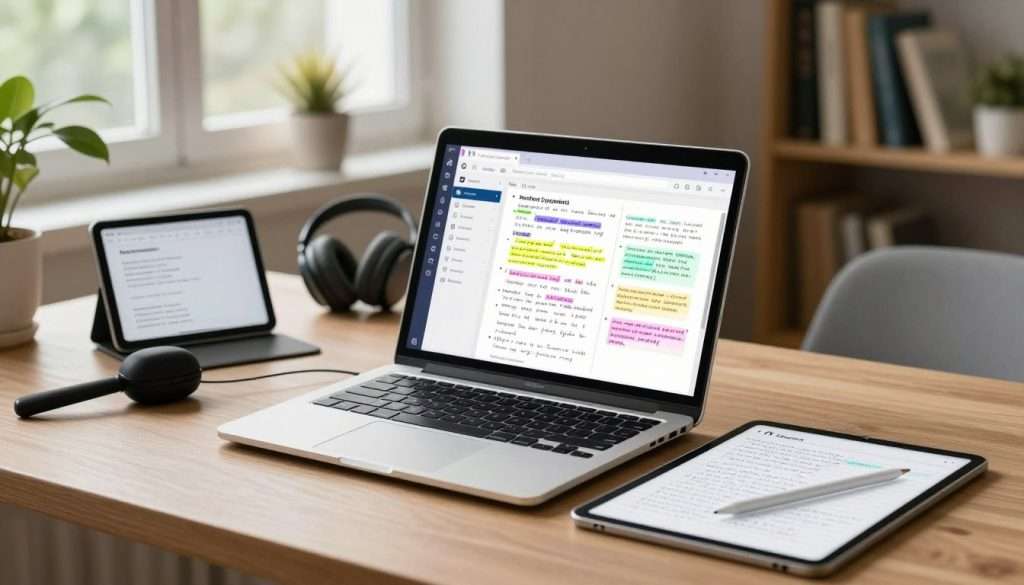
Handwritten Notes Versus Digital Note-Taking Tools
Choosing how to take notes is a personal choice. It depends on how you learn best. There’s no one right way, just what works for you.
Do you like the feel of pen on paper or typing fast? Your choice affects how you learn.
When Handwritten Notes Are the Better Choice
Supporting slower processing and selective note-taking
Writing by hand makes you slow down. You can’t write as fast as a teacher speaks. This helps your brain focus on what’s important.
You have to summarize ideas in your own words. This means you don’t just copy down everything.
Using paper for diagrams, equations, and visual layouts
Paper is great for complex visuals. In math or science, drawing by hand is often easier. You can sketch out ideas and connect them easily.
When Digital Notes Improve Efficiency
Searching, tagging, and reorganizing large amounts of information
If typing is your thing, digital note-taking tools are powerful. You can search through lots of notes quickly. This helps you find what you need fast.
Attaching lecture slides, readings, and audio resources
Digital tools keep everything in one place. You can add slides, PDFs, and audio to your notes. This makes studying easier and more organized.
Digital Tools College Students Can Use
Organizing course materials in Microsoft OneNote
OneNote is like a digital binder. It’s great for keeping notes organized by class. You can access them on any device.
Creating linked study notes in Notion
Notion is perfect for building a network of knowledge. You can link pages together. This helps you see how different topics are connected.
Using Google Docs for accessible collaborative notes
Google Docs is best for group projects. It lets you and your team edit the same document together. This makes it easy to catch up if you miss something.
Preventing Digital Distractions
Turning off notifications during lectures
Laptops can be distracting. Those little notifications can pull you away. Always turn off your alerts before class to stay focused.
Using a consistent folder and naming system
Digital clutter is a real problem. To stay organized, use a clear folder system. Name your files in a way that makes sense, like CourseCode_Date_Topic.
If this article helped you, check out my free book How to Become the Smartest Student in the Classroom. It has tips on memory, study routines, and more. No cost, no catch. Get your free copy here → https://www.studyingmachine.com/free-books/
Effective Note-Taking Strategies for Different College Subjects
Your history notes and chemistry homework might look different, and that’s okay. Using the same format for every class can limit your learning. By tailoring your college note-taking strategies to each subject, you can learn faster.
Taking Notes in STEM and Mathematics Courses
Recording problem-solving steps instead of only final answers
In math and science, the journey is key, not just the end. Write down all the steps to understand your logic later. Just the final answer won’t help when studying for exams.
Writing what each formula means and when to use it
Don’t just copy formulas. Explain why you use each formula and what the variables mean. This way, you grasp the concept, not just symbols.
Taking Notes in Reading-Heavy Courses
Separating an author’s claim, evidence, and assumptions
When tackling thick texts, break down the author’s argument. Distinguish the main claim, evidence, and assumptions. This makes essay writing easier.
Capturing page references for later essays and discussions
Keep track of where you find information. Note page numbers or chapter titles for future papers. Organization is your best friend in research-heavy semesters.
Taking Notes in Laboratory and Applied Courses
Documenting procedures, observations, variables, and results
Applied courses need detailed notes. Record your procedures, variables, and results. This helps in writing accurate lab reports.
Connecting practical activities to course concepts
Link your experiments to lecture theories. Think about how the experiment supports or challenges the textbook. This connection makes learning stick.
If this article resonated with you, my free book How to Become the Smartest Student in the Classroom offers a full system. It includes memory techniques, study routines, and strategies that work. No cost, no catch. Grab your free copy here → https://www.studyingmachine.com/free-books/
By using these college note-taking strategies, you turn study sessions into powerful learning experiences. Remember, your notes should help you, not hinder you!
Turning Lecture Notes Into Stronger Study Materials
Most students just take notes, but the real magic is in making those notes into study tools. You’ve already worked hard to capture the lecture. Now, let’s make sure that information stays in your brain. By improving study skills through active engagement, you can turn simple notes into a powerful learning system.
Convert Notes Into Questions
Writing prompts that require explanation rather than recognition
Don’t just read your notes. Challenge yourself instead. Write prompts that make you explain a concept in your own words. This active engagement is much better than just re-reading your textbook or slides.
Creating questions from headings, definitions, and examples
Turn your headings into questions. If you have a definition, write a question about it. This simple change turns your notes into a personal quiz.
Use Active Recall With a Blank Page
Reconstructing key ideas without looking at the notes
Start with a blank sheet of paper. Try to write down everything you remember about a topic. Don’t look at your notes yet! This retrieval practice strengthens your memory a lot.
Checking accuracy and correcting gaps afterward
After you’ve used up your memory, compare your blank page to your notes. Use a different colored pen to fill in the missing pieces. This shows you what you know and what you still need to study.
Create Spaced Review Sessions
Reviewing shortly after class, later in the week, and before exams
Learning is not a one-time thing. Review your notes soon after class, a few days later, and before exams. This spaced repetition helps you remember better.
Prioritizing difficult concepts over familiar information
It’s tempting to focus on what you already know. But that won’t help you grow. Spend your time on the concepts that are tricky or confusing. Improving study skills means facing your weak spots head-on.
“The secret to mastery is not just reading more, but testing yourself on what you have already learned.”
If this article resonated with you, my free book How to Become the Smartest Student in the Classroom offers a full system. It includes memory techniques, study routines, and strategies that really work. No cost, no catch. Get your free copy here → https://www.studyingmachine.com/free-books/
Using Memory Techniques to Make Notes Stick
To master best practices for taking notes in college, turn your scribbles into memory anchors. Just writing down what the professor says isn’t enough. You must engage your brain to keep the information.

Connect New Ideas to What You Already Know
Adding personal examples and real-world applications
Your brain loves patterns. When you learn something new, link it to something you already know. For example, if you’re learning about economics, think about how it applies to your budget or a local coffee shop.
Linking new concepts to earlier lectures
Don’t let your notes stand alone. Review your previous notes and see how the new topic connects to what you learned before. Connecting the dots helps you remember better.
Use Elaboration and Self-Explanation
Explaining why a process works
Instead of just memorizing steps, ask yourself why each step is important. Understanding the logic behind a process makes it easier to remember.
Describing a concept as if teaching it to a classmate
Try explaining a tough idea to a friend. If you struggle, you know what to review again. This is a key best practice for taking notes in college.
Apply Mnemonics Carefully
Creating acronyms for ordered information
Acronyms are great for remembering lists or sequences. Make sure the acronym is easy to remember, like “HOMES” for the Great Lakes.
Using vivid associations for difficult vocabulary
For hard terms, create a mental image that represents the word. The more bizarre or funny the image, the better your brain will remember it.
Separate Memorization From Understanding
Learning foundational facts before solving complex problems
You can’t build a house without a foundation. First, learn the basic definitions and facts. Then, apply them to complex ideas.
Testing whether you can apply information in a new situation
True learning happens when you can apply what you’ve learned in new ways. If you can solve a problem in a new context, you’ve really learned it.
| Technique | Best Used For | Primary Benefit |
|---|---|---|
| Personal Linking | Abstract concepts | Long-term retention |
| Self-Explanation | Complex processes | Deep understanding |
| Mnemonics | Lists and vocabulary | Quick recall |
If this article resonated with you, check out my free book How to Become the Smartest Student in the Classroom. It offers memory techniques, study routines, and strategies that really work. No cost, no catch. Get your free copy here.
Common College Note-Taking Mistakes and How to Fix Them
Improving your student note-taking techniques starts with spotting bad habits. We’ve all scribbled down every word, only to forget it later. It’s time to focus on learning, not just writing.
Trying to Capture Everything
Many students try to write down every word in class. This passive approach stops you from really understanding the material.
Prioritizing explanations, relationships, and likely test material
Instead, focus on the “why” and “how.” Look for connections and key exam info. This way, you learn more effectively.
Leaving space to add information later
Always leave room on your page. This lets you add insights or clarify points later.
Relying on Slides as Complete Notes
Just printing out slides misses the class’s best part. Slides are just outlines, not the full story.
Adding the professor’s examples and explanations
Write down the stories and examples the professor shares. These are often the keys to understanding tough concepts.
Recording questions that the slides do not answer
If a slide confuses you, write down your question. Active curiosity helps you learn deeply.
Never Reviewing Notes After Class
Your notes are useless if you don’t review them. Engage with your material to make it stick.
Scheduling a brief same-day processing session
Take ten minutes after class to review your notes. This habit reinforces what you learned and saves you from cramming.
Using retrieval practice instead of repeated rereading
Don’t just reread your notes. Cover them and try to explain the concepts out loud. This strengthens your understanding.
“The secret to mastery is not in how much you write, but in how much you think about what you have written.”
Using an Inconsistent System Across Courses
Switching methods for every class can be chaotic. While flexibility is good, a core system is essential.
Creating repeatable labels, symbols, and review habits
Develop a set of shorthand symbols for all subjects. This creates a mental rhythm that makes note-taking easier.
Adjusting the format without abandoning the core process
You can change your layout for different classes, but keep your review process the same. If this article helped, check out my free book How to Become the Smartest Student in the Classroom. It offers memory techniques, study routines, and strategies that work. No cost, no catch. Get your free copy here → https://www.studyingmachine.com/free-books/
Personalizing Your Note-Taking System for Better Study Skills
Improving study skills means finding a system that fits you. Each class is different, and your notes should match that. This way, you can learn better.
Match the Method to Your Learning Demands
Choosing structure for information-heavy courses
For classes with lots of facts, you need a clear plan. Use outlines or numbered lists to keep your notes organized.
Choosing diagrams or charts for relationships and processes
In subjects like biology or economics, text alone isn’t enough. Use diagrams or flowcharts to show how ideas connect.
Build a Course-Specific Note Template
Including space for questions, examples, and summaries
Don’t just write down what’s said. Make a template with space for your questions, examples, and a quick summary.
Adding an exam-preparation section for recurring themes
Have a small area for “Exam Focus” items. This helps you remember important themes your professor keeps coming back to.
Use Feedback to Improve Your Notes
Comparing notes with assigned readings and professor guidance
Your notes should evolve. Regularly check them against your textbook and syllabus to catch any missing details.
Checking whether your notes help you answer practice questions
Test your system by solving practice questions. If you struggle, it’s time to adjust your notes or add more details.
Get Additional Support for Memory and Study Routines
Using the free book How to Become the Smartest Student in the Classroom
If this article helped, check out my free book How to Become the Smartest Student in the Classroom. It offers memory tips, study routines, and strategies that really work.
“The secret to getting ahead is getting started, but the secret to staying ahead is having a system that evolves with your needs.”
Finding memory techniques, study routines, and strategies that actually stick
No cost, no catch. Get your free copy here → https://www.studyingmachine.com/free-books/. It’s time to take charge of your studies and improve your study skills today!
Conclusion
Finding the best note-taking method for college students is more than just writing. It’s about creating a personal tool that helps you understand and use complex ideas easily.
We’ve seen how the Cornell system, subject-specific tweaks, and quick reviews are key. By focusing on active learning, you stay organized and ready for any challenge. This includes tough exams and deep research papers.
The best note-taking method is the one that fits your brain. Keep trying different methods until studying feels like a journey to mastery, not a chore.
If this article struck a chord, check out my free book, How to Become the Smartest Student in the Classroom. It offers memory techniques, study routines, and strategies that stick. There’s no cost and no catch. Get your free copy here → https://www.studyingmachine.com/free-books/