

Do your study notes look like a messy pile of papers? Imagine if your brain worked like a grand symphony. We think making your study habits organized is key to success.
Marc Jovani has scored over 50 movies with a clear, rhythmic process. He doesn’t just throw notes on a page; he crafts a story. You can use this same approach to keep your studies on track and engaging.
By seeing your syllabus as a musical score, you turn a chore into a fun creative process. Let’s explore how this effective method makes learning new topics easy.
Key Takeaways
- Adopt a professional composer’s mindset to structure your study sessions.
- Use Marc Jovani’s proven methods to manage complex information.
- Turn boring tasks into a creative and engaging experience.
- Maintain focus by treating your learning path like a musical score.
- Boost your motivation through systematic organization techniques.
The Philosophy of Musical Architecture in Learning
Imagine your brain as a concert hall where knowledge plays different parts. Seeing education as a grand musical composition makes facts blend into a beautiful melody. This view helps you see how all knowledge fits together.
This new way of thinking makes studying a creative journey. You’re not just memorizing; you’re conducting your own learning. It helps you avoid feeling lost in a sea of information.
Treating Knowledge as a Composition
Every great song has a clear structure. Your learning journey needs a framework too. Treating knowledge as a composition helps you see the big picture and set achievable goals for each study session.
“Music is the shorthand of emotion, and learning is the shorthand of experience.”
This approach lets you organize information into sections. You can focus on one part at a time. It makes studying feel more intentional and less like a burden.
Identifying Your Core Motifs
In music, a motif is a short idea that ties the whole piece together. In studying, these are the fundamental concepts that hold everything. Finding these core ideas gives you a solid base to build on.
Think of these motifs as the “hooks” of your learning. When you learn new, complex things, relate them to these core ideas. This pattern recognition helps you remember and apply what you learn.
The Composer’s Logic for Organizing What You Learn
Imagine arranging your study habits like a master composer. The Composer’s Logic for Organizing What You Learn makes learning a beautiful experience. Instead of feeling lost in a sea of facts, you see the connections between your favorite subjects.
Applying Counterpoint to Multidisciplinary Study
In music, counterpoint means playing multiple melodies together. This brilliant strategy works for studying different subjects at once. When you study two subjects together, they should enhance each other, not fight for your attention.
Pair a technical subject like math with a creative one like history or literature. This mix creates a dynamic tension that keeps your mind active and prevents burnout. Your study time becomes a symphony, not chaos.
Developing Themes Through Repetition and Variation
Composers often use a core motif throughout their work, changing it slightly each time. This method helps you remember information better. Repetition is key to memory, but variation keeps it interesting.
When you go back to a tough concept, try explaining it differently or use it in a new way. This keeps your understanding sharp and your study sessions engaging. The table below shows how music can improve your study routine.
| Musical Technique | Study Application | Primary Benefit |
|---|---|---|
| Counterpoint | Mixing two distinct subjects | Balanced cognitive load |
| Motif Development | Revisiting core concepts | Deep long-term retention |
| Variation | Changing your study format | Increased mental flexibility |
| Crescendo | Gradual intensity increase | Better focus management |
By using The Composer’s Logic for Organizing What You Learn, every study session becomes a creative journey. You’re not just memorizing; you’re crafting a masterpiece of knowledge that grows every day.
Building a Personal Library of Educational Resources for Musicians
Think of your study area as a professional studio. Every tool has its spot. Organizing your educational resources for musicians saves time and boosts your growth.
A well-organized library is your foundation for success. It keeps your progress clear and your goals in sight.
Categorizing Theory Books and Digital Assets
Group your materials by difficulty or topic. Use physical shelves or digital folders. Consistency is key to mastering music theory.
Here are three simple categories to try:
- Foundational Texts: Basic harmony and rhythm books.
- Advanced Concepts: Complex scores and specialized theory guides.
- Digital Assets: Interactive apps, PDFs, and notation software files.
Curating High-Value Audio References
Reading about music isn’t always enough. Curate a list of high-value audio references. This lets you hear the concepts you’re studying.
When you’re stuck, revisit these tracks for inspiration. Keep them easy to find for a creative boost whenever you need it.
| Resource Type | Primary Benefit | Frequency of Use |
|---|---|---|
| Theory Textbooks | Deep conceptual understanding | Daily |
| Audio References | Aural pattern recognition | During practice |
| Digital Worksheets | Active skill reinforcement | Weekly |
Effective Learning Methods for Musicians Through Structural Analysis
Do you see a wall or a map when you look at a complex score? Many feel overwhelmed by dense music pages. But, seeing it as a map changes everything. Study techniques for musicians help you understand the music’s structure.
Deconstructing Complex Pieces into Manageable Fragments
Breaking down big pieces into small parts is key. It’s like learning a new language, one phrase at a time. This way, you avoid feeling overwhelmed.
It keeps practice sessions fresh and focused. By focusing on one part at a time, you learn better. Consistency is key, and small goals keep you motivated every day.
The Role of Harmonic Analysis in Retention
After breaking down the music, it’s time to see how it all fits together. Harmonic analysis is like the glue that holds it all. It helps you understand the music’s deeper meaning.
This method makes learning stick longer. You learn why the music sounds good, not just how it sounds. Recognizing patterns makes practice more efficient and fun.
| Learning Approach | Primary Focus | Retention Level |
|---|---|---|
| Traditional | Rote Memorization | Low to Moderate |
| Structural | Pattern Recognition | High |
| Fragmented | Bite-sized Chunks | Very High |
Establishing a Consistent Practice Routine
Consistency is the magic ingredient that turns a simple hobby into a lifelong passion. Finding time to play your instrument can feel like a chore. But, it doesn’t have to be.
By setting a reliable rhythm, you make your daily practice rewarding. It becomes the highlight of your day.
Scheduling Deep Work Sessions
To make real progress, you need to carve out time for deep work. This means setting aside blocks where you can focus entirely on your craft without any distractions. When you dedicate your full attention to a specific goal, you will find that your brain absorbs new information much faster.
We know that life gets busy, so we offer weekly live video chats to help you stay on track. These sessions are the perfect place to ask questions and get the support you need to keep your momentum going. Think of these meetings as your dedicated time to clear any hurdles and refine your approach.
Balancing Technical Drills with Creative Exploration
It is vital to balance your technical drills with creative exploration so you do not lose your spark. While scales and finger exercises build the foundation, they can lead to burnout if they are all you ever do. We encourage you to mix in time for improvisation or playing pieces that you simply love.
By alternating between structured study and pure musical play, you keep your passion alive and well. This balance ensures that your practice routine remains a source of joy rather than a source of stress. Remember, the goal is to grow as a musician while keeping your love for the art form at the very center of everything you do.
Leveraging Music Theory for Composers to Enhance Memory
We think music theory for composers should be fun, not boring. When you see these rules as tools, not strict laws, they become vibrant tools for your music. This way, you can make abstract ideas into memorable songs.
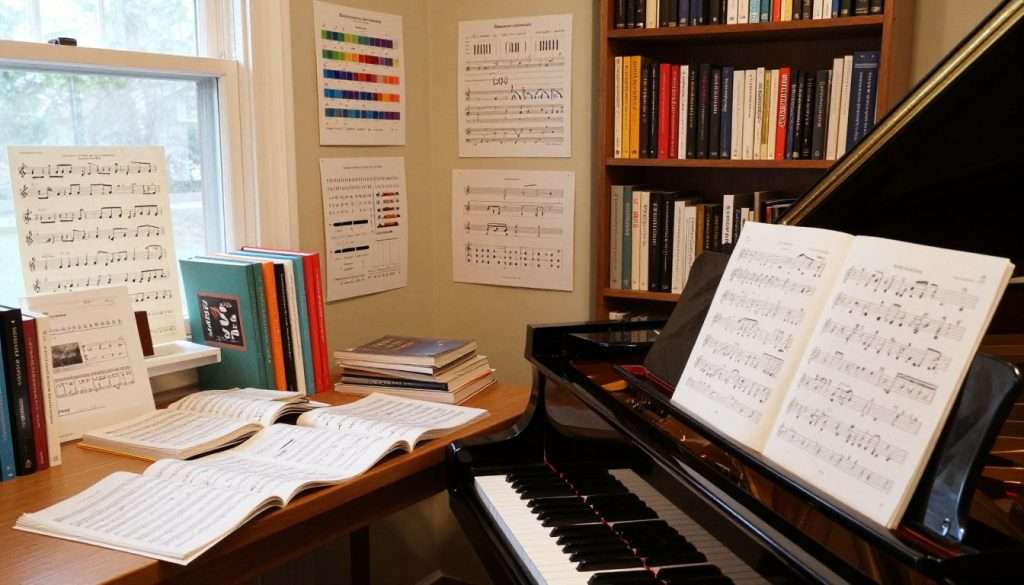
Connecting Abstract Concepts to Practical Application
Remembering a complex scale or chord progression is easier when you use it right away. Instead of just reading about it, try writing a short melody. This active engagement connects theory to your music.
Harmonizing a simple chord progression teaches your brain to recognize patterns. This makes music theory feel real and useful. Your memory will improve when you link a rule to a feeling in your music.
“Music is the shorthand of emotion. Those who write it must understand the architecture behind the feeling.”
Using Mnemonics and Pattern Recognition
Your brain loves patterns, and you can use this to your advantage. Mnemonics are great for remembering complex info without losing your flow. Use acronyms for chords or shapes for intervals to keep your creativity flowing.
Pattern recognition helps you see the whole picture of a piece. By spotting recurring motifs, you can store info better. The table below shows how to change your study habits for better retention.
| Learning Method | Traditional Approach | Practical Composer Approach |
|---|---|---|
| Chord Progressions | Memorizing Roman Numerals | Writing a song using the progression |
| Scale Theory | Rote memorization of notes | Improvising melodies over the scale |
| Intervals | Flashcards and drills | Identifying intervals in favorite songs |
By making music theory a part of your daily life, you stop fighting to remember rules. Instead, you start internalizing the language of music. This way, your knowledge is always ready when you need it.
Digital Tools for Organizing Music Knowledge
We think that organizing music knowledge is key to moving from a hobbyist to a pro. In today’s digital world, you have many resources at your fingertips. But, keeping them organized is the real challenge. Mastering your digital workspace helps you find files faster and spend more time making music.
Utilizing Note-Taking Apps for Theory Notes
Your brain is for creating, not for storing every chord progression. Use apps like Notion, Obsidian, or Evernote to jot down your theory insights. These apps let you tag your notes, making them easy to find when you need a quick review.
By organizing music knowledge digitally, you build a personal database that grows with you. You can link concepts, attach audio, and write out musical examples. It’s a great way to keep your best ideas from getting lost.
Managing Digital Sheet Music Libraries
Physical sheet music can quickly become a mess and hard to navigate. Switching to a digital library with apps like forScore or archives like IMSLP is a game-changer. You can instantly access any score, mark it up, and keep everything on one device.
This digital approach saves you from the hassle of lost pages or forgotten references. A tidy digital library keeps your focus sharp and your workflow smooth. See how different tools can help your musical journey in the table below.
| Tool Category | Primary Benefit | Best For |
|---|---|---|
| Note-Taking Apps | Searchable Theory | Capturing Ideas |
| Sheet Music Apps | Instant Access | Performance Prep |
| Cloud Storage | File Syncing | Backing Up Assets |
The Art of Iterative Learning
Learning an instrument is a journey, not a straight path. It’s about discovering new things every day. Learning music efficiently means building a connection with your instrument, not just memorizing notes.
This cycle keeps your passion for music alive. It also sharpens your skills.
Refining Your Understanding Through Feedback Loops
Think of playing as a conversation with your instrument. Recording yourself or playing for friends helps you see where you need to get better. This turns frustrating practice into a clear path for improvement.
You don’t have to get it right the first time. Focus on small steps that build your confidence. This makes learning music efficiently feel like a part of your daily life, not a chore.
Revisiting Old Concepts with New Perspectives
Our platform lets you access all materials for life. As you grow, old lessons reveal new insights. A concept that was hard to grasp before might now make sense because of your increased experience.
We suggest revisiting your favorite modules when you’re stuck. You’ll find you can learn more from the same content with a fresh perspective. This iterative cycle helps you grow into a better musician.
| Learning Style | Primary Focus | Result |
|---|---|---|
| Linear | Completing tasks | Surface knowledge |
| Iterative | Deepening mastery | Long-term retention |
| Feedback-Driven | Self-correction | Rapid improvement |
Overcoming Cognitive Overload in Music Education
Ever felt like your brain is too full while learning music? It’s a common problem, but we have music education strategies to help. You don’t need to learn everything at once to make progress.

Prioritizing Essential Skills Over Peripheral Information
Trying to learn too much at once can be overwhelming. We recommend focusing on the core pillars of your instrument first. This way, you can concentrate on the skills that really matter.
Learning should be like a carefully chosen playlist, not a random mix. Here are some tips to stay focused:
- Identify the three most important techniques for your current level.
- Ignore advanced theory topics until you have mastered the basics.
- Focus on one musical genre at a time to avoid confusion.
Managing Mental Fatigue During Intensive Study
Even the most dedicated musicians need breaks. Trying to push through exhaustion can lead to frustration. Taking intentional breaks is crucial for learning.
Your brain needs time to process new information after intense practice. Take a few minutes to step away from your instrument. This simple approach will keep your practice sessions engaging and productive.
Collaborative Learning and Peer Review
Why struggle alone with a tough passage when you can join a huge network of musicians? We think learning is a team sport, even when you’re working on your own music. By joining a community, you get new views you might never see by yourself.
Our community has over 21,000 composers and more than 10,000 students. You’ll always have someone to support you, cheer you on, or listen to your music. Sharing your journey makes the tough days easier and the wins even sweeter.
The Value of Sharing Insights with Other Musicians
Sharing your knowledge helps you understand music theory and technique better. Teaching someone else helps you learn it even more. You’ll find that others offer unique solutions to problems you’ve been stuck on for weeks.
“Individual commitment to a group effort—that is what makes a team work, a company work, a society work, a civilization work.”
Sharing your music also builds lifelong friendships. These friendships grow from the shared struggles and triumphs of learning music. Having friends to support you keeps you motivated, even when it’s hard.
Incorporating Constructive Criticism into Your Workflow
Getting others to review your work might seem scary at first. But it’s a game-changer for your growth. Constructive feedback shows you new sides of your music you might have missed. It helps you spot areas for improvement faster than working alone.
We suggest making feedback a regular part of your practice. Welcoming honest feedback makes your creative process more dynamic and resilient. Here’s how collaboration compares to solo study:
| Feature | Solo Study | Collaborative Study |
|---|---|---|
| Perspective | Limited to self | Diverse viewpoints |
| Problem Solving | Trial and error | Shared expertise |
| Motivation | Internal only | Community support |
| Growth Speed | Steady | Accelerated |
Adapting Your Strategy for Different Musical Genres
Music is a vast, beautiful landscape, and your organizational strategy should be just as flexible as the notes you play. While the core principles of learning remain constant, the way you apply them often changes depending on the style you are currently exploring. By staying open-minded, you can master any genre that captures your imagination.
Tailoring Your Logic for Jazz versus Classical
When you dive into classical music, you are often dealing with structured complexity and precise notation. Your organizational logic here should focus on deep analysis of form, harmony, and historical context. You are acting as an interpreter of a composer’s original vision.
On the other hand, jazz requires a shift toward improvisational freedom and spontaneous creation. Instead of memorizing every note, you might organize your study around chord scales, rhythmic motifs, and ear training. Embracing the unknown is key in jazz, unlike the rigid preparation of classical music.
Integrating Modern Production Techniques into Traditional Theory
You don’t have to choose between old and new. Blending modern production techniques with traditional theory can give you the best of both worlds. Think of your digital audio workstation as a canvas where you can test your theoretical knowledge in real-time.
Try using software to visualize harmonic progressions or to experiment with sound design while studying counterpoint. This hands-on approach helps you see how classic rules of voice leading apply to modern synth patches or drum programming. By bridging these two worlds, you create a unique sound that is grounded in history but built for the future.
Conclusion
Learning is more than just checking boxes. It’s about finding joy in growing as a musician.
This guide aims to make your studies beautiful. You can turn complex theory into art.
You’re part of a huge, supportive community. Share your progress on Discord or Reddit. Your voice is important in this global ensemble.
Keep practicing and exploring new sounds. The world needs your music. Grab your instrument and start today!