
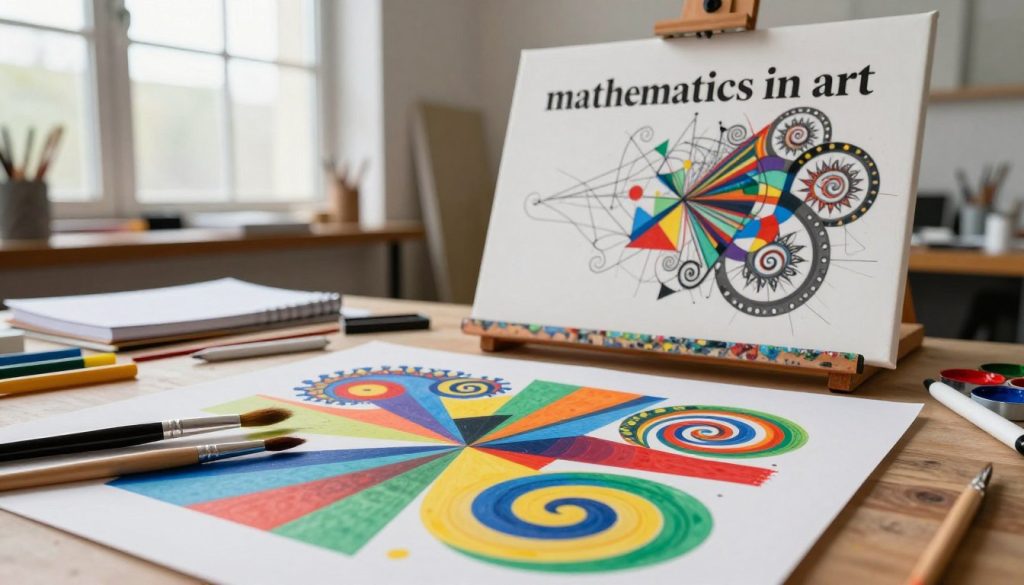
Have you ever thought about the link between mathematics and art? They might seem like different worlds, but they’re closely connected. Olivier Bodini, a computer science professor, says math can spark creativity.
We usually see mathematics as just numbers and formulas. But it’s so much more. It’s about patterns, structures, and the hidden order of things. Artists use these math concepts to create something new and exciting.
Key Takeaways
- Mathematics and art are more connected than you think.
- Mathematical principles can fuel creativity and innovation.
- Understanding patterns and structures can inspire artistic expression.
- The intersection of math and art can lead to new and exciting possibilities.
- Embracing math can help artists tap into their creative potential.
The Hidden Connection Between Mathematics and Creativity
Mathematics and creativity are more connected than you might think. They meet in the world of art and innovation. At first, math and art seem very different. But they both use similar thinking skills.
Breaking the Myth: Math as a Creative Discipline
Many think math is boring and lacks creativity. But math is actually full of innovation and problem-solving. Mathematicians see their work as an art form, valuing simplicity and elegance.
The Shared Cognitive Processes in Math and Art
Math and art both use pattern recognition and abstract thinking.
Pattern Recognition
Seeing patterns is key in both math and art. In math, it helps solve problems. In art, it creates beautiful compositions. For example, Islamic art uses geometric patterns to show math’s beauty in art.
Abstract Thinking
Abstract thinking is also shared. It lets mathematicians think about complex ideas and artists create new works. Fractals in art are a great example, using math to make stunning patterns.
Understanding the link between math and creativity opens up new ways to solve problems and create art. By combining these disciplines, we can discover new ideas and innovations.
The Historical Marriage of Math and Art
Mathematics has shaped the creative world, from Islamic architecture’s patterns to Renaissance art’s precise lines. This union has created some of the most stunning works of human creativity.
From Leonardo da Vinci to M.C. Escher
Artists like Leonardo da Vinci and M.C. Escher saw math’s power to improve their art. Da Vinci used the golden ratio, and Escher explored tessellations. These examples show how mathematical principles can make art visually stunning.
The Golden Ratio and Classical Beauty
The golden ratio, or divine proportion, has been key in art and architecture for ages. It’s found in ancient Greek temples and Renaissance works. It’s believed to bring harmony and balance.
Fractals in Nature and Art
Fractals have inspired artists with their repeating patterns. They reflect the beauty and complexity of nature. From tree branches to river flows, fractals help us understand and depict nature’s intricate structures.
| Artist | Mathematical Concept | Notable Work |
|---|---|---|
| Leonardo da Vinci | Golden Ratio | Mona Lisa |
| M.C. Escher | Tessellations | Day and Night |
| Salvador Dali | Fractals | The Swallow’s Tail |
Mathematical Principles That Enhance Creative Thinking
Mathematics can boost our creative thinking. It’s more than just a school subject. It helps us see the world in new ways. We can use math in art, music, and even writing.
How to Develop Pattern Recognition Skills
Pattern recognition is key in math and creativity. It lets us spot and make new patterns. These patterns can spark our artistic side.
Exercises for Visual Patterns
Here are some ways to get better at seeing visual patterns:
- Look at nature’s patterns, like leaf arrangements or tree branches.
- Make your own patterns with shapes and colors.
- Study artists who use math in their work, like M.C. Escher.
Finding Patterns in Music and Language
Patterns are everywhere, not just in art. They’re in music and language too.
“The rhythm of music is based on mathematical patterns, and understanding these patterns can enhance your musical creativity.”
See if you can spot patterns in your favorite songs or poems. Look at their structure and rhythm. This can help you understand their impact.
Using Abstraction as a Creative Tool
Abstraction is powerful in math and art. It simplifies complex ideas into abstract forms. This gives us new views and insights.
For instance, simplifying a complex system into a math model can reveal its core dynamics.
Applying Symmetry and Balance in Design
Symmetry and balance are key in design. They come from math.
| Principle | Mathematical Concept | Design Application |
|---|---|---|
| Symmetry | Reflection and rotation | Creating visually appealing compositions |
| Balance | Equilibrium of elements | Ensuring stability in design |
Using these math principles, designers can make things that look good and feel right.
From Algorithms to Art: How Mathematics Fuels Your Creativity
Mathematics is more than just numbers. It’s a powerful tool for creativity. Exploring the link between algorithms and art opens up a new world of artistic expression.
Understanding Algorithms as Creative Frameworks
Algorithms act like recipes for art. They offer a structured way to create complex designs. By grasping how algorithms work, artists can make unique and innovative pieces.
Perlin noise, created by Ken Perlin, is key in art and film. It makes textures that look like nature, from clouds to landscapes.
How to Create Generative Art Using Mathematical Rules
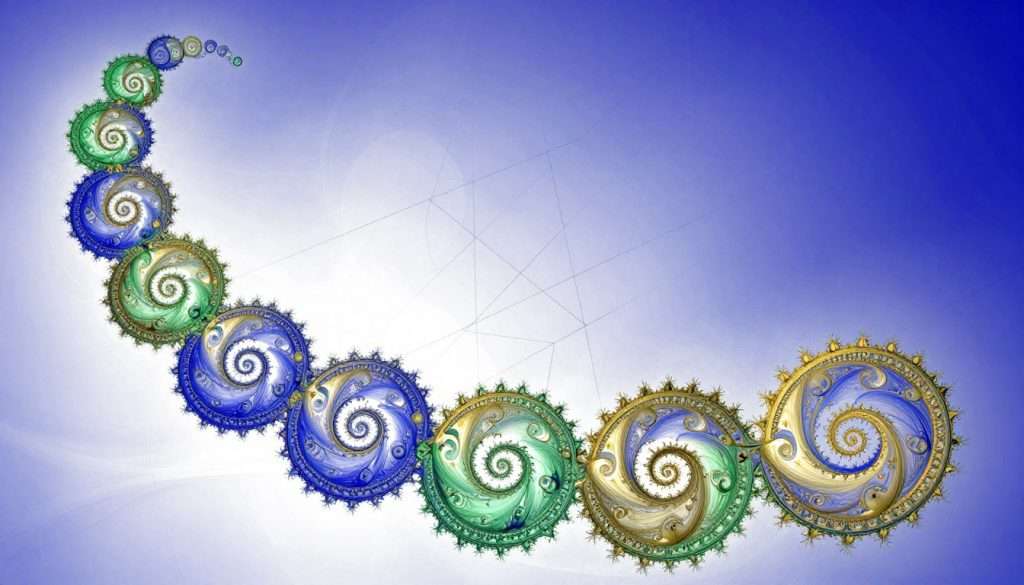
Generative art uses algorithms to evolve or change with each iteration. Artists start with simple rules like fractals or symmetry. These rules create complex, beautiful patterns.
L-Systems are a way to make fractals. They produce patterns that look like nature, like trees or flowers.
Learning from Artists Who Use Mathematical Algorithms
Many artists now use algorithms in their work. By looking at their art, we learn how math can improve creativity.
Case Study: Processing and Creative Coding
Processing is a language for visual arts. It lets artists make interactive, dynamic art with algorithms. Artists use Processing to create art that changes with the environment or over time.
| Artist | Technique | Notable Work |
|---|---|---|
| Georg Nees | Algorithmic Art | Generative Graphics |
| Manfred Mohr | Algorithmic Painting | P-1974 |
| Casey Reas | Processing | Process Compendium |
By using algorithms, artists can create new and beautiful art. This art is both innovative and pleasing to the eye.
Practical Applications of Math in Visual Arts
Math is key in the visual arts, from perspective geometry to digital art algorithms. It helps artists create balanced and stunning works. Whether you’re new or experienced, knowing math can take your art to the next level.
How to Use Perspective and Geometry in Drawing
Perspective drawing tricks the eye into seeing depth on a flat surface. Artists use geometry to make three-dimensional scenes look real. “Simplifying shapes into basic forms is crucial,” says Paul Klee. Start by breaking objects into simple shapes and use vanishing points for perspective.
Applying Color Theory Through Mathematical Relationships
Color theory also relies on math. The color wheel shows how light wavelengths relate. This knowledge helps artists create colors that evoke feelings and moods. For example, complementary colors, opposite on the wheel, make striking contrasts.
Getting Started with Digital Art and Computational Aesthetics
Digital art lets artists explore math in new ways. Computational aesthetics uses algorithms to create art. This can include simple patterns or complex installations.
Tools and Software Recommendations
To start with digital art, you need the right tools. Some top software includes:
- Adobe Photoshop and Illustrator for graphic design and digital painting
- Processing and OpenFrameworks for algorithmic art
- Blender for 3D modeling and animation
Try different software to see what fits your style.
Leonardo da Vinci believed, “No science is true without math.” Embracing math in art can unlock creativity and precision.
Mathematical Thinking in Music Composition
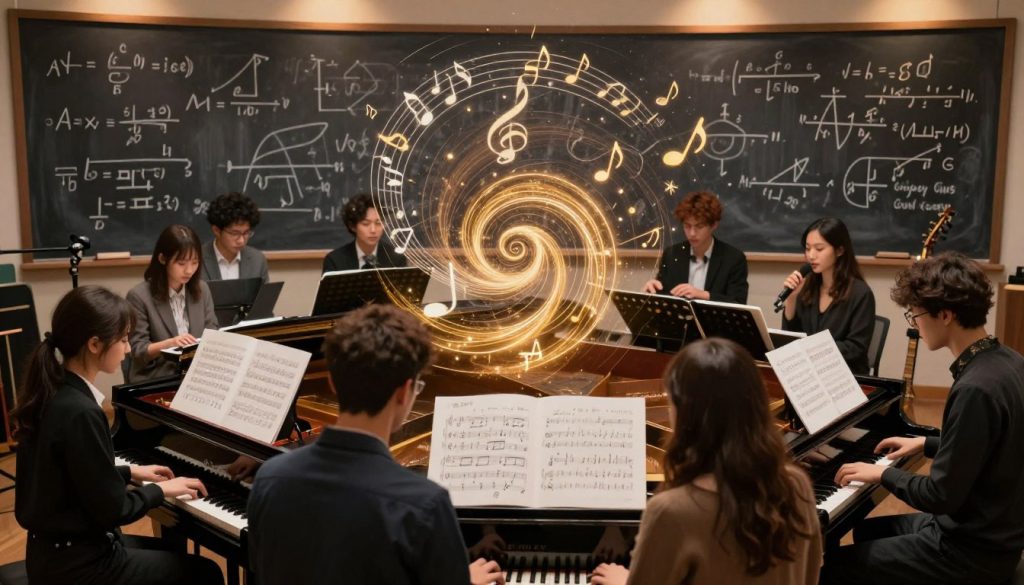
Math plays a big role in music composition. It helps create harmonious and structured pieces. We’ll see how math enhances creativity and precision in music.
How to Create Rhythms Using Mathematical Sequences
Mathematical sequences can make rhythms more complex and interesting. Using the Fibonacci sequence, composers can add depth to their music.
Applying Harmony Through Mathematical Ratios
Harmony in music relies on mathematical ratios. Ratios like 2:1 for octaves and 3:2 for fifths create pleasing sounds. Knowing these ratios helps composers make harmonious music.
Step-by-Step Guide to Algorithmic Composition
Algorithmic composition uses algorithms to create music. Here’s a simple guide:
- Choose a mathematical sequence or algorithm.
- Apply it to a musical parameter like rhythm or pitch.
- Experiment with different algorithms and parameters.
Beginner-Friendly Tools for Mathematical Music
Some easy tools for algorithmic composition include:
| Tool | Description |
|---|---|
| MuseScore | A music notation software that allows for plugin-based algorithmic composition. |
| Max/MSP | A visual programming language for music and multimedia. |
Architecture and Design: Where Math Meets Functional Art
In architecture, math is the hidden power that makes buildings into works of art. We see it in the grand symmetry of cathedrals and the precise geometry of skyscrapers. It’s also in the intricate patterns of historical monuments. Math in architecture makes buildings look good and stay strong.
Implementing Geometric Principles in Your Designs
Geometric principles are key to creating designs that are balanced and harmonious. Architects use symmetry, tessellations, and fractals to make buildings that look amazing and are mathematically correct. For example, tessellations help create complex patterns that are both repetitive and varied, adding depth and interest.
How to Get Started with Parametric Design
Parametric design is a powerful tool in modern architecture. It lets architects create complex shapes and structures using algorithms. To start, you need to learn software for parametric modeling. This means understanding how to set parameters and constraints to explore different design options. It’s a mix of creative thinking in mathematics and practical design skills.
Learning from Mathematical Structures in Famous Architecture
Famous buildings often show how math and creativity come together. The use of the Fibonacci sequence in design is a great example. It’s used to make architectural elements’ proportions harmonious and balanced.
The Fibonacci Sequence in Building Design
The Fibonacci sequence is seen in many natural patterns and is used in architecture. It helps architects create buildings that feel natural and look good. For instance, using Fibonacci numbers for a building’s facade or column spacing can make it balanced and pleasing.
Writing and Literature: Mathematical Structures in Storytelling
Math and literature might seem far apart, but they share a common base. This base is the structure that makes up stories. By using math, writers can make their stories more engaging and find new ways to express themselves.
Let’s explore some techniques that show how math helps in literature.
How to Structure Narrative Arcs Using Mathematical Curves
Narrative arcs can be shaped with mathematical curves for a more gripping story. For example, the exponential curve can increase tension. Meanwhile, the sigmoid curve helps in showing character growth in a more detailed way.
Creating Patterns and Symmetry in Poetry
Poetry often uses patterns and symmetry to share feelings and ideas. Poets can add layers to their work by applying math concepts like fractals and symmetry.
Using Combinatorial Techniques to Generate Creative Ideas
Combinatorial techniques are great for coming up with new ideas. By mixing different elements in new ways, writers can craft unique stories. Olivier Bodini’s work shows how knowing historical context and rules in art is key.
By using math, writers can explore new ways to be creative. Whether it’s shaping story arcs, making patterns in poetry, or coming up with ideas through combinatorial methods, math is a valuable tool in the creative process.
Implementing Mathematical Thinking in Your Creative Process
Mathematical thinking is more than solving problems. It’s a way to boost your creativity. By using math in your creative work, you can find new ways to express yourself.
Step 1: Identify Patterns in Your Creative Field
Look for patterns in your creative field. Whether you’re into art, music, or writing, patterns are key. Find recurring themes or shapes that math can help you understand better.
Exercise: Pattern Mapping for Your Projects
Make a visual map of the patterns you’ve found. Use it to see how math can change or improve these patterns.
Step 2: Experiment with Mathematical Constraints
Using math to limit your work can spark creativity. It forces you to think differently and find new solutions.
Step 3: Use Mathematical Tools for Inspiration
There are many math tools and software that can inspire you. From art algorithms to geometry software, they can introduce you to new ideas.
Step 4: Collaborate Across Disciplines
Working with artists, mathematicians, and tech experts can lead to amazing results. Look for chances to team up with people from other fields to bring new ideas to your work.
| Step | Action | Creative Outcome |
|---|---|---|
| 1 | Identify Patterns | Enhanced thematic coherence |
| 2 | Experiment with Constraints | Innovative problem-solving |
| 3 | Use Mathematical Tools | New forms and patterns |
| 4 | Collaborate Across Disciplines | Fresh perspectives and hybrid creativity |
Overcoming Creative Blocks with Mathematical Approaches
Using math can help us get past creative blocks. It’s easy to feel stuck. But math can open up new ways to think creatively.
How to Apply Systematic Problem-Solving to Creative Challenges
Systematic problem-solving breaks down big problems into smaller parts. This lets us look at each part and find new solutions. It’s great for creative fields where big challenges are common.
Olivier Bodini shows how rules can spark creativity. By setting limits, artists can explore new ideas safely.
Using Randomness and Probability as Creative Tools
Randomness and probability can spark new ideas. They let us find unexpected solutions.
The Dice Method for Breaking Creative Blocks
The “Dice Method” uses dice to make random choices. For example, it can pick colors or textures for art.
Mathematical Games to Spark Creativity
Playing math games can also spark creativity. Sudoku, KenKen, and geometric puzzles improve problem-solving and thinking outside the box.
| Mathematical Game | Creative Benefit |
|---|---|
| Sudoku | Improves logical reasoning and pattern recognition |
| KenKen | Enhances problem-solving skills and mathematical fluency |
| Geometric Puzzles | Develops spatial reasoning and visual creativity |
Using math in our creative work can help us break through blocks. It can lead to new ideas. Math and art together offer a rich field for exploration.
Conclusion: Embracing the Mathematical Mind for Enhanced Creativity
Mathematics is more than solving problems; it sparks creativity. By using math in your creative work, you can find new ways to express yourself. This is true for artists, musicians, and writers, as math helps uncover hidden patterns and connections.
Math algorithms can lead to amazing creative outcomes. For example, generative art made with math rules can be truly stunning. Also, thinking creatively with math can solve complex issues in new ways. By embracing math, your creative work can grow and explore new territories.
In conclusion, math adds depth to our experience of beauty and innovation. Mixing math with your creative projects opens up a world of new ideas. So, try using math algorithms and principles in your work. See the exciting things you can create!