

A study plan works best when it fits your real day, gives you a clear first task, and leaves room for rest. Pair realistic tasks with focused practice and recovery, then adjust when life changes. That balance helps students and lifelong learners build lasting learning without making every day feel like a test.
You sit down with a full to-do list, open your books, and suddenly every task looks urgent. We can make that moment easier by choosing a small first step and giving it a place in your day. A plan should support your goals, not demand superhero-level motivation.
Key Takeaways
- Build a routine around commitments you already have.
- Choose one clear task to start each session.
- Use focused practice to bring learning back to mind.
- Leave room to rest and adjust your plan.
- Start with a structure you can repeat on an ordinary day, not a fantasy day with nothing else on the calendar.
How Do You Build a Study Routine That Fits Your Life?
A useful study routine is a repeatable cue and a clear first task, sized to fit the day you actually have. Spaced retrieval practice means testing yourself on learned material across separate study sessions, rather than cramming all the tests into one session.
Start with one manageable 20-30-minute session, then build from what you can keep doing. A study routine for students, including college students, can fit around classes, work, and other commitments. It is a pattern for when to begin and what to work on, not a rigid timetable.
Before you begin, make the space less tempting for distractions:
- Silence notifications.
- Close unrelated tabs.
- Put the first task’s materials within reach.
- Jot down distracting thoughts to handle later.
Keep the start ritual shorter than the study session. A perfect setup that takes longer than the work is a trap.
There is no need to arrange a spotless desk or find a special playlist first. Get the right book or file ready, and let the rest wait. That small setup makes the first task easier to see when you sit down.
Choose one cue you already meet most days, such as sitting down after dinner, and use it to begin.
How Can You Fit Study Blocks Around Classes and Work?
Put classes, work, and family or activity commitments on the calendar before you try to squeeze study into the gaps. Fixed plans come first, so your schedule reflects the day you have instead of the day you wish you had.
Add study blocks only after marking meals and non-negotiable responsibilities. A calendar week has seven days, but you do not need to fill every open space. The sample below is an illustration to adapt, not a required daily load.

Map fixed commitments before study blocks
Mark your classes, work shifts, activities, meals, and other duties first. Then look for openings that can hold a focused block without crowding out something important. A simple week view can reveal a better opening than a long daily to-do list.
For a Class 7 or Class 8 study routine, account for classes and homework before adding study blocks. A younger student can use the same flexible idea without copying an adult timetable.
Match study blocks to your energy
Place harder work in the part of the day when you feel naturally alert. Use a lower-energy window for lighter review or organizing materials. If your focus changes between morning and afternoon, shift the harder task rather than forcing it into a fixed slot.
| Schedule piece | Morning-leaning example | Evening-leaning example |
|---|---|---|
| First focused block | 8-9 a.m. | 6-7 p.m. |
| Second focused block | 1-2 p.m. | 8-9 p.m. |
| Review slot | 4-4:30 p.m. | 9-9:30 p.m. |
| Open buffer | One flexible hour | One flexible hour |
These times are examples, not a scorecard. A morning plan may suit someone with a clear early window, while an evening plan may fit around classes or work.
Keep one flexible block in the week so a late assignment or a busy day does not topple the whole plan.
Which Study Methods Help You Remember More?
If you want information to stick, spend part of your study session trying to bring it back from memory before you look at your notes. Active recall means bringing information to mind without looking at the answer.
Testing yourself and spacing those tests across sessions can improve retention. Spaced retrieval practice means testing learned material in separate study sessions instead of doing all the tests at once.
Test yourself before checking notes
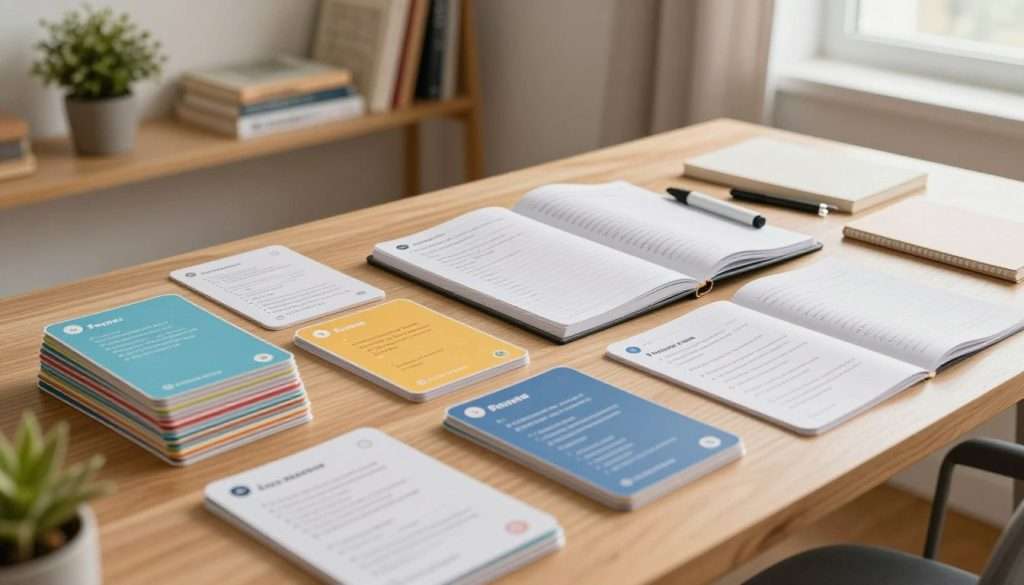
Use flashcards, practice questions, or a blank page. Try to answer first, then check your notes and mark the gaps. The effort of recalling an idea shows what you can bring back without help, not just what looks familiar while reading.
Space reviews across days
Return to material in later sessions instead of testing it all in one sitting. A 2021 meta-analysis of 29 studies found better final retention with spaced rather than massed retrieval, with an effect size of g = 0.74. Expanding gaps did not significantly beat uniform gaps, with g = 0.034.
The 2021 meta-analysis results make uniform spacing a sensible starting point, not a promise for every subject. Try a steady gap between reviews and adjust if the course or your results call for it.
Mix practice and explain what you learn
Switch between related topics during practice, especially when you need to tell similar ideas apart. Then explain a concept in plain language, as if a curious friend asked how it works. If the explanation gets tangled, find the missing link and try again.
| Method | What you do | A useful fit |
|---|---|---|
| Flashcards | Recall an answer before turning the card | Terms and facts |
| Practice questions | Solve before checking the worked answer | Problem-solving |
| Teach-back | Explain the idea without notes | Linked or complex concepts |
Findings across STEM courses were not uniform. A 2024 study of nine introductory STEM courses found a significant spacing effect in its meta-analyses when all courses were included, but not when calculus was excluded.
In that study, spaced retrieval improved end-of-course tests significantly in two of nine courses, with small positive effects in two others. The course results are a reason to check what helps in your own class, not assume one schedule wins everywhere.
End a session by writing down one question you still cannot answer, then use it to start your next review.
How Long Should You Study Before Taking a Break?
Try a 25-minute focus block followed by a 5-minute pause, then adjust if that rhythm feels awkward. That simple pattern gives you a clear point to stop and reset without turning the clock into your boss.
Short breaks can help with energy and fatigue, but they do not guarantee better performance. A break should feel like a pause, not another task dressed up in a tiny hat.
Choose a repeatable study interval
The Pomodoro example pairs 25 minutes of study with 5 minutes off. It is a starting point, not a rule for every learner or subject. In a 2023 study, 24-minute blocks followed by 6-minute breaks and 12-minute blocks followed by 3-minute breaks had similar task completion and mental effort to self-chosen breaks.
Self-chosen breaks in that study were linked with more fatigue and distraction, and less focus and motivation. That does not make one timed rhythm the winner; it shows why a planned pause may help some people keep track.
Make the pause genuinely restful
Micro-breaks are interruptions lasting no longer than 10 minutes. A 2022 meta-analysis of 22 study samples, with 2,335 people, found small gains in vigor and lower fatigue after micro-breaks. It found no significant effect on overall performance.
Step away from the screen, stretch, or get water. Those choices can make the pause feel refreshing, but they are not a promise of a higher test score. Keep the timer gentle, and use the pause to let your attention loosen.
If breaks keep stretching because you are unsure what comes next, write the next task down before you step away.
How Do Sleep and Workload Protect Your Focus?
Adding more study hours is not a good trade if it regularly pushes sleep and recovery off the calendar. Sleep needs change with age, and protecting enough of it can support your focus through the day.
Children ages 6-12 need 9-12 hours per 24 hours, teens ages 13-18 need 8-10, and adults 18 and older need at least 7. These ranges come from the American Academy of Sleep Medicine.
Protect sleep before adding study hours
Recommended sleep ranges by age can help you see whether late-night work is taking too much room. Use the routine check below as a prompt to protect rest, not as a test you must pass.
| Age group | Recommended sleep per 24 hours | Routine check |
|---|---|---|
| Ages 6-12 | 9-12 hours | Protect a bedtime that allows the full range |
| Ages 13-18 | 8-10 hours | Avoid homework regularly crowding out sleep |
| Adults 18 and older | 7 hours or more | Leave time to wind down |
The National PTA and National Education Association support a homework guideline of 10 minutes per grade level each night. It is a guideline, not a hard ceiling or a promise that every assignment will fit.
A 2015 study found middle school students’ math and science test scores began to decline when homework went beyond 90-100 minutes daily. A 2013 study found high school students assigned more than two hours of homework each night could face higher stress and sleep loss.
Notice when the workload is wearing you down
Studying all day without getting tired is not a realistic target. Sustained study takes breaks, food, movement, and sleep; working nonstop is not a badge we need to earn.
Academic burnout is a negative emotional, physical, and mental reaction to prolonged study. It can bring exhaustion, frustration, low motivation, and reduced ability at school.
Possible signs include ongoing exhaustion, insomnia, low motivation, irritability, trouble focusing, missed deadlines, headaches, anxiety, or losing interest in school and leisure. These signs do not diagnose you, but they can flag a need for support.
If exhaustion, anxiety, or loss of interest persists, talk with a trusted adult, school counselor, or health professional.
How Can You Adjust a Routine Without Starting Over?
Missing one session is a scheduling problem to solve, not proof that you have failed. Keep the parts that still fit, then change the piece that keeps slipping.
A Class 9 plan should fit its classes, assignments, and available time, not a fixed number of study hours. A useful study routine template has five parts: cue, one specific task, study block, next action, and a realistic stopping point.
For example: after school, finish two history questions, work for one block, mark the next question, and stop before dinner. Another day, your cue might be opening a laptop after work, with a reading task and a clear stopping time.
A template that only works on a perfect day is not a template you can trust.
A weekly master list helps you choose a few priorities without pretending every task fits today. Try this reset:
- Make a master list of obligations.
- Choose 3-4 tasks for the day.
- Put tomorrow’s first task on the list the night before.
- Move unfinished work to a realistic open slot instead of doubling tomorrow’s load.
The 2/3,5/7 study rule has no widely established, evidence-based meaning. Use a weekly plan and adjust it to your actual responsibilities instead.
At the end of the week, keep the parts that worked and change just one part that repeatedly got in your way.
Conclusion
The best plan is not the fullest one; it is the one that helps you make steady progress and still leaves room for being human. A repeatable cue and one clear task can keep learning moving, even when life gets busy. Small changes can build motivation without asking you to become a different person.
Want to go deeper? If this article resonated with you, my free book How to Become the Smartest Student in the Classroom gives you a full system — memory techniques, study routines, and strategies that actually stick. No cost, no catch. Grab your free copy here → https://www.studyingmachine.com/free-books/.
Pick one cue and one task for tomorrow, then use the free book to build the next layer of your system.