

You can learn vocabulary faster by recalling it, reviewing it over time, and using it in context instead of staring at a list. Students often have little time, and a long list can make the mind feel full before learning begins. A small, steady routine works better than a marathon session.
Spaced repetition means reviewing material in separate short sessions over time, not in one or a few long cram sessions. We’ll also use active recall, memory tricks, and real-world examples to make new terms easier to keep. Fast learning still needs repeat practice. A word that feels familiar today may slip away tomorrow.
Key Takeaways
- Test your memory instead of only rereading.
- Review new terms across separate days.
- Group long lists into smaller sets.
- Use each word in a clear sentence.
- Choose a tool that makes recall easy.
Pick a small set of useful terms to practice today, rather than trying to swallow a whole dictionary at once.
What Does It Mean to Memorize?
If you can explain what “reluctant” means without peeking, you can retrieve its meaning instead of just recognizing its shape. Memorize is a verb that means committing information to memory so you can recall or repeat it later.
Recognizing a word is not the same as recalling its definition without help. A dictionary may make “reluctant” look familiar, but close the page and see whether you can explain it. The definition of memorize centers on keeping information ready for later recall.
Knowing a word means more than recognizing its shape. You should be able to recall or repeat its meaning.
U.S. English spells the word memorize; British English commonly spells it memorise. Both forms have the same meaning. A thesaurus may list “commit to memory,” “learn by heart,” “retain,” and “remember” as close synonyms.
“Commit to memory” points to a deliberate effort, while “retain” stresses keeping something in mind. “Remember” can be less deliberate, since a detail may come back without planned study. If you wonder what is another word for memorization, “learning by heart” or “memorization” can fit, depending on the sentence.
People use “learn by heart” when they know something well enough to repeat it without notes. The phrase often suits a poem, speech, or set of lines. A thesaurus gives options, but the best choice depends on whether you mean effort, recall, or keeping knowledge.
Choose “learn by heart” when you mean deep recall, and “remember” when you mean bringing something back to mind.
How Can You Test Yourself Instead of Rereading?
Cover the definition of one unfamiliar word and see whether you can bring it back without a clue. Active recall means retrieving information from memory without looking at the answer.
Rereading can make a word feel familiar without proving you can recall its meaning. A closed-book quiz gives your mind a chance to find the answer on its own. Try “scarce”: can you say what it means before checking?
Try a quick closed-book quiz
Use this four-step cycle with one word or a short list. It gives you a clean check of what you know, without turning practice into a copying contest.
- Read the word with its definition.
- Cover the definition.
- Write or say the meaning from memory.
- Check the answer and correct it.
For “scarce,” a good answer might be “hard to find” or “not enough.” Then make a short quiz from unfamiliar terms on your list. A quiz can hold just a few words, so you can focus on each answer.
Retrieve the answer in more than one way
Writing a meaning and saying it aloud are two different ways to test recall. Writing gives you a record to check; speaking lets you hear whether your answer makes sense.
A wrong answer is useful feedback, not a reason to copy the definition again and again. Check the meaning, notice what you missed, then make another attempt. That small correction helps you spot gaps before they become habits.
If you cannot recall a word, check the answer once and test yourself again before moving on.
How Does Spaced Repetition Help Words Stick?
Reviewing a new term in several short sessions over a few days is more useful than cramming it into one long sitting. Spaced repetition spreads study over time, giving you more than one chance to bring each word back.
Use a review schedule you can follow, rather than one packed session you dread. An expanding schedule starts at about 12 hours, then doubles the gaps, with reviews around day 1 or 2, day 3, day 5, and day 9.
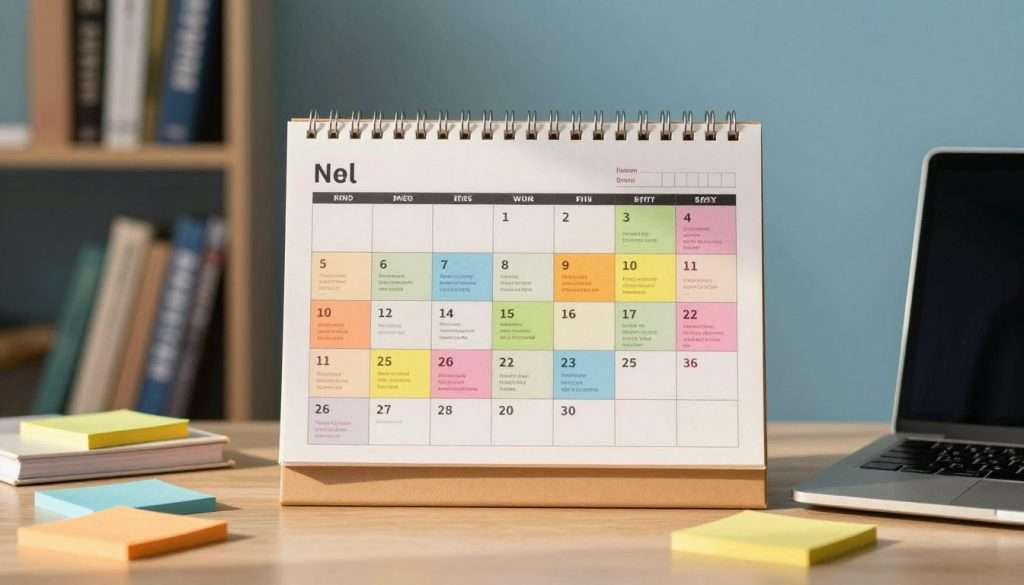
The table compares an expanding schedule with equal spacing. Both give you several chances to check what you remember.
| Review | Expanding intervals | Equal spacing |
|---|---|---|
| Review 1 | Day 1 or 2 | Day 1 |
| Review 2 | Day 3 | Day 3 |
| Review 3 | Day 5 | Day 5 |
| Review 4 | Day 9 | Day 7 |
An equal-spacing example adds a fifth review on day 9. You can also use the five-compartment flashcard method called the Leitner system.
In the Leitner system, a correct answer moves a card up one compartment. A missed card returns to the first compartment, where you see it sooner.
The five compartments have separate schedules; one example reviews cards in compartment three once a week. This makes a paper box useful, even without a phone or website.
A 2024 study followed 74 Japanese university EFL learners across two academic semesters. Its interleaved spaced-repetition group gained more total vocabulary-test points than the control group, with p = .002 and r = .360.
The treatment group’s gains were 16.71% for meaning, 15.39% for form, and 13.16% for use. Its pretest scores were 24.34%, 20.53%, and 13.16%, in the same order.
Those results describe one study group, not a guaranteed outcome for every learner. The reported test results show why spaced practice merits a try.
Put the next review on your calendar now, even if your first schedule is as simple as tomorrow and three days later.
What Memory Tricks Make Difficult Words Easier?
Imagine a 12-word list as one crowded room, then split it into three smaller groups of four. Chunking breaks a large set into smaller groups, so your mind handles a few words at a time.
Three groups of four make a 12-word list easier to approach than one block of twelve. You might group terms by topic, sound, or the class where you need them. The groups do not have to be perfect; they just need to help you sort the words.
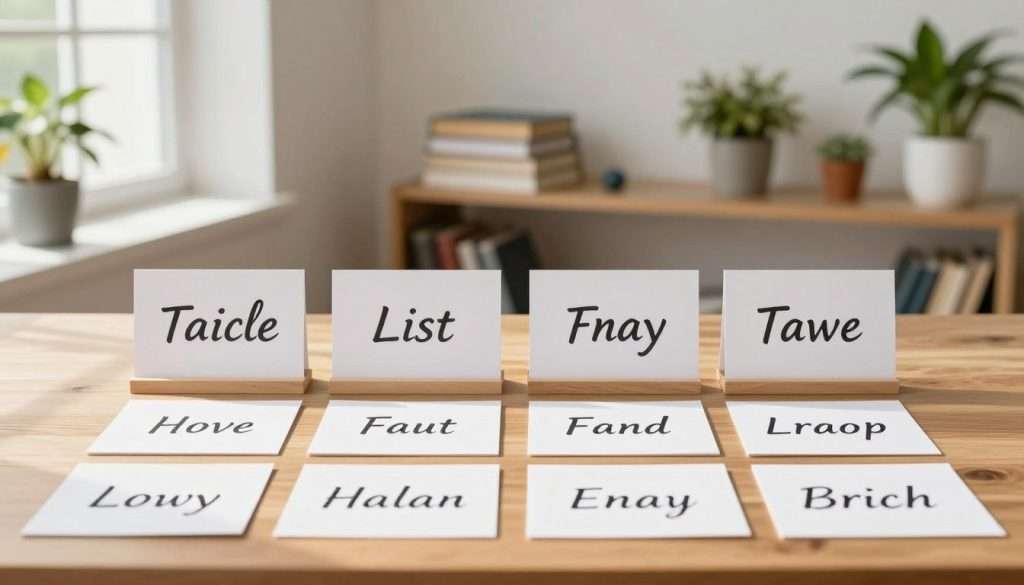
Break a long list into small groups
Give each group a simple label, such as “weather,” “feelings,” or “science.” A label creates a place for every word, like putting books on the right shelf instead of one tall pile.
For example, a biology list might hold four terms about cells, four about plants, and four about habitats. Study one set, then mix the terms later to check that you know each word by itself.
Link new words to vivid images and familiar ideas
A mnemonic is a memory aid that links an unfamiliar term to a familiar image, sound, or idea. If “frigid” means very cold, picture a friend shivering beside a frozen pond.
You can memorize a novel by dividing it into scenes or chapters, then linking a new name to a character or event. To memorize manhwa, break an episode into panels and connect a term with a striking image or action.
For a character name, picture the character doing something that matches the sound or meaning of the name. A silly image may stick, but it should still point back to the right idea.
A mnemonic is a memory aid, not a replacement for checking a word’s actual meaning or history. A name’s sound may suggest a clue, but it cannot prove where the name came from.
Keep each memory link accurate, so a clever image helps you recall the meaning instead of replacing it.
How Do Examples and Speaking Make Vocabulary Stick?
A word you can use in a sentence is more useful than one you can only point out in a dictionary. A clear example shows meaning, grammar, and usage at the same time.
Put a new word into a sentence that sounds like something someone might really say. “She turned on the light” uses “light” as a noun. “Light the candle” uses the same word as a verb.
Put each word into a useful sentence
A sentence shows what a word does around other words. It can reveal whether the term names something, describes something, or tells someone to act.
For “scarce,” you could write, “Fresh water became scarce during the dry summer.” That example gives the word a setting and makes its meaning clear without a long dictionary entry.
Check each sentence with three quick questions:
- Does the sentence make the meaning clear?
- Is the part of speech right?
- Does the word sound natural in that setting?
If one answer is no, change the sentence rather than forcing the word into place. A thesaurus can suggest another term, but check that the replacement fits the same meaning and grammar.
Say it, teach it or rehearse it aloud
Saying a word aloud lets you hear your own explanation. Teaching it to someone can show a gap: if you cannot explain the idea simply, check what part still feels fuzzy.
To memorize a speech, divide it into thought units, such as one claim or example at a time. Recall each unit aloud, then practice connecting the units without looking at the page.
Keep the first rehearsal short. Say one thought unit, pause, and state the next one from memory. Then join them into a smooth passage, like stepping from one stone to another.
Read your sentence aloud once, then change one detail to check whether you still understand the word.
Which Vocabulary Tools Fit Your Study Routine?
A paper card, browser tool or phone app can all work if they make you retrieve the answer instead of just reread it. The best fit is the tool that matches what you want to practice.
Choose a tool for its practice features, not for a promise of effortless learning. A memorize website can be a browser-based flashcard or quiz tool that hides answers and lets you review them again.
An app helps when its features suit your routine. These tools support different kinds of practice:
| Tool | Best fit | Practice options | Useful limits or features |
|---|---|---|---|
| Remember Vocabulary Flashcards App | Daily vocabulary | 10 new words daily; 5 minutes daily | 40+ languages; Remember Pro starts at $9.99 USD monthly in the United States; prices may vary elsewhere |
| MemoWord | Cards, audio, and quizzes | Flashcards, audio flashcards, hands-free, quiz, audio quiz, spelling test | Free mode: 100 cards and 2 modes; Excel import, offline study, device syncing; nearly 200 other languages in non-audio modes |
| Memorize By Heart | Speech, text, and recitation | Text-to-speech, hidden-text prompts, recall exercises, quizzes, recitation | Multiple languages; premium chunking, image scans, PDF uploads, and group creation; free group joining |
Remember lists a routine of 10 new words daily and five minutes of study each day, with a claim of up to 3,650 words in a year. Treat that figure as a product claim, not a promised result. Remember Pro’s starting price is $9.99 USD per month.
Memorize By Heart supports speeches, poems, verses, scripts, lyrics, language text, and exam material. Its free group feature lets you join, while creating a group is premium.
A tool earns its place when it makes you recall an answer and return to words you missed.
Choose the simplest tool that lets you test yourself and return to missed words.
Conclusion
A small routine you can repeat beats a perfect plan you abandon after one day. Useful vocabulary grows when you recall words, review them later, and use them in context.
Choose a short list of three to five terms today. Test yourself once, then schedule its first review for tomorrow. A calendar reminder can keep the next session from disappearing under homework, errands, or a busy week.
You do not need a special setup to begin. A scrap of paper works if it hides the answer until you try to recall it. Keep the first session short enough that you can repeat it tomorrow.
Want to go deeper? If this article resonated with you, my free book How to Become the Smartest Student in the Classroom gives you a full system: memory techniques, study routines, and strategies that actually stick. No cost, no catch. Grab your free copy here: https://www.studyingmachine.com/free-books/.
Choose a few useful terms, test yourself today, and grab your free copy of How to Become the Smartest Student in the Classroom at https://www.studyingmachine.com/free-books/.