
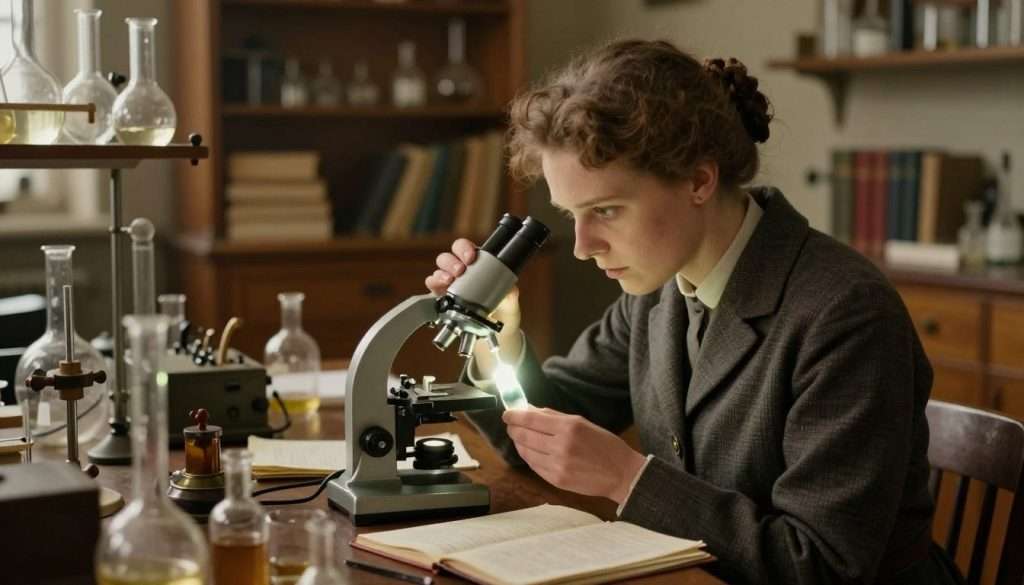
Ever wondered how the smartest minds in history learned so much? We’re looking into the life of a famous scientist to find out her secrets. It seems marie curie studied like this, showing us how to boost our own learning.
By watching her daily habits, we can learn practical ways to improve our study sessions. You don’t need a lab to be great. Just make your desk a place of focus. Let’s see how to make your routine fun and productive.
Key Takeaways
- Focus on deep work to master difficult topics.
- Turn your workspace into a sanctuary for discovery.
- Consistency beats intensity every single time.
- Curiosity is the ultimate fuel for academic growth.
- Small adjustments to your routine create massive progress.
The Early Life and Intellectual Hunger of Maria Sklodowska
Genius isn’t born; it’s forged in adversity. Maria Sklodowska’s early life shows this. She was a young woman with a relentless drive to learn. Her journey, as detailed in a marie curie biography, was tough, but her curiosity never wavered.
Overcoming Barriers in Occupied Poland
Maria was born in Warsaw in 1867. Her country was under foreign rule. Women’s education was limited, making school hard to get into.
She had to attend secretive, underground classes to keep learning. This didn’t stop her; it made her hungrier for knowledge.
The Move to Paris and the Sorbonne
At 24, Maria took a huge risk. She left Poland for Paris, seeking freedom to learn. This move to the Sorbonne tested her resilience and courage.
In Paris, she found the chance to study science freely. A marie curie biography shows this was a turning point. She chose a new world over her past, embracing limitless potential.
Marie Curie Studied Like This — And Won Two Nobel Prizes
Marie Curie didn’t just study for grades. She aimed to uncover the universe’s secrets. Her journey to earning marie curie nobel prizes was intense. By adopting her approach, you can make studying meaningful and life-changing.
The Philosophy of Deep Work and Immersion
Marie Curie’s learning was deep and focused. She practiced deep work, focusing fully on challenging tasks. Her Sorbonne thesis in 1903 was the result of years of deep immersion in her lab.
She knew true mastery comes from ignoring distractions. Here are key parts of her immersion strategy:
- Single-tasking: She focused on one problem at a time.
- Environment control: Her research was her only priority in her space.
- Mental stamina: She saw long hours as essential for discovery.
“Nothing in life is to be feared, it is only to be understood. Now is the time to understand more, so that we may fear less.”
Treating Scientific Inquiry as a Lifelong Pursuit
Curie’s success wasn’t just one breakthrough. It was a lifelong commitment to curiosity. She saw education as a never-ending journey, not a finish line. This mindset led to multiple marie curie nobel prizes in her career.
Seeing studies as a lifelong journey removes the pressure to just pass. You start asking better questions and seeking deeper connections. Embracing this mindset keeps you motivated, even when subjects get tough or results are slow.
When you view academic goals as ongoing, they become more achievable. By following those who won marie curie nobel prizes, you can make studying a powerful tool for growth.
The Power of Extreme Focus and Concentration
We often find it hard to put our phones down for just ten minutes. Yet, Marie Curie spent years in a cold, leaky shed chasing scientific breakthroughs. Her ability to focus was not just a trait; it was a masterclass in grit. By learning how she managed her environment, we can improve our focus in today’s digital world.
Eliminating Distractions in the Laboratory
Curie’s workspace was far from perfect. She worked in a shed that was poorly ventilated and leaked. But she thrived in these harsh conditions because she saw her lab as a place for deep thinking.
She knew that true discovery needs a quiet mind. By removing comforts and interruptions, she made a space where only her work mattered. You can do the same by creating a dedicated, distraction-free area for your toughest projects.
The Ability to Sustain Mental Effort Over Years
Processing tons of ore to find a tiny bit of radium was incredibly hard. But Curie saw it as a necessary step toward her goal. Her persistence helped her keep up high mental effort for years without losing focus.
This shows us that big achievements come from consistent effort, not quick energy. When tackling a long-term goal, remember that consistency is your greatest ally.
| Feature | Modern Study Habits | Curie’s Deep Work |
|---|---|---|
| Environment | Often cluttered and digital | Dedicated and minimalist |
| Focus Duration | Short, interrupted bursts | Extended, multi-year immersion |
| Distractions | Constant notifications | Physical barriers to entry |
| Primary Goal | Speed and efficiency | Accuracy and discovery |
Collaborative Learning and Partnership with Pierre Curie
Many think scientists work alone, but Marie and Pierre Curie’s story is different. Their partnership shows that collaboration can make learning exciting. Together, they achieved more than they could alone.
Synergy in Scientific Discovery
Marie and Pierre’s bond was more than love; it was intellectual. Pierre was so inspired by Marie’s work that he gave up his own research to join her. This incredible synergy helped them solve complex problems with more energy.
Having a partner who shares your passion creates momentum. They didn’t just work together; they pushed each other to think bigger. This teamwork is why Marie Curie’s achievements are legendary in science.
Sharing Knowledge and Intellectual Growth
Their home and lab were hubs of innovation because they valued open communication. They celebrated every discovery together, sharing ideas and improving their methods. This constant exchange of knowledge kept their minds sharp and motivation high.
Find a study partner who challenges you to grow. Here’s how they can help you achieve your goals:
- Accountability: You’re less likely to skip a study session with someone counting on you.
- Fresh Perspectives: A partner can explain complex concepts in a way that clicks with you.
- Shared Motivation: When you’re tired, your partner can give you the encouragement to keep going.
- Active Discussion: Teaching someone else helps you understand a concept better.
Surrounding yourself with someone who challenges you makes learning social and rewarding. Even the brightest minds need a little help sometimes!
Resilience in the Face of Failure and Skepticism
Ever felt like the world said “no” when you wanted to say “yes” to your dreams? It’s tough, but you’re not alone. Even the brightest minds faced rejection before reaching the top.
Marie Curie is a great example. She didn’t get through education easily; she fought for every chance. Her story shows that persistence is key, not just talent.
Navigating the Male-Dominated Scientific Community
In her time, the academic world was tough for women. She was even denied a spot at Kraków University due to sexism. It was easy to give up on her science dreams.
But she didn’t. She kept going with determination and focus. She didn’t let others’ views stop her. By staying committed, she showed that your worth comes from your work, not others’ opinions.
Turning Experimental Setbacks into Data Points
When you hit a wall in your studies, it feels like failure. But we want you to see it differently. View every setback as a valuable data point in your learning journey.
Marie Curie did the same. If an experiment failed, she didn’t see it as defeat. She saw it as a sign to try again. That’s the heart of a scientist.
Apply this mindset to build your resilience. When you face a tough concept or fail a test, don’t give up. Use it as a chance to learn and grow, coming back stronger.
Methodological Rigor and Systematic Documentation
Have you ever wondered how Marie Curie found tiny treasures in a huge pile of rock? It wasn’t luck or a sudden idea. She succeeded because she worked with extreme methodological rigor.
When you face a tough chemistry problem or a big exam, how you organize your info is key. A systematic approach can turn lots of data into clear, useful knowledge.

The Importance of Precise Record Keeping
Curie knew that a discovery’s value depends on its notes. She kept meticulous records of every step, observation, and measurement. This made her findings solid facts, not just guesses.
For your studies, keep a detailed log. Track your progress, find what you don’t get, and note what works for you. This helps you see patterns in your learning that you might miss.
Developing New Techniques for Isolating Elements
Curie’s work was massive. In 1902, she isolated one-tenth of a gram of radium chloride from a tonne of pitchblende. She had to create new chemical methods to find the elements she sought.
She didn’t just stick to the book; she innovated when old methods failed. When you hit a tough problem, don’t be afraid to try new ways of learning. Sometimes, the usual approach isn’t best for your brain.
| Study Habit | Messy Approach | Systematic Approach |
|---|---|---|
| Note Taking | Scattered papers | Organized digital or physical logs |
| Problem Solving | Guessing and checking | Step-by-step documentation |
| Review Process | Cramming at the end | Consistent, iterative analysis |
| Goal Setting | Vague intentions | Clear, measurable milestones |
The Nobel Prizes Won by Marie Curie and Her Legacy
Ever wondered what it takes to reach the top of science? Looking at the nobel prizes won by marie curie, it’s easy to think they were just luck or genius. But in truth, these awards came from years of relentless hard work and never giving up.
The 1903 Nobel Prize in Physics
In 1903, Marie Curie made history by becoming the first woman to win a Nobel Prize. She shared it with Pierre Curie and Henri Becquerel for their work on radiation. This wasn’t just a win; it was a validation of her systematic approach to understanding nature’s invisible forces.
The 1911 Nobel Prize in Chemistry
She didn’t stop there. By 1911, she won a second Nobel Prize, this time in Chemistry. She was recognized for discovering the elements radium and polonium. This second win showed her initial success wasn’t a one-time thing. It showed her extraordinary ability to find new elements through hard work and precise techniques.
Thinking about the nobel prizes won by marie curie shows us a path to our own dreams. You can use her legacy to push yourself to reach high and chase your goals with determination. Remember, even the greatest started where you are today—with curiosity and a drive to learn.
Applying Curie’s Habits to Modern Learning
We can learn from marie curie’s study habits in today’s digital world. It’s not just about working hard. It’s about finding purpose in every reading experience.
You don’t need a lab to think like a scientist. By changing your mindset, you can make any subject exciting and full of puzzles.
Cultivating Curiosity in a Digital Age
In today’s world, answers are just a click away. This can make the thrill of the hunt fade. We often stop at the first search result, missing the deeper “why” behind the facts.
To really understand a topic, go beyond the usual textbooks. Ask tough questions and seek out original sources whenever you can.
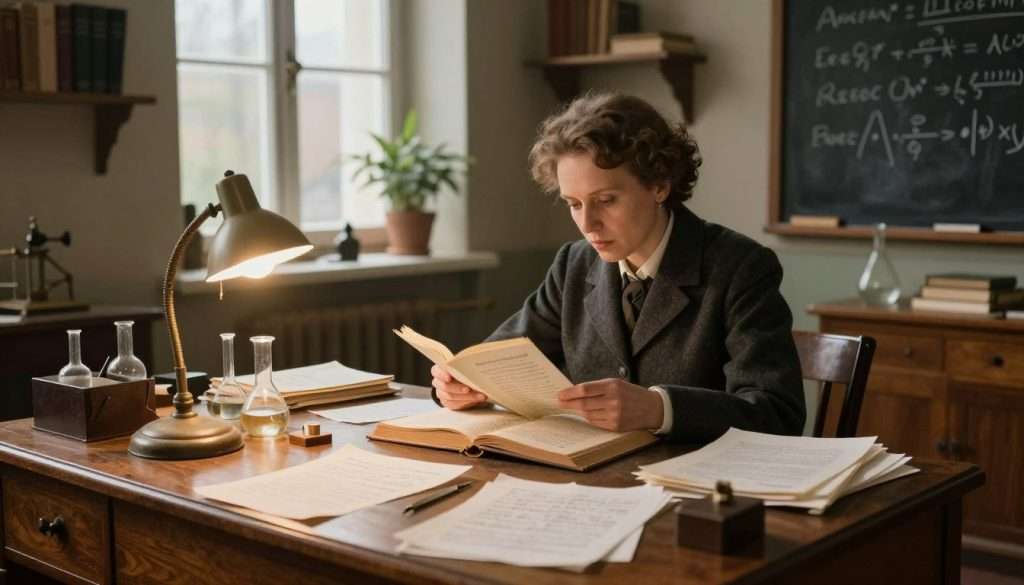
“Nothing in life is to be feared, it is only to be understood. Now is the time to understand more, so that we may fear less.”
Structuring Your Environment for Deep Study
Distractions are a major obstacle today. To follow marie curie’s study habits, you need a quiet space. A place where you can dive deep into complex ideas without interruptions.
Her work was intense; her notebooks from 1899 to 1902 are still radioactive. This shows the power of unwavering commitment to your goals, free from digital distractions.
Begin by clearing your desk and turning off your phone during study time. Protecting your focus allows for deep, lasting learning.
The Lasting Impact of Marie Curie’s Scientific Contributions
Have you ever thought about how one person’s curiosity can save millions of lives later? Marie Curie’s work changed how we see the atomic world. It also led to big medical advances.
Her work helps patients get life-saving treatments today. She turned complex physics into a tool for healing. This shows how studying deeply can greatly help people.
Pioneering Research in Radioactivity
Marie Curie didn’t just find elements; she helped us study them. She started the Curie Institute in Paris in 1920 and Warsaw in 1932. These places are still key for groundbreaking research today.
Her work made sure her discoveries would live on. Here are some ways her impact is still felt:
- Medical Innovation: Her research helped start modern cancer treatments.
- Atomic Theory: She changed what we thought about physics.
- Global Reach: The institutes she founded are still leaders in cancer research.
Inspiring Future Generations of Scientists
Talking about marie curie achievements is about her never-give-up spirit. She showed us to break through any obstacle with determination.
“Nothing in life is to be feared, it is only to be understood. Now is the time to understand more, so that we may fear less.”
Her story is a powerful reminder that you can change the world through learning. By studying with passion, you follow in her footsteps. Every student who asks “why” and keeps searching is carrying on her legacy.
Conclusion
Marie Curie shows us that curiosity and determination can make dreams come true. Her life teaches us to never give up on our goals. We hope her story inspires you to reach for your academic dreams.
You can improve your focus and work habits every day. These skills help you learn and solve problems better. Learning is a journey that you control, and it’s yours to explore.
Turn your study time into a place of growth and fun. You have the power to shape your future with hard work and a sharp mind. So, grab your notebook and start your own journey of discovery today!