

Ever wondered how some people remember everything? Humans have used visual tricks to remember since the beginning of time. You don’t need a super memory or be a genius to use these methods. Memory palaces for normal people are simple tools anyone can use today.
We often think these tricks are only for movie detectives or geniuses. But that’s not true! You can make studying fun and effective, not a chore.
Changing how you think, you’ll find your brain is ready for this. We’ll show you how to unlock your brain’s potential. Your next study session will be a breeze.
Key Takeaways
- Visual-spatial techniques are ancient, natural methods for boosting recall.
- You do not need special talents to master these mental strategies.
- Learning can become an enjoyable activity rather than a stressful task.
- These skills are accessible to everyone, regardless of your background.
- Small shifts in your perspective lead to massive improvements in retention.
The Science Behind Memory Palaces
Ever wonder why you can easily recall the layout of your childhood home but struggle to remember a simple grocery list? It turns out your brain is hardwired to prioritize spatial information over abstract data. By tapping into this natural ability, you can transform how you learn.
We are going to explore the biological magic that makes these memory techniques so effective. You do not need to be a genius to harness these tools; you just need to understand how your mind already works.
How the Brain Encodes Spatial Information
Our brains evolved to navigate the physical world, not to memorize endless lists of facts. When you walk through a room, your mind automatically records the location of furniture, doors, and windows. This is a survival mechanism that helped our ancestors find their way back to safety.
We can hijack this process to store information. By placing items in a mental space, you are basically tagging them with a location. This makes retrieval much faster than trying to pull a random fact out of thin air.
The Role of the Hippocampus in Navigation and Memory
Deep inside your brain lies the hippocampus, a small but mighty structure. It acts as your internal GPS, managing both spatial navigation and the formation of new memories. Because it handles both tasks, it is the perfect engine for your memory improvement techniques.
“The brain is not a vessel to be filled, but a fire to be kindled.”
When you visualize a path through a familiar building, you are activating the same neural pathways used for physical movement. This is why connecting data to a specific spot in your “palace” makes it stick so well. Your brain treats the information as a physical object you have encountered in the real world.
Why Visual Association Trumps Rote Memorization
Rote memorization is often a soul-crushing, boring task that leads to quick burnout. It forces your brain to work against its natural design. In contrast, visual association turns learning into a creative game.
When you create a vivid, absurd image, you engage more of your brain’s processing power. This makes the memory much harder to forget. The following table highlights why visual methods outperform traditional study habits:
| Feature | Rote Memorization | Visual Association |
|---|---|---|
| Engagement | Low (Boring) | High (Creative) |
| Retention | Short-term | Long-term |
| Effort | High mental strain | Natural and fun |
By shifting your focus toward these memory techniques, you stop fighting your biology and start working with it. You will find that these memory improvement techniques make even the most complex topics feel manageable and fun.
Memory Palaces for Normal People: No Genius Required
Forget what you’ve heard about needing a special brain for memory tricks. Many think high recall is rare, but memory palaces for normal people are common. This method, known as the method of loci, goes back to the Greek poet Simonides of Ceos around 556 BCE.
Debunking the Myth of the Photographic Memory
Stories of people with “photographic” memories are common. But, most are just using advanced mental filing systems. You don’t need a special brain to achieve this.
Instead, you can improve memory skills with practice. Think of your brain as a muscle that grows with exercise. Using spatial visualization, you can store lots of information easily.
Why Anyone Can Master the Method of Loci
This technique is simple. It doesn’t need a high IQ or years of school to start. You already use your brain to navigate spaces every day.
By applying this to abstract data, learning becomes fun and creative. You create a mental map your brain knows how to read. This is why anyone can master these tools.
The Practical Benefits of Memory Techniques for Everyday Life
Using memory techniques for everyday life changes how you handle information. You no longer need to memorize things the boring way. Instead, you organize your thoughts in a way that makes sense to you.
Here are a few ways these techniques can change your daily routine:
- Learning new languages: Easily associate foreign vocabulary with specific rooms in your home.
- Professional presentations: Remember your entire speech without needing a single note card.
- Daily errands: Keep track of grocery lists or to-do items by placing them along a familiar path.
- Complex concepts: Break down difficult ideas into smaller, manageable pieces that stick in your mind.
By taking control of your memory, you gain confidence in learning anything new. You’re not just memorizing; you’re building a foundation for lifelong learning.
Selecting Your First Memory Palace
Finding the right space is key to mastering simple memory techniques. You don’t need a big mansion or a maze to start. The best places are often the ones you visit every day without thinking.
Choosing Familiar Environments
When picking a location, familiarity is your best friend. Your brain already knows places you visit often. This saves you from having to memorize the layout.
Think about your favorite coffee shop or local park. These spots are great because you can easily picture your path through them. When the environment is clear in your mind, remembering becomes easier and more natural.
Why Your Home is the Best Starting Point
For beginners, your home is the best place to start with memory techniques. You know your home’s layout like you know your own hand. This comfort makes placing items in your mind easy.
Since you live there, recalling details like the rug’s color or a lamp’s position is simple. These details help anchor the information you want to remember. Your home is a solid base for your first memory palace.
Expanding to Workplaces and Commute Routes
Once you’re comfortable at home, try using simple memory techniques elsewhere. Your workplace is a good next step, with its structured layout and distinct areas. Even your commute can become a mental journey by picking out landmarks.
As you explore new places, your mental library grows. Whether it’s a grocery store or gym, these spaces help organize complex information. Here’s how different environments can help:
| Location Type | Ease of Use | Best For |
|---|---|---|
| Your Home | Very High | Daily tasks and lists |
| Workplace | Medium | Professional projects |
| Commute Route | Medium | Sequential information |
| Public Park | Low | Long-term storage |
Mapping Your Route and Anchor Points
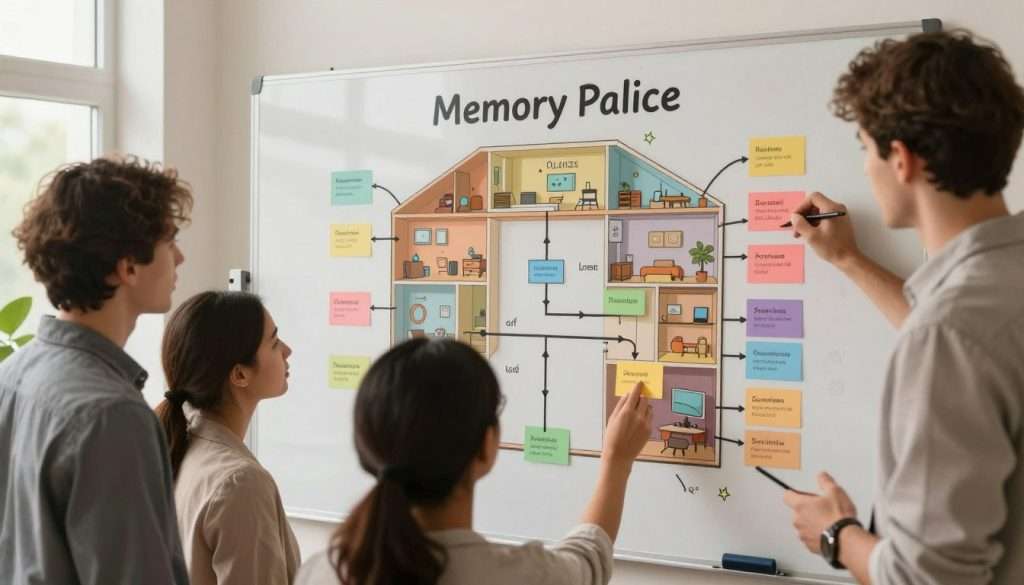
Creating a clear, reliable route is key for memory techniques for beginners. First, pick your space. Then, decide how you’ll mentally walk through it.
Imagine making a mental map. A set path helps your brain know where to look for info.
Defining a Logical Path
A logical path should follow a natural flow. Whether it’s your living room or a street, keep moving in the same direction.
Most find it easier to move left to right or from entrance to back. Consistency is your best friend to avoid getting lost.
Identifying High-Impact Anchor Points
Anchor points are where you “pin” your info. Think of them as mental hooks that keep memories in place.
Selecting Furniture and Fixed Objects
Large, stationary items are great anchors. A bookshelf, favorite armchair, or kitchen island works well because they are visually distinct and permanent.
If spots are hard to find, use your body as anchors. It’s a simple way to remember lists when you’re on the move.
Using Transitions Between Rooms
Doorways and hallways reset your brain. Use them to separate different info categories.
Think of each room as a new chapter. This helps organize complex topics without mixing them up. It’s a simple memory hack that boosts recall speed.
The Importance of Consistency in Your Path
Never change your route once set. If you walk clockwise in your bedroom, always do it the same way.
Your brain loves repetition and predictability. A steady path means less energy on navigation and more on remembering.
Encoding Information into Vivid Imagery
Want to make boring facts unforgettable? The key is to create vivid mental images. Use simple memory techniques to turn dry data into lasting memories.
The Power of Exaggeration and Absurdity
Your brain ignores the ordinary. So, make your mental images bizarre. For example, picture a giant, neon-blue cow dancing in your kitchen, spraying milk everywhere!
The sillier the image, the more it sticks in your memory. This is a basic rule of easy memory techniques that’s easy to learn.
Using Sensory Details to Make Memories Stick
To make images vivid, engage all your senses. Seeing an object isn’t enough; try to hear, smell, or feel it too. Research shows that blind people can remember just as well, proving memory works through internal images, not just sight.
Connecting Abstract Concepts to Concrete Objects
Abstract ideas are hard to remember because they lack a physical form. To overcome this, turn them into concrete objects. For instance, imagine a heavy, golden scale tipping over in your hallway to remember “justice.”
Techniques for Memorizing Lists
Memorizing long lists? Link items together in a story. Place each item at a specific spot in your memory palace, creating a flowing narrative. This sequential storytelling makes it easy to recall.
Techniques for Memorizing Names and Faces
Remembering names at events can be tough. But, simple memory techniques can help. Link a person’s name to a famous celebrity or an object that sounds similar. For example, if it’s “Baker,” picture them in a chef’s hat, holding bread.
By using these easy memory techniques, your memory will improve fast. Start small, be creative, and watch your memory grow.
Advanced Techniques for Complex Data
Once you get the hang of the basics, it’s time to take it up a notch. These memory improvement techniques help you handle big loads of information. This includes heavy course loads or professional certifications.
Linking Multiple Items at a Single Anchor
You might worry about running out of space in your favorite room. But, you can link several pieces of information to one anchor point. This is done using the peg method.
Just link a number to a specific image, then connect that image to your anchor. This makes a chain of data that keeps your mind organized and efficient.
“The secret to memory is not just storage, but the ability to retrieve information through structured association.”
Creating Narrative Arcs Within Your Palace
Instead of memorizing isolated facts, try weaving them into a story. When you turn your data into a narrative arc, your brain finds it much easier to follow the sequence.
Think of your memory palace as a movie set. Your items are the actors, and their interactions form the plot of your study session. These clever memory hacks turn boring lists into engaging experiences.
- Assign a protagonist to your data.
- Create a clear beginning, middle, and end.
- Use emotional triggers to make the story memorable.
Using Multiple Palaces for Different Categories
If you are juggling different subjects, do not try to cram everything into one house. It is much better to use separate palaces for distinct categories.
You might use your childhood home for history dates and your current office for complex formulas. By keeping these domains separate, you avoid confusion and sharpen your focus. These memory improvement techniques ensure that your mental library stays clean and accessible.
Mastering these memory hacks takes a bit of practice, but the payoff is immense. You will soon find that you can store vast amounts of information without feeling overwhelmed.
Maintaining and Refreshing Your Memory Palaces
You’ve built your palace, but how do you keep it tidy? Creating a mental map is a great start. But consistent upkeep turns it into a lasting skill. With the right memory techniques, your hard work will pay off for years.
The Science of Spaced Repetition
Our brains forget what we don’t use. To fight this, we use spaced repetition. This method reviews material at longer intervals.
Instead of cramming, review your palace soon after, then a few days later, and weeks later. This strengthens your brain’s pathways. It’s a top memory technique for keeping information long-term.
Reviewing Your Palaces to Prevent Decay
If you ignore your palace, its images will fade. A 2021 study showed memory palace training’s benefits over four months. Regular reviewers recalled more than those who didn’t.
Try a simple review schedule to keep your mind sharp. Imagine walking through your palace during commutes or waits. This keeps your memory fresh and ready.
Updating Your Palaces with New Information
Your life and studies change, so should your palaces. You don’t need a new palace for every new piece of information. Just refresh your existing ones with new data.
If a room gets too crowded, expand your path. Keep your palaces relevant to stay motivated. With these habits, storing and recalling information will become second nature.
Common Pitfalls and How to Avoid Them
We all want to sharpen our minds, but we can make mistakes. When you start to improve memory skills, it’s natural to feel excited. But moving too fast can lead to frustration.

Overcrowding Your Anchor Points
One big mistake is trying to cram too many items into one anchor point. If you put five different grocery items on one kitchen chair, your brain will struggle to remember them. Keep it simple by assigning only one or two pieces of information to each spot.
Think of your anchor points like shelves in a cabinet. If you stack too many things on one shelf, everything will fall over. By limiting the data per location, your easy memory techniques will stay effective and clear.
Choosing Palaces That Are Too Similar
Another trap is picking environments that look too much alike. If you use your childhood home and your current apartment, you might mix up the rooms. Your brain needs distinct visual cues to keep information organized and separate.
Try to pick locations with unique layouts or distinct color schemes. If you struggle, remember that everyone’s brain works differently. Acknowledging this can help you stay patient with your own process.
Lack of Emotional Engagement in Imagery
Your images need to be memorable. If your mental pictures are boring or flat, your brain will likely discard them. You must inject emotion and absurdity into your scenes to make them stick.
Instead of just picturing a plain apple, imagine a giant, neon-green apple that is singing your favorite song. When you add humor or drama, you improve memory skills significantly. These easy memory techniques work best when you let your imagination run wild and embrace the weirdness of your own mind!
Conclusion
You now have the tools to sharpen your mind. Building memory palaces is like training for a marathon. It requires effort, but the benefits are huge.
Begin with a small step today. Choose a room in your home and start with a few anchor points. Using memory techniques makes studying fun and creative.
Your memory will get better as you use vivid images. Try different places to find what works for you. Learning becomes a fun habit, not a task.
What will you memorize first? Share your progress or teach a friend. Your journey to better memory starts now.