
Ever felt like your brain is a leaky bucket? We’ve all tried cramming for exams, only to forget everything by morning. It’s frustrating to spend hours studying, only to see those facts disappear.
I found a powerful learning hack in graduate school, when I was struggling with German. This discovery changed how I studied, making it more efficient and less stressful.
This efficient learning method uses timing to review just before forgetting. By using spaced repetition, studying becomes enjoyable and effective. Let’s turn your academic challenges into lasting success!
Key Takeaways
- Boost memory retention with scientific timing.
- Stop wasting hours on ineffective cramming.
- Master difficult subjects with less daily effort.
- Build permanent knowledge that lasts for years.
- Make study sessions feel productive and fun.
- Apply proven strategies used by top linguistics students.
What Is Spaced Repetition and Why Does It Matter?
Spaced repetition is a study technique that’s been around for centuries. It’s not as well-known as it should be. This method involves spacing out repetition to maximize learning.
The Definition of Spaced Repetition
Spaced repetition is a learning technique. It involves reviewing material at longer intervals to solidify it in your long-term memory. This method uses the psychological spacing effect to improve retention.
Why Traditional Cramming Fails Your Memory
Traditional cramming tries to learn a lot in a short time. It’s stressful and doesn’t work well in the long run. Cramming leads to forgetting information because it’s not consolidated in your long-term memory.
The Promise of Long-Term Retention
Spaced repetition promises to help you remember information for a long time. By reviewing at the right times, you can improve recall. This technique has been used for centuries, with ancient poet Horace being an early advocate.
Hermann Ebbinghaus scientifically studied spaced repetition. He found it’s based on how our brains process and retain information. Let’s compare different study techniques:
| Study Technique | Short-Term Retention | Long-Term Retention |
|---|---|---|
| Cramming | High | Low |
| Spaced Repetition | Moderate | High |
Using spaced repetition helps focus on long-term understanding. It makes learning more effective and reduces cramming stress.
The Science Behind Spaced Repetition
Spaced repetition is more than just a learning trick. It’s based on years of research in cognitive psychology. This research shows how it works to keep information in our minds.
The Forgetting Curve: Understanding Memory Decay
Hermann Ebbinghaus first talked about the forgetting curve in 1885. His studies showed that our brains forget information at a certain rate if we don’t practice it. This forgetting isn’t steady; it happens most when we first learn something.
Have you ever studied hard for a test? You might have known everything during the test. But how much did you remember a week later? That’s the forgetting curve at work.
How Spaced Repetition Combats the Forgetting Curve
So, how does spaced repetition help? It reviews material at the right times to fight the forgetting curve. This way, we remember things just before we’re about to forget them, keeping our memories strong.
- Initial learning
- First review: Shortly before the memory is about to be forgotten
- Subsequent reviews: At increasingly longer intervals
This method uses the spacing effect. It’s a psychological fact that learning in spaced sessions keeps information in our minds better than learning all at once.
Neurological Benefits and Memory Consolidation
Spaced repetition does more than just help us remember. It also changes our brains for the better. It moves information from short-term to long-term memory, making it easier to recall later.
Studies have found that repeating information at the right times strengthens our brain connections. This is key to learning and remembering things.
How Spaced Repetition Actually Works
Let’s explore how spaced repetition works its magic. It’s a technique that uses the spacing effect to help you remember things better. But what’s behind its power?
The Spacing Effect Explained
The spacing effect shows that learning in bits over time works better than cramming. It’s key for keeping information in your long-term memory. By spacing out your study sessions, you can remember things better.
Optimal Timing Intervals for Maximum Retention
Finding the right time to review material is crucial. The best interval depends on how well you know the info. Start with short intervals for new stuff, then stretch them out as you get it.
For example, start with a day, then three days, and then a week. If you remember it, you can wait even longer before reviewing it again.
The Critical Role of Active Recall
Active recall is a big part of spaced repetition. It’s not just about reading your notes again. It’s about trying to remember the info. Use flashcards, quizzes, or write it in your own words.
To really make spaced repetition work, mix it with active recall. Review at the right times and actively engage with the material. This boosts your learning and memory.
Spaced Repetition: The Most Powerful Learning Hack You’re Not Using
Spaced repetition is a powerful tool for learning and memory. It has been shown to enhance learning and improve memory recall. This makes it essential for anyone wanting to improve their learning.
Why Most Learners Miss Out on This Technique
Many learners don’t use spaced repetition because they don’t know about it. They often cram information into short-term memory, which doesn’t last. Spaced repetition helps by reviewing material at longer intervals, making it stick in long-term memory.
Some think spaced repetition is too complex to start. But, the effort to set it up is worth it. With the right tools and practice, anyone can use it to improve their learning.
The Competitive Advantage in Academic and Professional Settings
In competitive fields, a strong learning strategy can set you apart. Spaced repetition is a powerful learning hack that can give you an edge. It helps students remember complex material better, leading to better grades. For professionals, it keeps them up-to-date in fast-changing fields.
| Field | Benefit of Spaced Repetition | Outcome |
|---|---|---|
| Medical Education | Improved retention of complex medical knowledge | Better patient care and exam results |
| Language Learning | Enhanced vocabulary retention and recall | More effective communication |
| Professional Development | Continuous updating of skills and knowledge | Career advancement and competitiveness |
Real-World Success Stories from Medical Students to Language Learners
Many people have used spaced repetition to reach their learning goals. Medical students have mastered complex information, and language learners have improved their vocabulary. These stories show how effective spaced repetition is in different fields.
“I’ve seen firsthand how spaced repetition can transform the learning process,” says a medical student. “It’s not just about memorizing facts; it’s about retaining knowledge over the long term.”
By adding spaced repetition to their study routine, learners can retain and recall information better. It’s beneficial for students, professionals, and anyone who loves to learn. This technique can change how you learn forever.
Proven Methods to Implement Spaced Repetition
Now that we’ve looked at the science behind spaced repetition, let’s talk about how to use it. Using the right tools and strategies can make learning much more efficient.
The Leitner System for Physical Flashcards
The Leitner system is a well-known way to use spaced repetition with flashcards. It’s easy to use and works well.
How the Leitner Box Method Works
The Leitner box method uses boxes to keep your flashcards organized. You start with all cards in the first box. If you remember a card, it moves to the next box. If not, it stays or goes back.
“The Leitner system is a great way to implement spaced repetition manually,” says a study on effective learning techniques. This method helps you focus on cards you’re struggling with.
Setting Up Your Five-Box Card System
To set up a Leitner system, you need five boxes. Here’s how to do it:
- Start with all your flashcards in Box 1.
- Review the cards in Box 1, and move the ones you remember to Box 2.
- If you forget a card, keep it in Box 1.
- Continue this process, moving cards through the boxes based on your recall.
- Cards that reach Box 5 are typically well-remembered and can be reviewed less frequently.
Digital Spaced Repetition Systems
Digital tools offer more flexibility and power than the Leitner system. Let’s look at some popular digital spaced repetition systems.
Anki: The Gold Standard for Spaced Repetition Software
Anki is seen as one of the best digital tools for spaced repetition. It’s free, open-source, and works on many platforms.
“Anki’s algorithm optimizes the review process, ensuring you review material at the optimal time for retention.” You can create your own decks or download ones from others.
SuperMemo and Alternative Digital Platforms
SuperMemo has been around since the 1980s. It offers advanced features for spaced repetition.
Other digital platforms and apps also offer spaced repetition. They often have extra features like gamification or community sharing.
Mobile Apps for On-the-Go Learning
For mobile learning, there are many apps that offer spaced repetition. These apps let you study anywhere, anytime, making the most of your time.
By using these proven methods, you can make spaced repetition a powerful tool for learning.
Creating Effective Spaced Repetition Study Materials
Spaced repetition can greatly improve your learning. But, the quality of your study materials is key. How well you make these materials can greatly affect your learning journey.
To make the most of spaced repetition, focus on creating top-notch flashcards. We’ll explore how to make flashcards that stick and other ways to improve your study materials.
Crafting High-Quality Flashcards That Stick
Making great flashcards is an art. It needs careful attention and understanding of memory. Aim for cards that are just right for your memory, not too easy or hard.
A good flashcard has a clear question on one side and a precise answer on the other. Keep your cards simple to avoid confusion and boost retention.
The Minimum Information Principle for Card Design
The Minimum Information Principle is key for flashcard design. It says each card should have just enough info to trigger recall. This makes your cards more effective.
Simple, focused flashcards improve retention and make studying more efficient. Instead of one card with lots of info, use several cards, each with one piece of info.
Using Images, Audio, and Mnemonics
Adding multimedia like images, audio, and mnemonics can make your flashcards better. Visual aids help encode info in your memory, while mnemonics make complex info easier to remember.
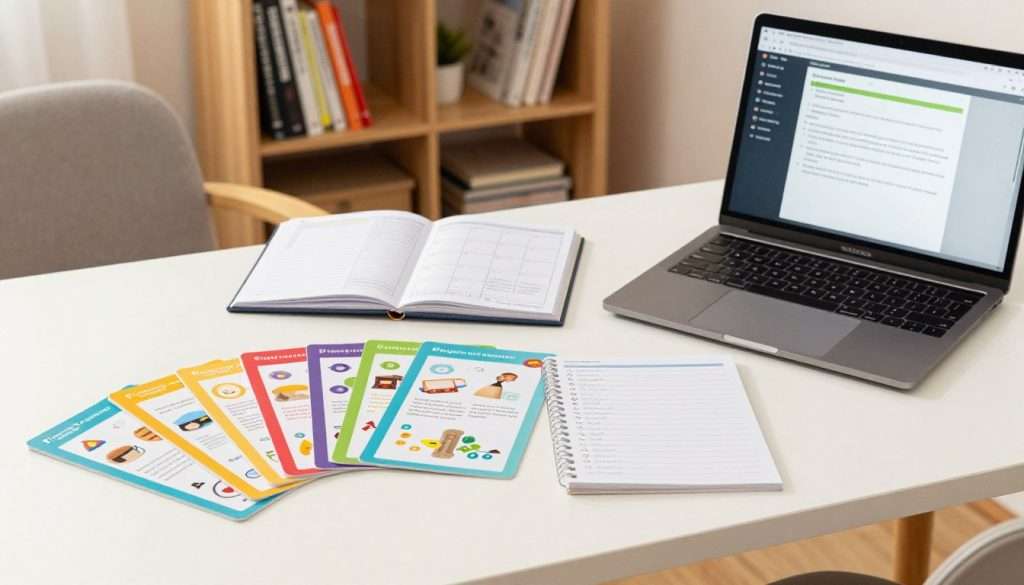
For example, images are great for learning new vocabulary. Linking a word to a picture can help you remember it better.
| Multimedia Element | Example Use Case | Benefit |
|---|---|---|
| Images | Associating vocabulary with pictures | Enhances visual memory |
| Audio | Listening to pronunciation | Improves auditory learning |
| Mnemonics | Creating acronyms for complex terms | Increases memorability |
Avoiding Common Card Creation Mistakes
Creating flashcards can lead to common mistakes. One is making cards too complex or packed with info. Another is not regularly reviewing and updating your cards.
By avoiding these mistakes and focusing on quality, your study materials will be more effective. This will help you reach your learning goals faster.
Maximizing Your Results with Spaced Repetition
To get the most out of spaced repetition, you need a smart plan. This powerful learning method works best when you use it wisely. Let’s look at the best ways to use spaced repetition to your advantage.
Establishing a Consistent Daily Review Schedule
Being consistent is key with spaced repetition. You should set a daily review time and stick to it. Choose a specific time each day to review your material. Use a planner, app, or reminder to keep on track.
For instance, review your flashcards every morning with your coffee or during your commute. Find a time that fits your schedule and stick to it. This way, you’ll strengthen your learning and keep moving forward.
Balancing New Material with Existing Reviews
It’s important to balance reviewing old material with learning new things. Use 70-80% of your time for old material and 20-30% for new stuff. This balance helps you keep your knowledge sharp while learning new things.
Tracking Your Progress and Retention Metrics
To really get the most from spaced repetition, track your progress. Use a spreadsheet or app to keep an eye on how well you’re doing. Look at how many cards you review, how many you get right, and your overall retention rate.
| Metric | Description | Target Value |
|---|---|---|
| Retention Rate | The percentage of correctly recalled cards | >90% |
| Cards Reviewed | The total number of cards reviewed per day | 50-100 |
| New Cards Introduced | The number of new cards introduced per day | 10-20 |
Tracking these metrics helps you see where you need to improve. Adjust your strategy to get better results. Remember, the secret to success with spaced repetition is being consistent, patient, and purposeful.
Practical Applications Across Different Fields
Spaced repetition is used in many areas to help learn and remember better. It boosts memory and supports long-term learning. This makes it useful for people in many fields and backgrounds.

Language Learning and Vocabulary Mastery
Language learners find spaced repetition very helpful, mainly for learning new words. Reviewing words at the right times helps them remember better. This method is great for learning tricky language parts, like idioms and words used in specific situations.
Linguist Stephen Krashen says, “Learning a language needs real talk in the target language. It’s about sharing and understanding messages, not just the words.” Spaced repetition helps keep vocabulary fresh and useful.
Medical School and Professional Licensing Exam Preparation
Medical students and professionals use spaced repetition for exams and to remember lots of medical info. It helps them remember everything from drugs to surgeries. With spaced repetition, they can keep up with new medical studies and rules.
- Remembering hard medical terms
- Learning about drug effects and interactions
- Getting ready for exams like the USMLE
Programming Languages and Technical Skills Development
Programmers and tech experts use spaced repetition to learn new coding languages and keep up with tech changes. It’s great for remembering coding rules and best practices. Spaced repetition helps them keep learning and growing in their careers.
General Knowledge Retention and Personal Development
Spaced repetition is also good for personal growth and keeping up with general knowledge. People can use it to learn new hobbies, remember history, or understand different subjects. Adding spaced repetition to daily life encourages ongoing learning and curiosity.
In summary, spaced repetition is a key tool with many uses. It helps improve learning and memory, making it essential for anyone wanting to grow their knowledge and skills.
Conclusion
We’ve looked into spaced repetition and how it can change learning. By using this powerful trick every day, you can remember things better and reach your goals faster.
Spaced repetition is not just a method; it’s a big change. It keeps information in your mind for a long time. This is great for students, workers, and anyone who wants to learn more. By using the spacing effect and planning your study time well, you can get the best results.
Now, it’s your turn to see how spaced repetition works. Start using the tips from this article and see how your learning changes. Whether you’re trying to pass a test, learn a new skill, or remember things better, spaced repetition can help you reach your highest potential.
So, don’t wait any longer. Start your spaced repetition journey today. Discover a smarter, more fun way to learn.