

Hey there! Ever feel like facts just slip away? We totally get it. Boosting cognitive enhancement starts with simple, fun daily habits.
By focusing on sleep and regular exercise, anyone can strengthen mental skills. Managing daily stress also supports a sharper mind.
We love finding ways to make learning feel like play instead of work. Challenging ourselves with new skills keeps our intellects firing well.
Let’s explore a solid method for memory improvement today. This specific framework helps turn complex information into vivid images.
It’s an ancient approach that still works wonders for modern students. Ready to transform that noggin?
Key Takeaways
- Prioritize sleep and exercise for better mental health.
- Manage stress levels to keep focus sharp.
- Challenge yourself with new hobbies or skills regularly.
- Transform dry data into exciting visual stories.
- Learn how simple sounds represent complex numbers.
- Make studying an enjoyable and active experience.
1. What Is the Major System and Why Should You Care?
Discover the secret to boosting your brain with the Major System. It’s a simple yet powerful memory technique. This tool can change how you remember things.
The Origins of This Powerful Memory Tool
The Major System was created in the 17th century by Stanislaus Mink von Wennsshein, a German philosopher. It was later made famous by mnemonic experts. This method has proven its worth over the centuries.
John Q. Public, a mnemonic expert, called it a game-changer. His words highlight its potential.
How the Major System Differs from Other Memory Techniques
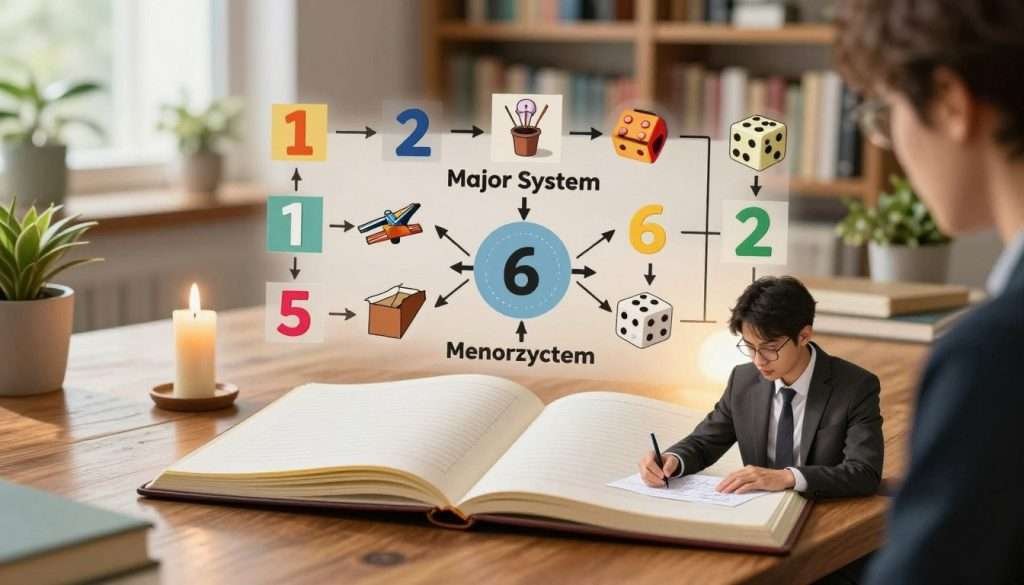
The Major System is different from other methods. It uses a phonetic approach to convert numbers into sounds. These sounds then become words and images, making it easier to remember.
For instance, to remember a phone number, turn it into a story or image. This makes it much easier to recall.
Who Can Benefit from Learning the Major System
Anyone can benefit from the Major System. It’s great for students, professionals, or anyone wanting to improve their memory. This technique is invaluable.
The beauty of the Major System lies in its versatility and simplicity. It’s a tool for all ages and backgrounds.
2. The Science Behind Why the Major System Works
Let’s explore the science behind the Major System’s success in memory enhancement. It’s based on how our brains handle numbers and images.
How Your Brain Processes Numbers Versus Images
Studies reveal our brains process visuals and numbers differently. Numbers are abstract and harder to remember. Images, on the other hand, are concrete and stick in our minds better.
The Major System uses this to our advantage. It turns numbers into images, making them easier to recall.
For example, trying to remember a phone number can be tough. But, if you turn it into a story or image with the Major System, it becomes easier.
The Psychology of Phonetic Associations
The Major System relies on phonetic associations. It connects sounds and words. This makes remembering numbers easier.
This method works because our brains are wired to remember patterns and associations better than random data. It’s like how song lyrics are easier to remember than random words because of the melody and rhythm.
Neuroplasticity and Memory Enhancement
The Major System also taps into brain training and neuroplasticity. Neuroplasticity is the brain’s ability to create new connections. The Major System helps stimulate this.
Using the Major System strengthens your brain’s adaptability. This improves your overall cognitive function and memory.
In summary, the Major System’s success is scientifically proven. By understanding and using it, you can boost your brain’s memory for numbers and more.
3. The Secret Code of Memory: How the Major System Supercharges Your Brain
Unlocking the Major System is like finding a secret code for your brain’s memory. It turns numbers into sounds, making words or images easier to remember. This method uses a special chart to make it work.
Understanding the Number-to-Sound Conversion Chart
The heart of the Major System is the number-to-sound chart. It links numbers to sounds, making it easy to remember information. For example, the number 1 is often “t” or “d,” and 2 is “n.”
This chart is not random. It’s based on how numbers sound and phonetic similarities. For instance, 1 is linked to “t” or “d” because of the single downstroke in “t.”
Why Sounds Instead of Letters Make All the Difference
Using sounds over letters is key in the Major System. It makes remembering easier and more creative. Letters can sound different, but sounds are consistent.
This method lets us create words based on sounds, not just letters. It’s this flexibility that makes the Major System so effective.
The Complete Major System Code Breakdown
The Major System code has a set of rules for converting numbers to sounds and words. Here’s a quick overview:
- Numbers 0-9 have specific sounds.
- Vowels (A, E, I, O, U) help create words but don’t represent numbers.
- Silent letters are ignored when turning words back into numbers.
Learning this code unlocks the Major System’s full power. It’s not just memorizing; it’s about using it to improve your memory and thinking.
With practice, the Major System becomes a valuable tool for remembering numbers and dates. The key is to keep practicing and use it in everyday life.
4. Step 1: Mastering the Basic Number-Sound Associations
Learning the Major System starts with a key step: mastering number-sound associations. This step is essential for more advanced memory skills. By the end of this section, you’ll know how to link numbers with sounds, boosting your memory.
Learning Numbers 0-9 and Their Corresponding Sounds
The Major System connects numbers with sounds. First, learn the sounds for numbers 0 through 9. It might seem hard at first, but it becomes easy with practice.
Digits 0-4: Your Foundation
Start with the first five digits. For example, 0 is linked with ‘s’ or ‘z’. Number 1 is associated with ‘t’ or ‘d’. As you learn more, patterns will help make memorizing easier.
2 is linked with ‘n’, 3 with ‘m’, and 4 with ‘r’. These are the basics of the Major System.
Digits 5-9: Completing Your Arsenal
The next five digits are just as simple. For instance, 5 is linked with ‘l’, and 6 with ‘j’. 7 is associated with ‘k’ or ‘c’, 8 with ‘f’ or ‘v’, and 9 with ‘b’ or ‘p’. Practice these regularly to remember them well.
Memory Tricks to Remember Each Sound Assignment
To learn these associations, use memory tricks. Create a story or image that connects the number to its sound. Make these connections vivid and personal. As one expert says,
“The more outrageous the association, the better it sticks in your memory.”
Practice Exercises for Instant Recall
Practice is key to mastering these associations. Write down numbers and their sounds many times. Test yourself by covering the sounds and recalling them. Regular practice will make these connections automatic, readying you for more advanced techniques.
Try converting random numbers into sounds. For example, 14 is ‘tr’ or ‘dr’. The more you practice, the easier it gets.

5. Step 2: Converting Numbers into Memorable Words
Now you know the basics of number-sound associations. It’s time to improve your memory by turning numbers into words. This step is key to unlocking the Major System’s full potential for memory enhancement.
Transforming Two-Digit Numbers into Words
To turn two-digit numbers into words, break them down into sounds using the Major System. For example, 14 breaks down into “T” or “D” for 1 and “R” for 4. You can then make a word like “Tire” or “Door.”
Let’s try a few examples:
- 25 = “N” (2) and “L” or “H” (5), so a word could be “Nail.”
- 63 = “SH” or “CH” (6) and “M” (3), making “Sham” or “Chum” possible.
Building Your Personal Number Dictionary
As you get better at converting numbers, start making your own number dictionary. List words for numbers 00 to 99. A personal dictionary helps you remember numbers by linking them to memorable words.
Here’s a simple table to start:
| Number | Word |
|---|---|
| 00 | Sausage |
| 01 | Seat |
| 02 | Sun |
Handling Vowels and Silent Letters
When making words from numbers, ignore vowels (A, E, I, O, U) and silent letters. Focus only on consonant sounds to find the number for a word.
For example, “Knight” is linked to 28 because “K” and “N” are sounds for 2 and “T” is for 1. But “T” is silent, so we look at “N” for 2 and ignore the silent “T.” The “K” sound is 7, making it 72 or just 2 based on sounds.
Creating Words for Three-Digit and Four-Digit Numbers
For three-digit and four-digit numbers, just extend what you’ve learned for two-digit numbers. Break down the number into parts and make words for each. For longer numbers, create a story or sentence to link the words.
For example, 1234 breaks down into 12 (T/N) and 34 (M/R), making “Tin” and “More.” You can link them in a sentence like: “I found a tin can filled with more treasures.”
By following these steps and practicing, you’ll get good at turning numbers into words. This will greatly improve your memory using the Major System.
6. Step 3: Building Vivid Mental Images and Stories
Now that you know the Major System, let’s make your memory better. You’ve learned to turn numbers into words. Now, it’s time to make those words into images and stories you won’t forget.
The Art of Creating Unforgettable Visualizations
Creating vivid mental images is key for better memory. Your images should be outrageous, emotional, and personal. Think of something funny, something you love, or something that really gets a reaction from you.
For example, to remember the number 14, imagine a huge tar-covered door in a funny situation. This makes it easier to remember.
To make it even more memorable, use as many senses as you can. What does the tar smell like? What does the door feel like when you touch it? The more details, the better you’ll remember it.
Linking Technique: Connecting Multiple Numbers in Sequence
The linking technique helps you remember a series of numbers. It’s great for remembering long sequences like phone numbers or PINs. For example, to remember 14-23-91, imagine a tar-covered door (14) opening to reveal a “name” (23) on a blackboard, and then a “pet” (91) jumping out.
Using Emotion and Exaggeration to Strengthen Memory
Emotion and exaggeration make memories stronger. Associating a number with a strong emotion or an exaggerated image makes it stick in your memory. For instance, to remember 78, imagine a giant coffee mug with a cave inside, filled with your favorite coffee.
Practice Exercise: Memorizing a 10-Digit Phone Number
Let’s practice with a simple exercise. Try to remember a 10-digit phone number using the Major System and these techniques. For example, with 555-123-4567, break it down, convert each part into words, and then create a story linking those words.
With regular practice, you’ll get good at making vivid mental images and stories. This is great for brain training and cognitive enhancement. It helps you remember phone numbers and learn new skills.
7. Real-World Applications: Where to Use the Major System
The Major System is more than a memory trick. It’s a tool for many real-life uses. You’ve learned to turn numbers into words and pictures. Now, let’s see how to use these skills in your daily life to improve memory and work better.
Memorizing Phone Numbers and Addresses
One great use of the Major System is for remembering phone numbers and addresses. By making numbers into words and linking them, you can easily remember contacts. For example, 555-1234 can become “L-L-L, T-N-M-R.” Make a story or image to help you remember it.
Remembering Important Dates and Historical Years
History lovers and students can use the Major System to remember dates and years. By linking numbers to sounds and stories, you can easily recall important events. For instance, 1492 (Columbus’s voyage) can be “T-R-B-N” and a memorable image.
Learning Mathematical Constants and Formulas
STEM students and professionals can use the Major System for math. It helps break down complex numbers into easy-to-remember words or images. For example, pi (3.14159) can be “M-T-R-L-B-L.”
Mastering PIN Codes and Passwords Securely
In today’s world, remembering PIN codes and passwords is hard. The Major System helps by turning numbers into words or phrases. This method boosts memory and makes passwords unique and easy to recall.
Academic and Professional Applications
The Major System is useful in school and work. Students can remember dates, formulas, and more. Professionals can recall client info, project codes, and other important data. Using the Major System daily can make you more productive and effective.
Using the Major System in everyday life can greatly improve your memory and thinking. It’s a helpful tool for anyone wanting to get better at remembering things.
8. Advanced Techniques and Common Pitfalls to Avoid
To boost your memory skills, we’ll dive into advanced strategies and common mistakes. As you master the Major System, you’ll aim to tackle more complex challenges.
Combining the Major System with Memory Palaces
Enhancing the Major System with memory palaces is a great idea. Imagine a place you know well, like your home. Then, link the images you create with specific spots in your memory palace. This makes remembering lots of info easier. For instance, use the Major System to turn numbers into words and place them in your memory palace.
Speed Training: Faster Encoding and Recall
Speed up your memory skills by practicing fast. Start with simple tasks like converting two-digit numbers. Then, move to harder ones. Use flashcards or apps to make it fun and challenging.
Common Mistakes Beginners Make
Even with the Major System, beginners face some common issues. Knowing these can help you learn faster and avoid getting stuck.
Confusing Similar Sounds
One mistake is mixing up sounds like ‘p’ and ‘b’. Focus on the unique traits of each sound. Practice to tell them apart.
Creating Weak or Forgettable Images
Another issue is making dull or forgettable images. Make your images vivid, emotional, and over-the-top. The wilder the image, the better it’ll stick in your memory.
Not Practicing Consistently
Consistency is crucial for mastering the Major System. Make time each day to practice, even if it’s just a few minutes. Regular practice will strengthen your memory skills.
Troubleshooting When the System Doesn’t Work
If the Major System isn’t working, don’t worry. Go back to basics, use vivid images, and adjust your practice. Sometimes, rethinking your approach can solve the problem.
9. Conclusion
We’ve looked into the Major System, a great tool for boosting your memory and unlocking your brain’s power. By learning this method, you can greatly improve your memory and cognitive skills. This leads to better thinking and memory.
The Major System is not just a memory trick. It’s a way to unlock your brain’s full potential. With regular practice, you can remember numbers, dates, and more easily. This makes you more confident and skilled in everyday life.
Now that you’ve finished this guide, it’s time to start using the Major System. Start with simple exercises and then try harder tasks. You’ll see amazing improvements in your memory and thinking skills.
Begin your journey today and unlock the power of a supercharged brain!