
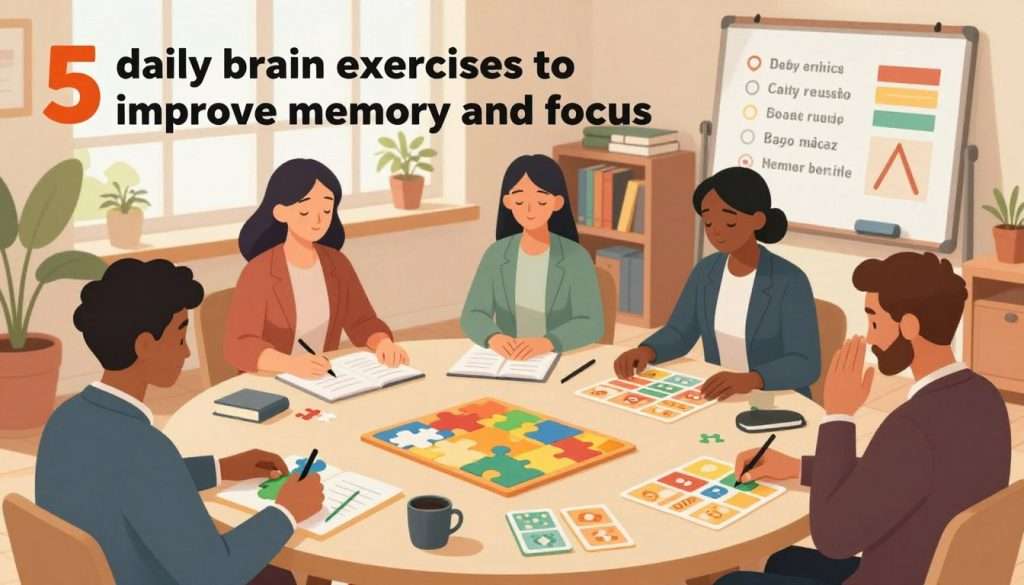
Keeping your mind sharp doesn’t have to be hard. Life gets busy, but you should feel mentally ready for anything. It’s possible to stay sharp without it feeling like a chore.
This guide shows how 5 daily brain exercises to improve memory and focus can make your mind sharper. Just a few minutes each day can make a big difference. You can build a more resilient and agile mind.
Are you ready to level up? Let’s explore simple, proven habits to keep your mind sharp at any age. It’s time to make your brain health a fun, lasting priority.
Key Takeaways
- Mental agility comes from small, consistent habits, not big efforts.
- Simple routines can greatly improve your thinking skills over time.
- Proven methods offer a reliable way to enhance your mental clarity.
- You can easily add these practices to your daily routine.
- Putting your mind first helps you stay sharp, no matter your age.
The Science Behind Cognitive Training and Brain Plasticity
Your brain is a lot like a muscle. It needs exercise to stay strong. We often think our mental abilities are fixed, but they’re not. Our brains can change and form new connections, a process called neuroplasticity.
When you do cognitive training activities, you’re not just killing time. You’re helping your brain build stronger paths. It’s like upgrading your brain’s hardware to handle tough tasks better.
Studies show that even meditation can change your brain. By doing these exercises, you’re making your mind more efficient. It’s all about making small, consistent efforts for lasting improvements in your brain health.
“The brain is a plastic organ, capable of learning and unlearning throughout our entire lives.”
You don’t have to be a genius to see improvements. By picking the right cognitive training activities, you can get better at focusing and remembering things. We’re here to help you make these scientific ideas simple and fit into your busy life.
5 Daily Brain Exercises to Improve Memory and Focus
Want to make your brain work better? We think keeping your mind sharp should be fun, not a hassle. By doing these 5 daily brain exercises to improve memory and focus, you can get smarter and learn easier.
Your brain is like a muscle that needs different workouts. Jigsaw puzzles are great for your eyes, but we also need structured mental workouts for brain health. Let’s explore the best ways to keep your mind sharp.
Active Recall and Spaced Repetition Techniques
Re-reading notes is not the best way to learn. Try active recall instead. It’s like lifting weights for your memory.
Use spaced repetition to remember things for a long time. Reviewing at different times helps you avoid forgetting. It’s a top mental workout for brain health for students.
The Power of Dual N-Back Training
Dual N-Back training is great for your working memory. It’s hard, but it makes your brain bigger. You need to watch and listen at the same time.
Even ten minutes can improve your ability to handle complex tasks. It’s like a workout for your brain.
Mindfulness Meditation for Sustained Attention
Focusing in a busy world is a superpower. Mindfulness meditation trains your attention. It’s not just relaxing; it’s hard work for your brain.
Start with five minutes each morning. Soon, you’ll focus better in class or when working deeply. Here’s a quick guide to help you pick your daily routine.
| Exercise Type | Primary Benefit | Difficulty Level | Time Required |
|---|---|---|---|
| Active Recall | Long-term Retention | Moderate | 15-30 Minutes |
| Dual N-Back | Working Memory | High | 10-20 Minutes |
| Mindfulness | Sustained Attention | Low | 5-10 Minutes |
| Jigsaw Puzzles | Visuospatial Skills | Low | 30+ Minutes |
Visualizing Information to Enhance Long-Term Memory
Ever noticed how a great story stays with you, but facts fade away? Our brains are better at remembering images than abstract data. Using memory-boosting exercises that involve visualization can make complex topics memorable.
A 2018 review shows that visualization aids in organizing information and decision-making. By turning study material into mental movies, you’re not just reading. You’re actively building a mental map for later.
The Method of Loci Explained
The Method of Loci, or “Memory Palace,” uses spatial memory. You pick a familiar place, like your childhood home. Then, you mentally place items to remember in specific spots.
Recalling information is easy by mentally walking through that space. Items appear where you left them. This spatial organization keeps your thoughts in order.
Creating Vivid Mental Associations
To make your visualizations stick, they must be memorable. Your brain loves the unusual, funny, or gross. Picture a wild scene involving the concept you’re trying to remember.
For a historical date, imagine the year acting out a scene with a famous figure in your kitchen. The more vivid and emotional the scene, the easier it is to recall. These memory-boosting exercises make studying a fun, imaginative journey.
The Role of Physical Exercise in Cognitive Health
Your brain loves to move. Adding physical activity to your day can be a game-changer for your brain health. We often see our minds as separate from our bodies. But, they are connected and need the oxygen and stimulation that movement provides.
Physical activity is a simple yet powerful concentration exercise. It’s something anyone can do.
A 2023 study found that regular exercise can boost brain function, even as we get older. Exercise increases blood flow to the brain. This helps grow new brain cells and keeps your mind sharp.
Aerobic Activity and Brain-Derived Neurotrophic Factor
Aerobic activities like jogging or swimming boost a protein called Brain-Derived Neurotrophic Factor (BDNF). Think of BDNF as fertilizer for your neurons. It helps repair and grow brain cells.
This protein is key for keeping focus and memory strong. By choosing aerobic activities, you’re building a stronger brain. It’s a simple way to keep your mind sharp all day.
Coordination Exercises for Neural Connectivity
Activities that challenge your brain and body are important too. Dancing or playing tennis requires focus and coordination. These concentration exercises make your brain’s connections stronger.
Learning a new skill, like a dance move, strengthens neural connections. This improves your ability to focus and switch tasks. Mixing aerobic and coordination exercises works out your mind and body.
Optimizing Nutrition for Peak Mental Performance
Feeding your brain the right nutrients is a key brain fitness technique. What you eat affects your brain’s performance. Small changes in your diet can boost your mental energy all day.
Essential Fatty Acids and Brain Function
Your brain is mostly fat, so it needs the right fats to work well. Essential fatty acids, like Omega-3s, are crucial for brain health. They help your brain cells stay strong and signals flow well.
Eating foods rich in these fats can improve your memory and mood. Add these to your shopping list:
- Wild-caught salmon or sardines for high-quality Omega-3s.
- Walnuts and chia seeds as perfect plant-based snacks.
- Flaxseed oil drizzled over your favorite salads.
Hydration and Its Impact on Concentration
Drinking enough water is key for staying focused and avoiding mental fatigue. Even a little dehydration can make you feel tired and unfocused. Keep a water bottle with you to stay sharp.
Water helps your brain work smoothly. Staying hydrated is a simple way to keep your mind sharp. If plain water is not exciting, try adding cucumber or lemon for a refreshing twist.
Sleep Hygiene and Memory Consolidation
Think of your nightly rest as the final, crucial step in your daily learning journey. While you might feel like you are just powering down, your brain is actually busy processing everything you encountered during the day. This process is essential for turning fleeting thoughts into long-term knowledge.
A 2015 review highlights that quality sleep is a proven way to boost memory recall and slash mental fatigue. Without enough rest, even the best study habits will struggle to stick. Think of these recovery periods as the ultimate concentration exercises that prepare your mind for the challenges of tomorrow.
The Importance of REM Cycles for Learning
During your REM cycles, your brain enters a state of high activity. It acts like a librarian, sorting through the day’s information and filing it away in the right spots. This is when your neural connections strengthen, making it easier to retrieve facts later.
If you cut your sleep short, you miss out on these vital consolidation windows. You might find that you struggle to focus or recall details during your next study session. Prioritizing deep, restorative sleep is one of the most effective ways to protect your cognitive health.
Establishing a Pre-Sleep Routine for Better Focus
Creating a calm environment before bed helps your brain transition into a restful state. By winding down properly, you ensure that your mind is ready to tackle the heavy lifting of memory storage. Consider these simple habits as part of your nightly concentration exercises to improve your mental clarity:
- Disconnect from screens at least one hour before you plan to sleep.
- Practice light stretching or deep breathing to release physical tension.
- Keep your bedroom cool, dark, and quiet to signal that it is time for rest.
- Review your most important notes briefly to prime your brain for overnight processing.
Consistency is the secret ingredient here. When you follow a routine, your body learns to expect rest, which makes falling asleep much easier. You will wake up feeling sharper, more focused, and ready to learn something new.
Leveraging Digital Tools for Brain Fitness
Your smartphone can do more than just scroll or send texts. It can be a tool for mental workouts for brain health right in your pocket. Use it to grow, not just to get lost in screens.
Selecting Effective Brain Training Applications
Not all apps are the same. It’s crucial to pick ones that really test your brain. A 2021 study showed that brain games can boost older adults’ thinking skills. Choose apps that get better as you do to avoid just playing games.
When searching for apps, look for ones that work on memory, speed, and planning. These apps use science to challenge you. Spend a few minutes each day to keep your mind sharp and ready for anything.
Balancing Screen Time with Offline Mental Stimulation
Technology is both good and bad. Finding the right balance is essential. Digital tools are great, but they shouldn’t replace real-life experiences.
Try mixing digital time with offline activities like reading, puzzles, or deep talks. This holistic approach gives your brain a variety of challenges. By combining digital and offline activities, you build a routine that supports your brain health over time.
Social Interaction as a Cognitive Workout
Did you know your next chat could be the best brain workout of the day? We often see mental training as solo work. But socializing is a powerful tool for keeping your mind sharp. By adding these social habits, you can find some of the most fun brain fitness techniques.
Engaging in Complex Conversations
Deep discussions make your brain work hard. You must listen well, process new info, and think of a good response quickly. This fast mental work keeps your brain flexible and strong.
A 2019 study showed that socializing often can help prevent cognitive decline and dementia. In short, staying connected is a top brain fitness technique.
The Benefits of Collaborative Problem Solving
Collaborative problem solving takes your social interactions up a notch. Working with others on a challenge makes you see things differently. This stretches your thinking and stops your mind from getting stuck.
Whether you’re studying with friends or brainstorming a project, you’re building mental strength. See how these social activities compare to solo study in the table below.
| Activity Type | Cognitive Benefit | Social Impact |
|---|---|---|
| Solo Flashcards | High Recall | None |
| Group Discussion | Active Processing | High |
| Collaborative Solving | Creative Thinking | High |
| Peer Teaching | Deep Understanding | Very High |
By making these social brain fitness techniques a regular part of your routine, you turn every hangout into a productive session. You get to enjoy friends’ company while sharpening your focus and memory. It’s the best of both worlds!
Overcoming Common Barriers to Consistent Practice
Ever felt like your brain hits a wall after a long day? It’s normal to feel drained when trying to improve. Starting strong is easy, but keeping up cognitive training activities takes strategy.

Managing Cognitive Fatigue
Feeling foggy means it’s time for a break. Cognitive fatigue is not failure; it’s your brain needing rest. Ignoring it can lead to burnout, making it harder to get back to your routine.
Listen to your body and mind when they need rest. A short walk or nap can help. By respecting these needs, your cognitive training activities stay positive, not a chore.
Building Habits That Stick
Success comes from making practice a natural part of your life. Start small and focus on being consistent, not intense. Learning something new, like a language or instrument, keeps your brain engaged and motivated.
Use “habit stacking” to tie your training to daily habits. For example, do a quick mental exercise after your morning coffee. This trick helps you stay on track, even when life gets busy.
| Strategy | Benefit | Difficulty Level |
|---|---|---|
| Habit Stacking | Creates consistency | Low |
| Active Rest | Prevents burnout | Medium |
| Skill Variety | Boosts engagement | High |
| Tracking Progress | Increases motivation | Low |
Advanced Memory Techniques for Lifelong Learning
Want to make your mind a super storage? These advanced techniques are for you. After mastering the basics, it’s time to get better with these memory-boosting exercises. They’re for those who learn new things fast and well.
Mastering the Art of Chunking Information
Ever felt swamped by too much data? Chunking is your key to success. It breaks down big topics into smaller bits that your brain can handle and remember.
It’s like cleaning a messy closet. Instead of trying to remember a long list, group things into meaningful groups. This makes your memory-boosting exercises much better.
Applying Mnemonic Devices to Daily Tasks
Mnemonic devices help facts stick in your memory. They turn dull data into vivid images. Use them for anything from learning a new language to remembering your shopping list.
Here’s how to use them in your daily life:
- Acronyms: Make a word from the first letters of a list to stay organized.
- Visualization: Make abstract ideas into funny or weird pictures in your mind.
- Rhymes: Use simple rhymes to make info catchy and easy to remember.
By using these memory-boosting exercises regularly, learning becomes fun, not a task. Start small, be patient, and watch your mind grow!
Accessing Further Resources for Academic Success
We want to make sure you have all the tools you need for school. We’ve talked about many brain fitness techniques, but your journey is just starting. The right guide can really help you reach your goals.
How to Become the Smartest Student in the Classroom
If this article spoke to you, we have something great for you. My free book, How to Become the Smartest Student in the Classroom, is for high achievers. It teaches advanced memory tricks, study plans, and effective strategies.
There’s no cost and no catch for this resource. You can get your free copy here: https://www.studyingmachine.com/free-books/. We’re dedicated to giving you the best tools for success in every class.
Integrating Professional Study Systems into Your Routine
Knowing stuff is great, but using it every day is even better. Adding professional study systems to your daily routine boosts your grades and memory. By making these brain fitness techniques habits, you’ll stop fighting to remember and start mastering it.
Begin by trying one or two strategies from the book in your next study session. Consistency is the secret ingredient for lasting success. We can’t wait to see how these methods make learning fun and effective for you.
Conclusion
You now have the tools to make your mind sharper and more resilient. We hope you’re excited to start improving your brain today.
Creating these 5 daily brain exercises is a smart move for your future. Small changes can lead to big results over time.
Being consistent is key for lasting change. Turn your study sessions into a fun challenge by sticking to these habits.
We can’t wait to see how you use these tools to learn new skills. Your journey to success begins with your next decision.
Why not try one of the 5 daily brain exercises right now? Your brain will thank you for it.