

Do you ever feel like your brain is a sieve? You spend hours cramming for an exam, only to forget everything the moment you step into the classroom. We have all been there, and honestly, it is exhausting.
The good news is that you do not have to keep struggling. By using a scientifically proven method, you can stop wasting time on ineffective habits. We are here to show you how to make your study routine more effective.
This method involves reviewing information at specific intervals to boost your memory. It’s not about working harder; it’s about working smarter. We believe learning should be fun, and we’re excited to help you master your coursework with less effort.
Key Takeaways
- Cramming is an ineffective way to retain information long-term.
- Spaced repetition helps you move knowledge into your permanent memory.
- Reviewing material at strategic intervals saves you significant study time.
- You can achieve better grades while feeling less stressed.
- Learning becomes an enjoyable habit rather than a dreaded chore.
Understanding the Science of Forgetting
Our brains are amazing, but they forget things quickly. Imagine your mind as a busy library where books get lost if not checked out. Spaced repetition for memory improvement helps keep important facts in your reach.
The Ebbinghaus Forgetting Curve Explained
In the 1880s, Hermann Ebbinghaus tested his memory. He memorized nonsense syllables and tracked his recall over days. He found that forgetting happens fast without review.
This discovery is known as the Forgetting Curve. It shows forgetting is natural if we don’t review what we learn.
“Memory is the residue of thought.” — Daniel Willingham
Why Cramming Fails the Brain
We’ve all tried cramming before a big exam, hoping to remember everything. But cramming only helps for a short time. It creates weak connections in your brain.
Cramming doesn’t build strong neural pathways. It just holds information for a few hours before it’s forgotten. Spaced repetition for memory improvement is a smarter way to learn. It respects your brain’s limits.
The Ultimate Guide to Spaced Repetition for Students: Core Principles
Ready to make your study sessions more productive? The ultimate guide to spaced repetition for students shows it’s not just about working harder. It’s about working smarter, matching your study habits to how your brain learns best.
We aim to reduce the stress of cramming. By spreading out your review sessions, you build a stronger memory than cramming ever could.
Defining the Spacing Effect
The spacing effect is a key tool for top learners. It shows that your brain keeps information better when you review it at intervals, not all at once.
Watering a plant is a good analogy. Dumping a lot of water once a month won’t help. But a little water every few days keeps it healthy.
The Role of Retrieval Intervals
Learning how to use spaced repetition effectively means mastering your retrieval intervals. You should challenge your brain just when you’re about to forget.
Reviewing too soon means just reading. Waiting too long means you have to start over. The goal is to find that sweet spot where it’s hard but successful, strengthening your brain’s connections.
How Spaced Repetition Transforms Long-Term Memory
Did you know your brain changes every time you review your notes? It’s not just about reading words. It’s about building a stronger mental structure. This process turns short-term thoughts into lasting knowledge.
Consolidation and Synaptic Plasticity
Imagine your brain as a dense forest. Learning something new is like carving a path through it. If you don’t revisit that path, the memory fades.
But, spaced repetition for memory improvement helps you return at the right time. Each time you recall information, it strengthens the connections in your brain. This makes your memories more reliable.
Moving Information from Short-Term to Long-Term Storage
Your short-term memory is like a whiteboard that erases every night. To keep information, you must move it to long-term storage. This requires consistent effort and the right timing.
By spacing out your reviews, you tell your brain that the information is truly important. This helps prevent memory loss. You can retain complex ideas for years, not just hours.
| Memory Stage | Duration | Neural Activity |
|---|---|---|
| Short-Term | Seconds to Minutes | High, but fragile |
| Intermediate | Hours to Days | Active consolidation |
| Long-Term | Weeks to Years | Stable synaptic links |
Using spaced repetition benefits helps you study smarter, not harder. You’re not just memorizing; you’re training your brain. This is the key to lasting academic success.
Essential Spaced Repetition Techniques for Academic Success
We’ve put together a set of smart strategies to help you reach your academic goals. By using these spaced repetition techniques, you can change how you learn and keep your mind sharp. These methods are easy to fit into any busy schedule.
The Leitner System for Physical Flashcards
If you prefer the feel of paper, the Leitner System is perfect for you. It involves sorting your flashcards into boxes based on how well you know the material. Correctly recalled cards move to a box with a longer interval, while those you miss stay in the front for more frequent review.
This system helps you focus on the topics that really challenge you. It’s a great way to keep your study materials organized without feeling overwhelmed by too many cards.
Using Incremental Reading for Complex Texts
When dealing with dense textbooks or long articles, it’s easy to get lost. Incremental reading breaks these texts into smaller, easier-to-manage chunks over time. Instead of reading a whole chapter at once, you focus on a small section and make a summary or question for later.
This method prevents burnout and keeps your focus sharp. You’ll find that you retain more information when you learn in smaller pieces.
The Power of Interleaving Subjects
Many students study one subject for hours without switching. We recommend trying interleaving, which involves switching between different subjects during a single study session. This keeps your brain active and helps you connect different topics.
These spaced repetition techniques are meant to keep you engaged. By mixing things up, you avoid the boredom that comes with studying the same subject for too long.
| Technique | Best For | Primary Benefit |
|---|---|---|
| Leitner System | Flashcards | Efficient memory sorting |
| Incremental Reading | Complex Texts | Prevents cognitive overload |
| Interleaving | Multiple Subjects | Boosts problem-solving skills |
Top Spaced Repetition Software for Students
Are you tired of keeping track of when to review your notes? It’s time to let technology do it for you. Spaced repetition software for students makes scheduling easy. It shows you the right info when you’re about to forget it.
Anki: The Gold Standard for Customization
Anki is a top choice for memory tools. It uses smart algorithms like FSRS to find the best time to review each card. This makes it great for students who need to remember a lot, like medical students and language learners.
“The secret to memory is not just repetition, but the timing of that repetition.”
Quizlet: User-Friendly Flashcard Creation
Quizlet is easy to use and perfect for beginners. It’s great for students who want to start quickly without dealing with complicated settings. Plus, you can share decks with friends for group study.
RemNote: Combining Notes with Spaced Repetition
RemNote mixes your notes with flashcards in one place. You can turn important parts of your notes into cards easily. This spaced repetition software for students keeps everything you need in one spot.
| Feature | Anki | Quizlet | RemNote |
|---|---|---|---|
| Customization | High | Low | Medium |
| Ease of Use | Moderate | Very High | High |
| Note Integration | No | No | Yes |
Choosing the right tool depends on how you like to study and how tech-savvy you are. Whether you want Anki’s control or Quizlet’s simplicity, the right spaced repetition software for students can change your study routine.
Best Practices for Spaced Repetition Implementation
Ever wondered how to make studying more effective without getting tired? Starting a new study system can seem daunting. But, we’re here to share best practices for spaced repetition to keep you motivated. By adopting smart habits, studying can become a rewarding journey.
Creating High-Quality Flashcards
The key to success is in making quality flashcards. Instead of just copying, try to explain topics in your own words. This way, you’re more likely to remember them.
Don’t overload your cards with too much text. Keep each card simple to keep your brain focused. This spaced repetition study tip helps you actively recall information, not just read it.

Managing Your Daily Review Load
It’s easy to feel overwhelmed with a growing card pile. Remember, spaced repetition beats massed repetition for better retention. You don’t need to study for hours daily to see progress.
Try to clear your daily queue instead of trying to learn everything at once. If you’re falling behind, slow down. Consistency is your best friend in keeping your study load manageable.
Consistency Over Intensity
Many students cram before exams, but this isn’t effective. Best practices for spaced repetition show that short, frequent sessions work better. Daily study sessions build a stronger memory than cramming.
Think of your brain as a muscle that needs regular exercise. By sticking to a routine, your spaced repetition study tips will become second nature. Stay patient and enjoy watching your knowledge grow!
Overcoming Common Challenges in Your Study Routine
Feeling like studying is a chore is common. Even the most dedicated learners face challenges with spaced repetition techniques. But, these obstacles are normal and can be overcome with the right mindset.
Dealing with Backlogs of Reviews
Sometimes, your flashcard pile grows faster than you can clear it. When this happens, it’s tempting to cram. But please resist that urge.
Set a strict time limit for your daily sessions and stick to it. Focus on clearing the most important cards first. This way, you keep your momentum without burning out. Remember, consistency is key when using spaced repetition techniques.
“Success is the sum of small efforts, repeated day in and day out.”
Avoiding Passive Recognition
Ever felt like you knew the answer to a flashcard, only to realize you were just recognizing it? This is the “fluency illusion.” It happens when you confuse familiarity with actual knowledge, which can hinder your progress.
To avoid this, try explaining the concept out loud before flipping the card. If you can’t articulate the answer clearly, mark it as “incorrect” and review it again later. This self-challenge is crucial for mastering spaced repetition techniques.
Balancing Spaced Repetition with Other Assignments
Fitting your review sessions into a busy schedule needs strategy. Treat your flashcard time like a non-negotiable appointment. Even ten minutes during your commute can be beneficial.
| Challenge | Common Mistake | Better Approach |
|---|---|---|
| Backlogs | Cramming for hours | Set a 20-minute limit |
| Passive Recognition | Just reading the card | Active verbal recall |
| Time Management | Skipping sessions | Micro-study sessions |
By being flexible and keeping your goals realistic, spaced repetition techniques will become a natural part of your day. Keep going, and trust the process!
Integrating Spaced Repetition with Active Recall
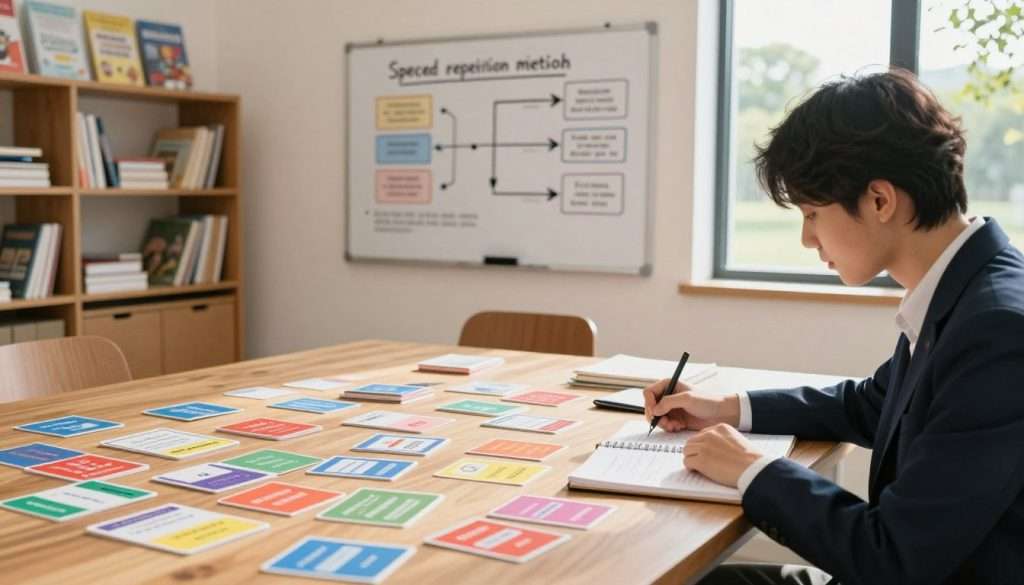
Think of spaced repetition as your study schedule. Active recall is the actual brain workout. The schedule tells you when to study. But, actively recalling information strengthens your memory.
The Synergy Between Recall and Spacing
Active recall drives your learning. Every time you recall a fact without looking at your textbook, you reset the forgetting curve. This strengthens your brain’s pathways.
Combining active recall with a smart schedule creates a powerful loop. You’re not just reviewing; you’re actively reconstructing knowledge. This is why some students can recall complex details confidently during exams.
Designing Effective Question-Answer Pairs
To make the most of your study time, ask deeper questions. Instead of “What is photosynthesis?”, ask questions that make you connect concepts or explain the “why”. This deeper engagement helps you remember information better.
Here are tips for creating better questions:
- Keep it atomic: Focus on one concept per card to avoid confusion.
- Use your own words: Paraphrasing makes your brain process information, not just memorize.
- Add context: Include a brief scenario or example to make the information relevant to your life.
By focusing on quality, every review session is productive. Remember, the goal is to make your brain work hard during study. This way, exams will feel easy.
Measuring Your Progress and Adjusting Intervals
How do you know if your study habits are actually paying off? It’s easy to feel busy while studying. But tracking your progress is the only way to see if you are truly learning. By keeping an eye on your performance, you can turn your study sessions into a precise, data-driven experience.
Most best practices for spaced repetition rely on honest feedback. When you look at your results, you can quickly identify which topics are stuck in your brain and which ones are slipping away. This clarity helps you focus your energy where it matters most.
Analyzing Retention Rates
To get the most out of your study time, you need to look at your retention rates. Many modern spaced repetition software for students provide built-in analytics that show you exactly how well you remember specific cards or concepts. You should look for these key indicators:
- Success Rate: The percentage of cards you answer correctly on the first try.
- Ease Factor: How quickly you recall information after a long break.
- Review Load: The number of items you need to tackle each day to stay on track.
When to Shorten or Lengthen Intervals
Once you have your data, you can start fine-tuning your schedule. If you find that you are consistently forgetting material, it is time to shorten your intervals. For example, if you want to ensure one-month retention, research suggests reviewing at 10-20% of the gap, which equals roughly 3-6 days.
On the flip side, if you are acing every single card, you are likely reviewing too often. In this case, you should lengthen your intervals to save time and challenge your brain more effectively. Adjusting these gaps based on your personal pace ensures that your study routine remains both efficient and manageable.
Taking Your Learning to the Next Level
You’ve mastered the basics of memory retention. But there’s always more to learn. By pushing your limits, you can make study sessions truly transformative. We aim to help you go beyond simple memorization to deep understanding.
Advanced Memory Techniques for Complex Concepts
Standard flashcards might not be enough for tough topics. Try the Feynman Technique along with your regular review. This method involves explaining a concept in simple terms, as if teaching a child.
If you struggle, you’ll know exactly where to improve. Mix this with spaced repetition study tips for a powerful learning cycle. You’ll pinpoint weak areas, simplify explanations, and schedule next reviews.
Accessing Further Resources
We’re dedicated to making you the best learner you can be. For deeper learning, we’ve put together a comprehensive system. It includes memory hacks and daily routines to help you succeed without stress.
The table below shows how to mix different methods for better academic performance:
| Method | Primary Benefit | Best For |
|---|---|---|
| Spaced Repetition | Long-term retention | Vocabulary and facts |
| Feynman Technique | Conceptual clarity | Complex theories |
| Interleaving | Problem-solving skills | Math and science |
Download Your Free Study System
Ready to elevate your learning? My free book, How to Become the Smartest Student in the Classroom, offers a full system of memory techniques and study routines. It’s free with no catch. Get your copy here → https://www.studyingmachine.com/free-books/ to access proven strategies.
Conclusion
You’ve learned about the science of learning and how to make studying fun. By adopting these habits, your brain becomes super efficient. Now, you can retain knowledge for a long time.
Spaced repetition is more than just passing tests. A 2025 study found that doubling your review sessions strengthens your mind. These effects last a year after you first studied.
Begin with daily reviews using Anki or Quizlet. It’s better to be consistent than to try too hard. Soon, you’ll see how these efforts improve your grades and confidence.
We’re excited to hear about your progress. Which subjects are you tackling first with your new flashcard routine? Share your successes and keep pushing your limits as you make every study session count.