

Students, professionals, and lifelong learners all face the same challenge: how to remember what they study. Your brain processes thousands of pieces of information daily, but most of it disappears within hours. The good news? Science-backed study hacks can dramatically boost your memory retention and make learning stick.
This guide shares 20 proven techniques designed for students cramming for exams, professionals learning new skills, and anyone wanting to remember more of what they read. You’ll discover how to optimize your study environment for better focus and retention, plus master active learning techniques that turn passive reading into powerful memory-building sessions. We’ll also explore spaced repetition methods that help you remember information for months, not just days.
These aren’t complicated theories – they’re simple, practical strategies you can start using today to transform how your brain stores and recalls information.
Optimize Your Environment for Better Retention

Create a Distraction-Free Study Zone
Your brain craves consistency, and establishing a dedicated study space signals your mind that it’s time to focus. Pick one specific location for studying and use it only for academic work. This mental association becomes powerful over time, automatically putting you in the right mindset when you sit down.
Remove digital temptations by keeping your phone in another room or using apps that block social media during study sessions. Visual clutter competes for your attention, so clear your desk of everything except the materials you need for that specific study session. A clean, organized space reduces cognitive load and lets your brain channel all its energy toward learning.
Use Proper Lighting and Temperature Control
Poor lighting strains your eyes and makes you tired faster, while harsh fluorescent lights can create headaches and reduce concentration. Natural light works best for sustained focus, so position your study area near a window when possible. If natural light isn’t available, invest in a good desk lamp that provides bright, even illumination without creating shadows on your work.
Temperature significantly impacts memory formation. Research shows that slightly cool environments (around 68-70°F) promote alertness and better cognitive performance. When it’s too warm, your body expends energy regulating temperature instead of processing information. Too cold, and you’ll spend mental energy staying comfortable rather than absorbing material.
Incorporate Background Sounds That Enhance Focus
Silence isn’t always golden when it comes to studying. Many people find that certain types of background noise actually improve concentration and memory retention. White noise or nature sounds can mask distracting environmental noises while creating a consistent auditory backdrop that helps maintain focus.
Instrumental music, particularly classical or ambient electronic tracks, can enhance mood and motivation without competing for the language-processing areas of your brain. Avoid music with lyrics, as your brain will automatically try to process the words, splitting your attention. Experiment with different soundscapes to find what works best for your learning style – some people thrive in complete quiet, while others need gentle background sounds to stay engaged.
Organize Materials for Easy Access and Review
Smart organization saves precious mental energy and keeps you in the flow state longer. Set up your materials before each study session so you don’t break concentration searching for notes, textbooks, or supplies. Use color-coding systems for different subjects or topics, making information easier to locate and creating visual connections that aid memory.
Keep frequently used items within arm’s reach and create designated spots for everything. This systematic approach reduces decision fatigue and lets you dive straight into productive studying. Consider using binders, folders, or digital organization systems that mirror your brain’s natural way of categorizing information.
Master Active Learning Techniques

Transform Reading into Interactive Dialogue
Reading becomes infinitely more powerful when you turn it into a conversation with the material. Instead of passively scanning text, challenge every paragraph by asking questions: “Why does this matter?” or “How does this connect to what I already know?” This mental interrogation keeps your brain actively engaged and creates multiple pathways to the same information.
When you encounter a complex concept, pause and argue with it. Play devil’s advocate or imagine explaining it to someone who disagrees. This internal debate forces you to examine ideas from multiple angles, strengthening your understanding far beyond simple memorization. You’ll find yourself naturally identifying gaps in your knowledge and seeking answers that stick.
Teach Concepts Aloud to Reinforce Understanding
Speaking your thoughts aloud transforms abstract knowledge into concrete understanding. When you explain a concept to an imaginary student or even to your reflection in the mirror, you quickly discover which parts you truly grasp and which remain fuzzy. Your brain processes spoken words differently than internal thoughts, creating additional neural connections that improve recall.
The magic happens when you simplify complex ideas using everyday language. If you can’t explain photosynthesis using words a ten-year-old would understand, you don’t really understand it yourself. This teaching process reveals knowledge gaps immediately and forces you to reorganize information in logical, memorable sequences.
Create Visual Mind Maps and Diagrams
Your brain craves visual connections. Converting linear text into colorful, branching mind maps engages spatial memory systems that pure text reading never touches. Start with your main topic in the center, then branch out with related concepts, using colors, symbols, and drawings to represent different categories or relationships.
The physical act of drawing these connections reinforces memory through kinesthetic learning. Each line you draw represents a thought pathway your brain can follow later during recall. Even crude sketches work better than elaborate artwork – the goal is creating visual anchors for abstract concepts, not winning art contests.
Practice Retrieval Without Looking at Notes
Testing yourself without peeking at answers builds retrieval strength like nothing else. Close your books and write down everything you remember about yesterday’s lesson. Don’t worry about perfect accuracy initially – the struggle to remember actually strengthens neural pathways more than easy recall ever could.
Make retrieval practice a daily habit. Quiz yourself while walking, waiting for coffee, or during commercial breaks. The more you practice pulling information from memory without prompts, the more accessible that knowledge becomes during actual tests or real-world applications.
Harness the Power of Spaced Repetition
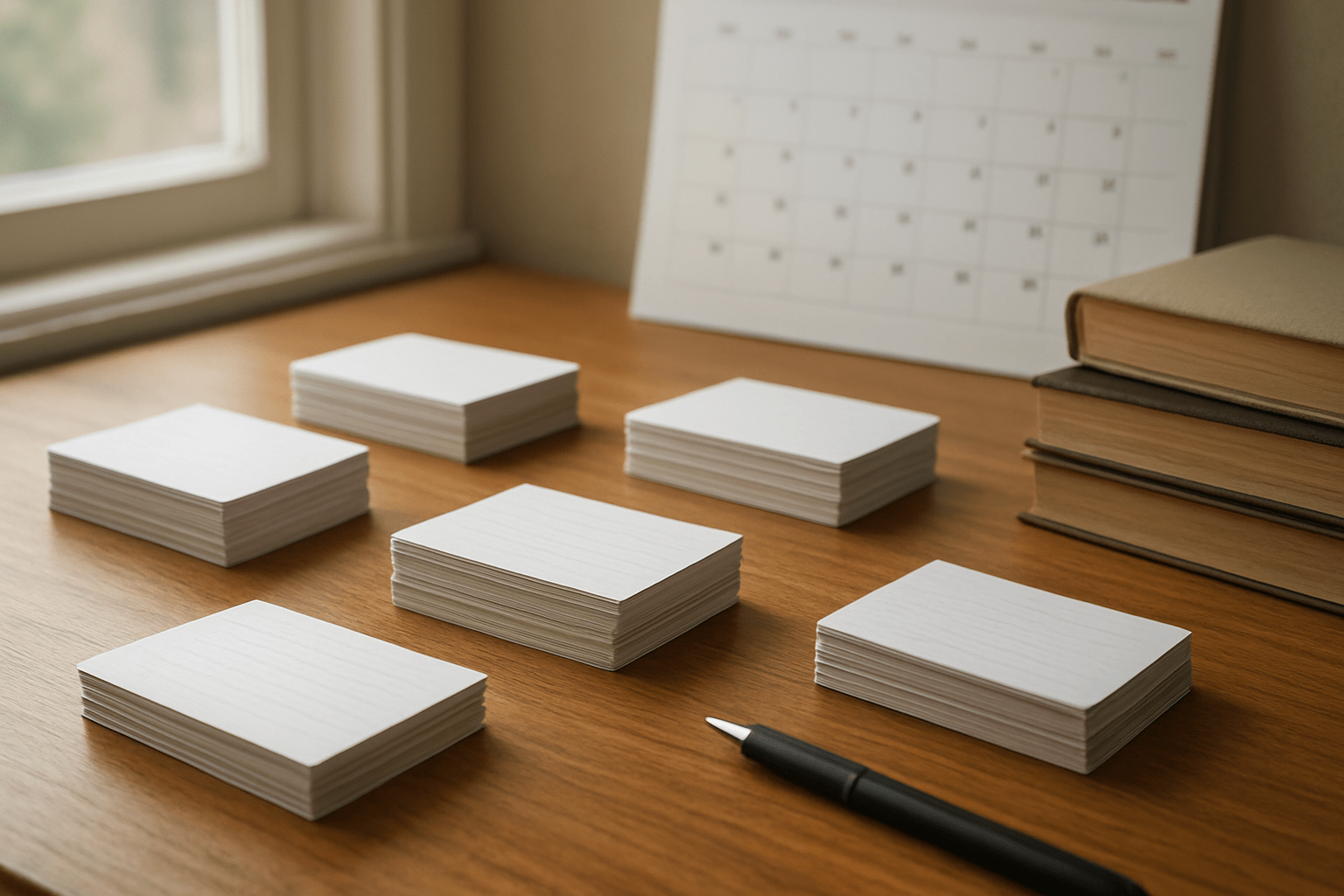
Schedule Reviews at Increasing Intervals
Your brain naturally forgets information over time, but you can beat this process by reviewing material at strategic moments. The key lies in spacing your review sessions progressively further apart. Start by reviewing new material within 24 hours of first learning it. This initial review should happen when the information is still fresh but beginning to fade.
After that first review, wait 2-3 days before your next session. If you can recall the information easily, extend the gap to a week for the third review. Continue expanding these intervals – two weeks, then a month, then three months. Each successful recall strengthens the memory pathway and allows you to wait longer before the next review.
Track your review schedule using a simple calendar or spreadsheet. Mark when you first learned something and plot out your future review dates. This systematic approach prevents you from reviewing too frequently (wasting time) or waiting too long (losing the information completely).
Use Flashcard Systems with Built-in Spacing
Digital flashcard platforms like Anki, Quizlet, or Brainscape automatically calculate optimal review timing based on your performance. These systems track how well you know each card and adjust the scheduling accordingly. Cards you struggle with appear more frequently, while easy cards show up less often.
When creating flashcards for spaced repetition, keep each card focused on one concept. Write clear, specific questions that test understanding rather than mere recognition. For example, instead of “What is photosynthesis?” try “What are the three main products of the light-dependent reactions in photosynthesis?”
Set up your flashcard sessions to last 15-20 minutes daily. This consistency matters more than marathon study sessions. The software will present cards due for review based on your previous performance, making each session efficient and targeted.
Apply the Forgetting Curve to Timing
Hermann Ebbinghaus discovered that we forget roughly 50% of new information within an hour and up to 70% within 24 hours. This forgetting curve shows exactly when your memory is most vulnerable and when reviews will have the biggest impact.
Time your first review right before the steep drop-off begins – typically within the first few hours after learning. This intervention dramatically slows the forgetting process and creates a gentler decline curve. Each subsequent review further flattens the curve, making the information stick longer.
Pay attention to your personal forgetting patterns. Some people retain verbal information longer, while others excel with visual content. Notice which subjects or types of material you forget fastest, then adjust your review timing accordingly. Challenging topics might need reviews after 1 day, 3 days, and 1 week, while easier material could follow a 2 day, 1 week, 1 month pattern.
Leverage Memory Palace and Visualization Methods

Build Mental Locations for Information Storage
The memory palace technique, also known as the method of loci, turns your spatial memory into a powerful filing system. Start by choosing a familiar location like your home, workplace, or favorite walking route. Mentally walk through this space and identify specific landmarks – your front door, kitchen counter, bedroom dresser, or that corner coffee shop.
Assign each piece of information you want to remember to a specific location along your route. For example, if you’re studying the periodic table, place hydrogen at your front door, helium on your coat rack, and lithium on your coffee table. The key is creating a logical path you can easily follow every time.
Practice walking through your palace regularly, both forward and backward. This reinforces the connections between locations and information. You can create multiple palaces for different subjects – use your childhood home for history facts, your current workplace for business concepts, and your gym for anatomy terms.
Create Vivid Mental Images for Abstract Concepts
Abstract ideas become memorable when you transform them into concrete, bizarre images. Take the economic concept of inflation and picture a giant balloon shaped like a dollar sign slowly expanding until it fills an entire room. For photosynthesis, imagine tiny green workers inside a leaf operating miniature solar panels.
Make your images as outrageous as possible – your brain remembers unusual things better than ordinary ones. If you’re learning about democracy, picture a giant voting booth with arms and legs dancing around a town square. For the concept of entropy, visualize a perfectly organized room slowly dissolving into chaos as invisible wind scatters everything around.
Engage all your senses in these mental images. Don’t just see the inflation balloon – hear it squeaking as it expands, feel its rubbery texture, and smell that distinct balloon scent. The more sensory details you add, the stronger the memory becomes.
Connect New Information to Familiar Objects
Your brain excels at building on existing knowledge. When learning new vocabulary words, connect them to objects you encounter daily. The Spanish word “mesa” (table) becomes easy to remember when you picture your dining room table every morning over coffee.
For complex scientific processes, use familiar machines or activities as analogies. The circulatory system works like your home’s plumbing – the heart is the main pump, arteries are the supply pipes, and veins are the return lines. DNA replication resembles a zipper unzipping and creating two identical copies.
Create a personal reference library of familiar objects for different categories. Use kitchen appliances for chemistry reactions, sports equipment for physics concepts, and family members’ personalities for historical figures. This personal connection makes abstract information feel relevant and easier to retrieve.
Use Storytelling to Link Facts Together
Transform boring lists of facts into engaging narratives. When memorizing the order of planets, create a story about a space traveler named Mercury who visits Venus’s beauty salon, then stops at Earth’s cafe for lunch before heading to Mars’s red rock concert.
Build characters and plotlines that incorporate the information you need to remember. For historical dates, create a timeline story where each event is a chapter in an ongoing adventure. The protagonist experiences the signing of the Magna Carta in 1215, witnesses the invention of the printing press in 1440, and celebrates the Declaration of Independence in 1776.
Use emotional hooks in your stories – make them funny, dramatic, or surprising. When learning about the water cycle, tell the tale of a water droplet’s epic journey from ocean to cloud to mountain peak and back again, complete with friendship, danger, and triumph. Stories with emotional content stick in memory far longer than dry facts.
Time Your Study Sessions for Maximum Impact
Identify Your Peak Cognitive Hours
Your brain doesn’t operate at the same level throughout the day. Most people experience natural energy peaks and valleys that follow their circadian rhythm. For many, peak mental performance occurs during morning hours, typically between 9 AM and 11 AM, when cortisol levels are naturally elevated and the mind feels fresh. However, some night owls find their sweet spot during evening hours.
Pay attention to when you feel most alert and focused during a typical week. Notice when complex problems seem easier to solve and when your concentration feels effortless. Track your energy patterns for several days, noting times when you feel sharp versus when your mind feels foggy. This personal data becomes your roadmap for scheduling the most challenging study materials during your golden hours.
Break Study Time into Focused Intervals
The human brain can only maintain intense focus for limited periods before attention begins to wander. Research shows that 25-50 minute study blocks followed by short breaks often produce better retention than marathon study sessions. This approach, popularized by the Pomodoro Technique, works because it aligns with your brain’s natural attention spans.
Start with 25-minute focused sessions if you’re new to this method, then gradually extend to 45-50 minutes as your concentration improves. During these intervals, eliminate all distractions – put your phone in another room, close unnecessary browser tabs, and create a dedicated study environment. The key is maintaining laser focus during these blocks rather than passively reading for hours.
Use Strategic Breaks to Consolidate Memory
Your brain continues processing information even when you’re not actively studying. Strategic breaks allow your mind to consolidate what you’ve learned, transferring information from short-term to long-term memory. The most effective breaks involve activities that give your brain a chance to rest while still remaining lightly engaged.
Take a 5-10 minute walk outside, do some light stretching, or practice deep breathing exercises. Avoid scrolling social media or watching videos during breaks, as these activities can interfere with memory consolidation. Physical movement is particularly beneficial because it increases blood flow to the brain and can actually enhance the formation of new neural connections.
Schedule Difficult Topics During Optimal Times
Reserve your peak cognitive hours for the most challenging or important material. If you’re a morning person, tackle complex mathematical concepts, dense reading assignments, or new languages when your mind is freshest. Save routine review, flashcard practice, or familiar topics for times when your energy naturally dips.
This strategic scheduling maximizes your brain’s capacity to form strong memories when dealing with difficult content. When you’re mentally fatigued, your brain struggles to encode complex information effectively, leading to poor retention and increased frustration. By aligning your toughest study challenges with your natural energy peaks, you’ll find that previously difficult concepts become more manageable and memorable.
Transform Information Using Memory Tricks

Create memorable acronyms and mnemonics
Acronyms pack complex information into simple, memorable packages. When you need to remember the Great Lakes, “HOMES” (Huron, Ontario, Michigan, Erie, Superior) beats trying to memorize five separate names. The key is making your acronym relevant and easy to recall.
Create acronyms that connect to your existing knowledge or personal experiences. If you’re studying the order of operations in math (Parentheses, Exponents, Multiplication, Division, Addition, Subtraction), “Please Excuse My Dear Aunt Sally” works because most people can picture a polite family scenario.
Mnemonics work even better when you make them personal or silly. The more ridiculous, the stickier they become in your memory. For remembering the colors of the rainbow, “Roy G. Biv” turns abstract light wavelengths into a person’s name you can visualize.
Turn facts into catchy rhymes and songs
Your brain naturally gravitates toward rhythm and melody. That’s why you can still sing advertising jingles from years ago but struggle to remember what you studied last week. Music creates multiple memory pathways, making information harder to forget.
Transform dry facts into simple rhymes. “In 1492, Columbus sailed the ocean blue” demonstrates how rhythm makes dates stick. You don’t need to be a poet – basic rhymes work just as well as complex ones.
Songs work even better than simple rhymes because they engage more of your brain. Set key concepts to familiar tunes like “Twinkle, Twinkle, Little Star” or “Row, Row, Row Your Boat.” Students have successfully memorized entire periodic tables, mathematical formulas, and historical timelines using this technique.
Use word associations and verbal links
Word associations create bridges between new information and things you already know. When learning a new vocabulary word, connect it to something familiar through sound, meaning, or visual similarity.
To remember that “gregarious” means sociable, link it to “Greg” – imagine a friendly guy named Greg who loves parties and meeting people. The connection doesn’t have to be logical; it just needs to work for you.
Create chains of associations for lists or sequences. If you need to remember milk, bread, eggs, and apples at the store, build a story: “The milk was so white it looked like bread, which cracked open like an egg, revealing a bright red apple inside.” Each item triggers the next through your narrative chain.
Apply number-to-image conversion systems
Numbers become memorable when you convert them into vivid images. The Major System assigns consonant sounds to digits 0-9, letting you transform any number into a word or image.
| Number | Sound | Example Words |
|---|---|---|
| 0 | S, Z | Zoo, Sea |
| 1 | T, D | Tea, Day |
| 2 | N | Noah, New |
| 3 | M | Ma, Aim |
| 4 | R | Ray, Row |
Using this system, 42 becomes “rain” (R=4, N=2), and 357 becomes “mail” (M=3, L=5, K=7). These concrete images stick in your memory far better than abstract numbers.
For simpler approaches, create visual associations directly. Remember your friend’s phone number by picturing the digits as objects or actions. The number 8 looks like a snowman, 0 resembles a donut, and 1 stands like a pencil.
Strengthen Memory Through Physical Actions

Incorporate movement while studying
Walking while reviewing flashcards can boost your memory by up to 20% compared to sitting still. The brain creates stronger neural pathways when your body is in motion because physical activity increases blood flow and oxygen to the hippocampus, the brain’s memory center.
Try these movement-based study techniques:
- Walking meetings with study materials: Read notes or listen to recorded lectures while taking a slow walk
- Standing desk sessions: Switch between sitting and standing every 30 minutes during long study periods
- Pacing while memorizing: Walk back and forth when learning lists, formulas, or vocabulary
- Stair climbing reviews: Use stairs as prompts for different topics or chapters
Research shows that bilateral movement (using both sides of your body) particularly enhances memory consolidation. Simple activities like marching in place or doing light stretching between study sessions can reactivate your brain and improve focus.
Use hand gestures to reinforce concepts
Your hands are powerful memory tools that most students completely ignore. When you pair physical gestures with information, you create multiple memory pathways that make recall easier and more reliable.
Gesture-based learning strategies:
| Concept Type | Gesture Example |
|---|---|
| Mathematical formulas | Trace equations in the air |
| Language vocabulary | Act out verb meanings |
| Historical events | Create timeline movements with hands |
| Scientific processes | Mimic molecular interactions |
Sign language research reveals that people who use hand gestures while learning retain information 35% longer than those who don’t. Your brain processes visual, verbal, and kinesthetic information simultaneously, creating a rich memory network.
Start small by pointing to key terms while reading them aloud, or use your fingers to count off important points. Graduate to more complex gestures like drawing diagrams in the air or creating unique hand movements for abstract concepts.
Change body positions during review sessions
Your brain associates information with your physical state, including body position. Studying the same material in different positions creates multiple retrieval cues that strengthen memory formation.
Position rotation schedule:
- First review: Sitting upright at desk
- Second review: Lying on floor with materials above
- Third review: Standing with materials at eye level
- Final review: Sitting in different chair or location
This technique works because of context-dependent memory – your brain encodes environmental and physical cues alongside the actual information. When test time comes, you’ll have multiple physical memory triggers to help recall the material.
Change positions every 25-30 minutes to prevent your brain from becoming too comfortable in one state. Even simple shifts like crossing your legs differently or adjusting your arm position can create new memory anchors for the information you’re studying.
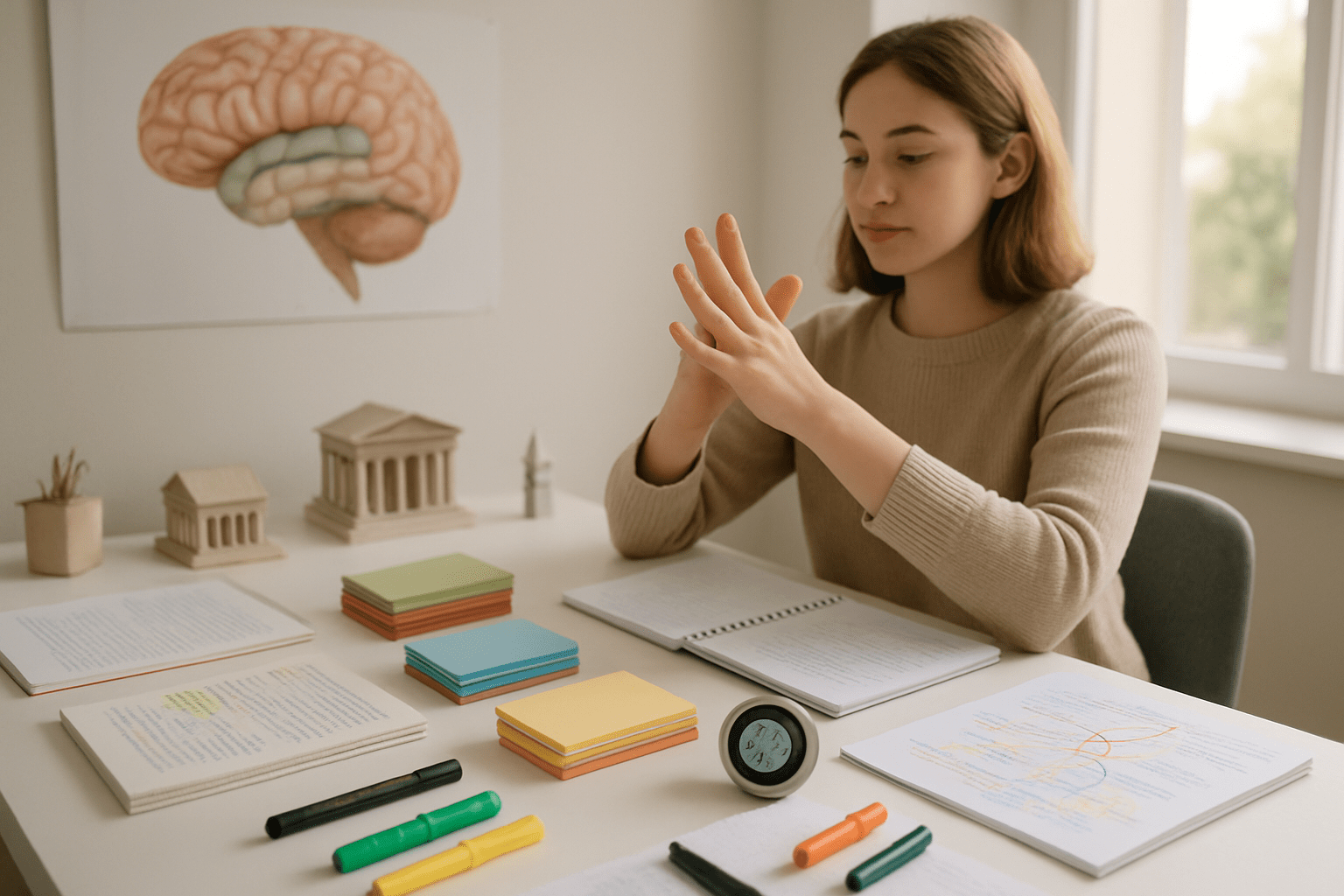
Your memory doesn’t have to be your biggest study struggle. These 20 strategies work because they tap into how your brain naturally learns and stores information. From creating the right study space to using spaced repetition, each technique builds on proven science that helps information stick long-term. The memory palace method might seem weird at first, but it’s one of the most powerful tools you can learn. Physical movement, visualization, and active learning all work together to make studying more effective and less frustrating.
Start small and pick just one or two techniques that feel right for you. Maybe try the spaced repetition method for your next exam or experiment with turning your notes into stories. The key is consistency – these memory hacks work best when you make them part of your regular routine. Your brain is already amazing at remembering things, and now you have the tools to unlock that potential and make studying actually work for you.