

Imagine finishing your homework in half the time and understanding it better. Some people worry about new tech in school. But using efficient studying with artificial intelligence is not cheating. It’s upgrading your brain.
Experts at Penn Foster say there’s a thin line between help and cheating. We’ll show you where that line is. With ai study techniques, you can dive deep into the material, not just memorize it.
Think of these tools as a smart co-pilot for your studies. You’re still in charge, making all the decisions. By using ai for academic success, studying becomes an exciting adventure.
Defining the Boundaries of Academic Integrity
Before we dive into the fun stuff, let’s talk about the rules. Integrity is more than just a list of “don’ts.” It’s about making sure you’re doing the real work. Learning how to use ai to study faster (without cheating) is essential for today’s students.
The Philosophy of AI as a Co-Pilot, Not an Autopilot
Imagine flying a plane where the software handles the busy work. This is how we see modern learning today. With study tips with ai, the machine helps you grow, not replace your thinking.
Key Takeaways
- Understand the thin line between assistance and academic dishonesty.
- Learn to use technology as a co-pilot for your own research.
- Discover ways to summarize complex topics in seconds.
- Keep your academic reputation spotless while working faster.
- Transform your study habits into an enjoyable, active experience.
- Master tools that help you focus on high-level understanding.
How to Use AI to Study Faster (Without Cheating)
Now that we’ve established the importance of maintaining academic integrity, let’s dive into the practical ways you can harness AI to boost your study efficiency.
To effectively use AI for studying, it’s crucial to understand the fine line between getting assistance and committing plagiarism. AI can be a powerful tool when used correctly. It can summarize complex texts, generate practice questions, or even create concept maps. But relying on AI to do the work for you not only undermines your learning but also violates academic integrity.
Understanding the Difference Between Assistance and Plagiarism
The distinction between AI assistance and plagiarism lies in how you use the output. If AI generates content that you pass off as your own without any significant contribution or understanding, that’s plagiarism. On the other hand, if you use AI-generated content as a starting point, add your insights, and properly cite any sources, you’re leveraging AI as a tool to enhance your work.
When you use AI to study, you’re not just saving time; you’re also learning how to effectively utilize technology to improve your study habits with AI. For instance, you can use AI tools to create flashcards, make concept maps, or even simulate exam environments. The key is to ensure that you’re not relying solely on AI for answers but rather using it to facilitate your understanding.
Setting Up Your AI Environment for Productivity
To get the most out of AI tools, you need to set up an environment that fosters productivity. This involves selecting the right AI models for your needs.
Selecting Reliable AI Models Like ChatGPT or Claude
Tools like ChatGPT and Claude are popular among students due to their versatility and capabilities. When choosing an AI tool, consider what you need it for. Are you looking to summarize texts, generate practice questions, or get help with writing? Different tools excel in different areas, so it’s worth exploring various options to find what works best for you.
For example, ChatGPT can be used to generate detailed explanations on a wide range of topics, while Claude might be better suited for tasks requiring a more nuanced understanding of context. Experimenting with different tools will help you understand their strengths and limitations.
By setting up your AI environment thoughtfully and understanding how to use these tools effectively, you can significantly enhance your studying with AI technology. Remember, the goal is to improve your study habits with AI, not to replace your efforts.
Leveraging AI for Active Recall and Spaced Repetition
Transform your study habits with AI-powered active recall and spaced repetition. These techniques make learning faster and more fun. The Cornell University Learning Strategies Center says retrieval practice and spaced study are key to learning.
Generating Practice Questions from Lecture Notes
AI can change the game in making practice questions from your notes. It looks at your notes and picks out key concepts. Then, it makes questions to test your understanding.
This saves time and makes sure you focus on the most important stuff. For example, AI can make practice questions from your notes. This helps you check your knowledge and see where you need to improve. AI study aids like these can really boost your learning efficiency.
Creating Flashcard Decks with AI Assistance
Flashcards are a classic study tool, and AI makes them easier to create. AI looks at your study materials and makes flashcard decks just for you. This is great for subjects with lots of vocabulary or key terms.
Creating flashcard decks with AI assistance saves time and makes sure your flashcards are useful. You can use these decks with tools like Anki to help you remember better.
Optimizing Anki Decks Using AI-Generated Content
Anki is a top tool for spaced repetition, and AI makes it even better. AI can generate questions, answers, and even mnemonics to help you remember hard concepts.
For instance, AI can make Anki decks with the best content. This ensures you review material at the right times for the best retention. This is a big boost to your learning with AI.
By using AI for active recall and spaced repetition, you can make studying more productive and fun. Whether it’s making practice questions or flashcard decks, AI helps you study smarter, not harder.
Transforming Dense Textbooks into Digestible Summaries
AI can now make complex chapters easy to understand. Dense textbooks can feel overwhelming. But tools like Google’s NotebookLM can simplify them by focusing on the most important points.
This makes studying faster and helps you understand better. You can break down big information into smaller, easier pieces. Let’s see how AI can make your study materials easier to handle.
Synthesizing Complex Chapters into Key Concepts
AI can spot the most important parts of a chapter. This lets you focus on what really matters. By turning complex chapters into key concepts, you can:
- Quickly get the main ideas without getting lost in details
- Review material faster before exams
- Build a strong base for more learning
Creating Hierarchical Outlines for Better Retention
Organizing info in a clear outline helps you remember it better. AI can help make these outlines by:
- Breaking down chapters into sections and subsections
- Finding key terms and concepts
- Organizing info in a logical way
Using AI to Identify Knowledge Gaps in Your Notes
AI can also spot where you might not understand something. By checking your notes, AI tools can:
| Feature | Description | Benefit |
|---|---|---|
| Gap Analysis | AI looks at your notes to find missing info | Helps you focus on what needs more work |
| Concept Mapping | Creates a visual map of concepts and their connections | Improves understanding and keeps info in your mind |
| Personalized Feedback | Gives you specific tips for getting better | Makes studying more efficient |
Using these AI features can enhance your studying with AI technology. It leads to efficient studying with artificial intelligence. This way, you can use AI for academic success and make studying more fun and effective.
Using AI as a Personalized Socratic Tutor
Now, you can have a personalized Socratic tutor with AI. It engages you in dialogue to deepen your understanding. This learning method is not just about giving you information. It encourages critical thinking and creativity through interactive conversations.
Engaging in Dialogue to Deepen Conceptual Understanding
Talking with AI can clarify complex concepts. You can ask questions and get detailed explanations. For example, if you’re stuck on a historical event, your AI tutor can explain it from various angles. This helps you understand it better.
Benefits of AI Dialogue:
- Clarifies complex concepts through detailed explanations
- Encourages critical thinking by prompting you to question assumptions
- Fosters creativity by exploring different perspectives and scenarios
Requesting Analogies to Explain Difficult Theories
Understanding difficult theories is easier with analogies. AI can offer relatable analogies that make abstract concepts clear. For instance, complex scientific theories can be explained using everyday phenomena, making them easier to understand.

Simulating Exam Scenarios for Stress-Free Preparation
Exam preparation can be stressful, but AI can help. It simulates exam scenarios, allowing you to practice under realistic conditions. This helps you understand the exam format and manage your time better during the actual exam.
| Exam Preparation Benefits | Description | Outcome |
|---|---|---|
| Simulated Exams | Practice with AI-generated exam scenarios | Reduced stress and improved time management |
| Personalized Feedback | AI provides detailed feedback on your performance | Identifies areas for improvement |
| Confidence Boost | Repeated practice with AI tutor | Increased confidence for the actual exam |
Using AI as a personalized Socratic tutor can greatly improve your study habits and boost your learning. This interactive method enhances understanding and makes learning more engaging and effective.
Streamlining Research and Source Verification
Research is key to academic integrity. AI can make it more efficient and reliable. Finding credible sources and verifying information are crucial. AI tools can greatly improve this process.
Using AI Tools to Locate Credible Academic Databases
We can use AI to find academic databases that are often missed. For example, AI can find relevant journals and publications in your field. Some benefits include:
- Access to a vast array of academic resources
- Filtering out non-academic or unreliable sources
- Saving time by automating the search process
Summarizing Research Papers While Maintaining Citations
AI can summarize long research papers, highlighting key points and keeping citations. This saves time and helps understand complex ideas. Key features of AI summarization tools include:
- Identifying main arguments and findings
- Preserving original citations for academic integrity
- Generating concise summaries for quick review
While AI is powerful, it’s important to check its claims against primary sources. This ensures the accuracy and validity of the information. You can do this by:
- Checking AI-generated references against original texts
- Using academic databases to validate AI findings
- Consulting with experts or peers to confirm AI interpretations
By using AI to streamline research and source verification, you can enhance your studying with AI technology and achieve greater academic success. It’s about using AI as a tool to augment your capabilities, not replace them.
Enhancing Writing Skills Through AI Feedback Loops
AI can take your writing to new heights. It offers suggestions for grammar, structure, and argumentative flow. It’s not just for creating content; it’s also for improving your writing skills.
AI provides instant feedback, which is key for better writing. This feedback loop helps you grow as a writer.
Using AI for Grammar and Structural Suggestions
AI tools can spot and fix grammar errors. They also suggest better sentence structures and phrases for clarity. For example, Grammarly or Ginger can check your grammar and spelling as you write.
- Grammar and spell checks
- Suggestions for improving sentence structure
- Alternative phrases for better clarity
Refining Your Argumentative Flow
AI can also improve your argumentative flow. It suggests ways to strengthen your arguments and make your ideas flow better. This is great for essays or research papers.
AI can point out gaps in your argument. It might also suggest more evidence to support your claims. This boosts your writing quality and critical thinking.
Learning from AI Critiques to Improve Future Drafts
Using AI for writing is valuable for learning from its critiques. By analyzing AI feedback, you can spot areas to improve. This helps you get better with each draft.
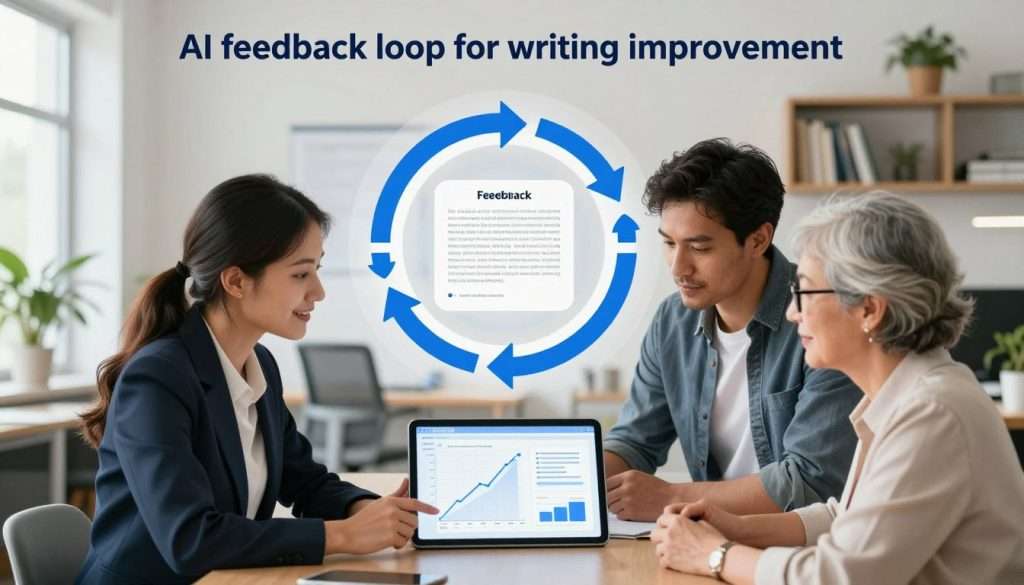
By using AI to enhance your writing, you’ll become more effective and confident. Whether it’s academic papers or professional documents, AI helps you create top-notch content. It showcases your ideas and arguments well.
Organizing Study Schedules with Intelligent Planning
Effective time management is key to academic success. AI can help you manage your time better. It creates a study schedule that fits your needs and how you work.
Breaking Down Large Projects into Manageable Tasks
Studying big projects can be tough. AI makes it easier by breaking them down into smaller tasks. For example, it can help with a big research paper by setting milestones like literature review and drafting.
Here’s how AI can help:
- Identify key components of the project
- Estimate time required for each task
- Prioritize tasks based on importance and deadlines
Balancing Study Sessions with Rest Periods
AI helps find the right balance between studying and resting. It looks at your productivity to suggest the best study times and breaks. This keeps you motivated and avoids burnout.
For example: AI might suggest 45-minute study sessions followed by 15-minute breaks. This is the Pomodoro Technique, customized for you.
Adapting Your Schedule Based on AI Productivity Analytics
AI’s real strength is in adjusting your schedule based on how you work. It tracks your time to find when you’re most productive. Then, it suggests changes to make you even more efficient.
| Time of Day | Productivity Level | Suggested Activity |
|---|---|---|
| Morning | High | Focus on challenging tasks |
| Afternoon | Medium | Continue with less demanding tasks |
| Evening | Low | Relaxation and review |
Using AI for your study schedule means more than just planning. It’s about optimizing your study time for success. AI helps you balance work and life, leading to better grades.
Avoiding Common Pitfalls and Academic Integrity Risks
Using AI in your studies can be helpful, but it comes with risks. It’s important to know these risks to keep your academic integrity safe. AI tools can make learning better, but you must use them wisely.
Recognizing AI Hallucinations and Fact-Checking
AI hallucinations happen when AI makes up information that’s not true. This is a big problem in school where facts are key.
To stop AI hallucinations, always check the facts. Here’s how:
- Check information from different sources.
- Use fact-checking websites and academic databases.
- Watch out for info that seems too good (or bad) to be true.
Protecting Your Intellectual Property and Privacy
When you use AI tools, you share personal data or ideas. It’s important to know how this data is used and kept safe.
Here are some tips to protect your intellectual property and privacy:
- Read the terms of service and privacy policies of AI tools.
- Think carefully about what personal data you share with AI tools.
- Choose AI tools that follow data protection laws.
Understanding Institutional Policies on AI Usage
Every school has its own rules about AI. Knowing these rules helps you avoid trouble.
Look at your school’s website or talk to your advisor to learn what’s okay and what’s not.
By knowing these risks and how to avoid them, you can improve your study habits with AI and stay true to your academic values. Remember, AI is meant to help you, not replace your own thinking and judgment.
Curating Your Personal AI Toolkit
AI technology is growing fast, and finding the right tools is key for success in school. It’s important to pick tools that will enhance your studying with AI technology and boost your learning. We’ll look at the essential tools and how to use them in your studies.
Essential Browser Extensions for Academic Research
Browser extensions can make your research easier. Here are some must-haves:
- Grammarly: It improves your writing by suggesting grammar and style changes.
- Zotero Connector: It lets you save and organize research sources right from your browser.
- Scholarcy: It simplifies complex research papers into easy-to-understand summaries.
These extensions help make your research more efficient and organized. This lets you focus on understanding and using the information.
Specialized AI Tools for STEM Subjects
For STEM students, there are AI tools that make complex ideas easier to understand.
| Tool | Description | Benefit |
|---|---|---|
| GeoGebra | Interactive mathematics software for graphing and exploring mathematical concepts. | Visualizes complex equations and geometric shapes. |
| ChemDraw | Chemistry drawing tool for creating molecular structures. | Helps understand chemical reactions and structures. |
| Mathematica | Computational software for symbolic and numerical computation. | Solves complex mathematical problems and visualizes data. |
These tools are great for STEM students. They make it easier to understand and apply complex ideas.
Integrating AI into Your Existing Note-Taking Apps
Many note-taking apps now use AI to improve your study experience. For example, Evernote and OneNote can be used with AI tools to:
- Summarize long notes into key points.
- Organize notes using AI-driven tagging and categorization.
- Offer suggestions for related content based on your notes.
Using AI in your note-taking can make your study sessions more productive and efficient.
Conclusion
Using AI can really help you study better. It’s not about cheating, but making learning easier. We’ve talked about how AI can help, like making practice questions and flashcards.
AI is meant to help, not replace your effort. It can be your study buddy, helping you stay focused and honest. By using AI, you can do well in school without cheating.
It’s time to pick the AI tools that fit you best. Try out different ones to see what works. This way, you’ll make studying more fun and effective.