

You don’t need a perfect plan or a free weekend to start learning something new. A busy schedule can make practice seem impossible, while the fear of being a beginner can make a first step feel bigger than it is. We can make that step small enough to fit your actual life.
Maybe you have ten minutes before class, a quiet evening at home, or a lunch break at work. That time can help you begin. You do not need marathon study sessions to make progress.
We’ll build a flexible route from choosing a goal to keeping practice in your routine. You’ll learn how to break a big task into smaller parts, get useful feedback, and make time for review. The aim is steady progress, not a perfect plan.
Pick one curiosity you keep coming back to, and we’ll turn it into a first small step.
Key Takeaways
- Pick a goal that matters in your real life.
- Turn the goal into small tasks you can practice.
- Use feedback to spot what to adjust.
- Return to the material after time has passed.
- Track what you can do, not just what you studied.
What counts as a useful skill, and why learn one now?
A useful skill is something you can reliably do, not just something you recognize when you see it. Skill acquisition is turning knowledge into a repeatable ability through practice and feedback. A skill counts when you can apply it to a real task.
New skills are abilities you are beginning to build or can now perform more reliably. You might know the steps for making a budget, for instance, but still need practice using them with your own bills. Information gives you a map; practice helps you travel the route.
Skills can help in many parts of life. You might want to communicate more clearly, finish school tasks with less help, or feel ready for a change at work. Different people need different abilities in different environments, so usefulness depends on what you want to do.
A four-stage competence model can explain why the first attempts feel strange. At first, you may not know what you cannot do; this is unconscious incompetence. Next comes conscious incompetence, when you notice the gaps. Conscious competence means you can do the task with focus, while unconscious competence means it takes less thought.
These stages describe possible changes in awareness, not a promise that everyone reaches effortless mastery. The middle stages can take time, and some tasks stay challenging. Early awkwardness is a sign that you can see the work more clearly.
Feeling clumsy can mean you have started noticing the parts that practice can improve.
That new awareness is useful. It shows you where knowledge ends and action begins, which gives your practice a clearer purpose.
Feeling clumsy at first often means you can finally see what there is to learn.
How to choose a new skill that fits your life
The best first choice is one you care about enough to practice and can use in a real situation. Start with fit, not a long list of impressive goals. Choose one goal you can test within two weeks.
Use this four-item check before you commit. A rough choice is better than waiting for the perfect answer, because you can adjust after trying it.
- Curiosity: Does the idea keep pulling your attention?
- Real-life use: Where could you apply it soon?
- Clear first task: What could you make, explain, or do?
- Protected time: When can you practice without a major struggle?
Then turn a vague wish into a SMART goal: Specific, Measurable, Achievable, Relevant, and Time-bound. Instead of “get better at spreadsheets,” try, “By next Friday, make a monthly spending sheet with five expense groups.” You can see whether you finished it.
The 80/20 rule is a way to focus on the small parts that may bring much of a skill’s practical value. For a spreadsheet, that could mean entering data, using a basic formula, and sorting costs. It is a helpful prioritizing idea, not a promise that a fixed share of effort creates a fixed result.
Examples of new skills include drawing, basic coding, public speaking, and planning a household budget. A new skill I can do today is give a one-minute talk about something I know. Three new skills I can do as simple starter activities are a short talk, a basic budget, and a beginner spreadsheet.
The “20-hour rule” is another beginner-practice heuristic, not a finish line. It suggests focused practice can build basic ability, but it does not promise mastery. Pick a useful task, then give yourself room to learn what the task requires.
Write down one small result you can show yourself within the next two weeks.
Which skills can open up personal and career options?
If you want a career-facing choice, data analysis and information security are two practical areas to explore. Useful abilities can also support hobbies and daily life. Learning one can support career options, but it does not guarantee income.
Here are five starting ideas you can try at home. A first task gives you something concrete to make before you spend much time or money.
| Skill | First practice task | At-home option | Possible use |
|---|---|---|---|
| Data analysis | Sort sample figures | Build a simple spreadsheet | Spot patterns in data |
| Web development | Write a basic page | Make a one-page site | Build or update web content |
| Public speaking | Give a one-minute talk | Record a short presentation | Share ideas with a group |
| Project management | Plan a small event | Track tasks on a simple list | Organize shared work |
| Emotional intelligence | Listen without interrupting | Reflect on a recent talk | Handle conversations with care |
Current, useful capabilities include data analysis, digital literacy, communication, and project management. Emotional intelligence can help you notice feelings and respond with care. These abilities can matter at school, at home, and across many kinds of work.
Technical and data skills you can try
Technical skills can be fun to learn at home. You could explore a spreadsheet, write a basic web page, or try a simple data project. Photography and music are other new skills to learn for fun, with plenty of room for small experiments.
The U.S. Bureau of Labor Statistics projected job growth from 2023 to 2033 for several roles. Wind turbine service technicians were projected to grow 60%, solar photovoltaic installers 48%, nurse practitioners 38%, data scientists 34%, and information security analysts 29%.
Software developers were projected to grow 17%, with 327,900 new jobs, while home health and personal care aides were projected to grow 21%, with 820,500 new jobs. These projections describe occupations, not a guaranteed result for any one learner.
Communication, creative and everyday skills
Communication skills such as public speaking can help you share an idea with a class or a team. A simple presentation at home lets you practice without a stage or an audience. Emotional intelligence and time management can also support personal development.
New skills to learn to make money can support career options, but a course or practice project cannot promise paid work. Check what a real task involves before investing heavily. A small project is a good test of whether the work suits you.
Choose an idea you can test with a small project before investing heavily in it.
How do you break a big goal into manageable parts?
“Learn public speaking” sounds enormous until you decide what you will actually do in your next talk. Break the task apart so you can see what to practice. A clear first attempt makes a broad goal feel workable.
One broad ability often contains several smaller ones. Learning a language can involve speaking, listening, reading, and vocabulary. Public speaking can involve shaping a talk, managing nerves, pacing, eye contact, and storytelling.
Map the real task into subskills
Start with the real-world task, rather than a label like “get better.” If you want to speak in class, the task might be explaining one idea to classmates. Critical thinking helps you find the part that blocks the whole task.
Use this four-step process to make the target clear:
- Name the real-world task you want to do.
- Break that task into smaller parts.
- Pick two or three useful starting parts.
- Describe what a successful first attempt looks like.
For a short talk, success might mean sharing one main point in two minutes. For language practice, it might mean following a short conversation about familiar topics. A visible result gives you a fair way to judge the attempt.
Start with the part that matters most
The 80/20 rule can help you choose two or three subskills with high practical value. If the audience cannot follow your main point, talk structure may deserve attention before eye contact. The best place to start depends on the task’s biggest obstacle.
Sometimes the most useful subskill is not the most exciting one. You might want to work on storytelling, but unclear pacing could be making every story hard to follow. Practice the current bottleneck, even when another part sounds more fun.
Once you choose a part, make the first attempt small enough to repeat. Record a short talk, try a brief conversation, or draft one simple page. That first try helps you notice what to adjust.
A subskill is a good first target when practicing it makes the whole task easier.
What does deliberate practice look like?
Deliberate practice gives each session a job, so you know what to listen for or look for. Focused work targets a specific weakness, uses feedback, and gives you a chance to adjust. Repeating an activity without noticing what changes is not enough.
Suppose you want to improve a short presentation. Simply giving the same talk several times may help, but it can also preserve the same rushed pace. Record one version, listen for your speed, then try again with that one detail in mind.
A session might focus on a single task: explain one idea, check whether the main point is clear, and revise a confusing sentence. Small goals keep practice from turning into a long, blurry work session. You can also enhance professional development by choosing practice that resembles a real task.
The “20-hour rule” is a rough beginner heuristic for building basic, functional ability through focused practice. It does not mean you will reach expertise after 20 hours. Treat the number as a starting idea, not a guarantee.
Some learners use the Pomodoro format to protect their attention. A common version has 25 minutes of focused work and a five-minute break. After four cycles, take a longer break of 15-30 minutes.
You can also try the Feynman technique: explain an idea in simple words, then return to any gap you find. If you cannot explain why a formula works, that gap gives you a useful next task. Keep the explanation close to something you could actually use.
Neither a timer nor a simple explanation replaces feedback on the real task. A recording, a test run, or a clear response from another person can show what your own mind misses. Use the feedback to make one change, not ten at once.
End a session by naming one thing you improved and one thing to adjust next time.
How can practice tests and feedback help you remember?
Before you reread a page, close it and see what you can explain from memory. Retrieval practice means recalling information without looking at the answer. Try to recall first, then check and correct your gaps.

A low-stakes quiz is a practice test with little or no consequence. After watching a tutorial, close it and write down the steps you remember. Then reopen it, compare your notes, and correct any missing step.
That small check gives practice a job. A 2021 meta-analysis covered 242 studies, 1,619 effects, and 169,179 participants. It identified distributed practice and practice testing as the most effective techniques it examined.
Feedback matters because a wrong answer can stick if you never correct it. Research on learning across primary, secondary, and college settings found that low-stakes practice tests can improve achievement. Retrieval practice with feedback also supports long-term retention better than testing without feedback.
Change the context after you recall an idea. Explain it to someone, apply it to a new task, or make your own example. Recalling the same words again and again is less useful than using the idea in a fresh way.
A 2014 classroom study found that retrieval practice reduced test anxiety among middle- and high-school students. That finding describes those students, not a guarantee for every learner. A practice quiz can still help you find weak spots before a higher-stakes test.
Make the quiz small enough that you can check it honestly. A few questions about a lesson or the steps in a task are plenty for one session. Correct one gap, then try the task again.
A quick correction after a wrong answer turns a quiz into a learning tool.
How often should you study and review?
A useful starting rhythm is to return to a new topic after at least a day instead of cramming it all into one sitting. Spaced practice means learning sessions separated over time. One delayed review is better than leaving the material untouched.
A 2006 review of 184 verbal-memory studies found that separating sessions by at least one day can help long-term retention. A 2008 review found that any delayed review can help more than no delayed review. The best interval depends on the material and the learner.
Spreading five hours of study across several days can work better for verbal recall than putting all five hours into one day. The table shows a flexible example, not a universal ideal timetable. Short sessions still count when they give you time to return to the idea.
| Session | Example timing | What to do | Why it helps |
|---|---|---|---|
| First session | Day 1 | Learn one small part | Sets a starting point |
| First delayed review | Day 2 or later | Recall the main idea | Returns after a gap |
| Another practice session | Several days later | Practice the same task | Builds another recall chance |
| Mixed-context check | Later session | Use the idea in a new task | Checks flexible use |
Use this four-step delayed-review loop when you return:
- Recall the idea before opening your notes.
- Check the answer or steps.
- Correct one gap you noticed.
- Use the idea in a new example.
You do not need a perfect calendar. If the topic feels fresh, wait longer before checking it again; if it feels hard to recall, return sooner. Keep the next session short enough to fit your day.
If you miss a planned review, restart with the next available session rather than abandoning the schedule.
Where can you find free or affordable online courses?
Start with a free preview or a public program you are eligible for before paying for a larger course library. Check the access terms before you plan around any course. A free preview is not the same as full paid-library access.
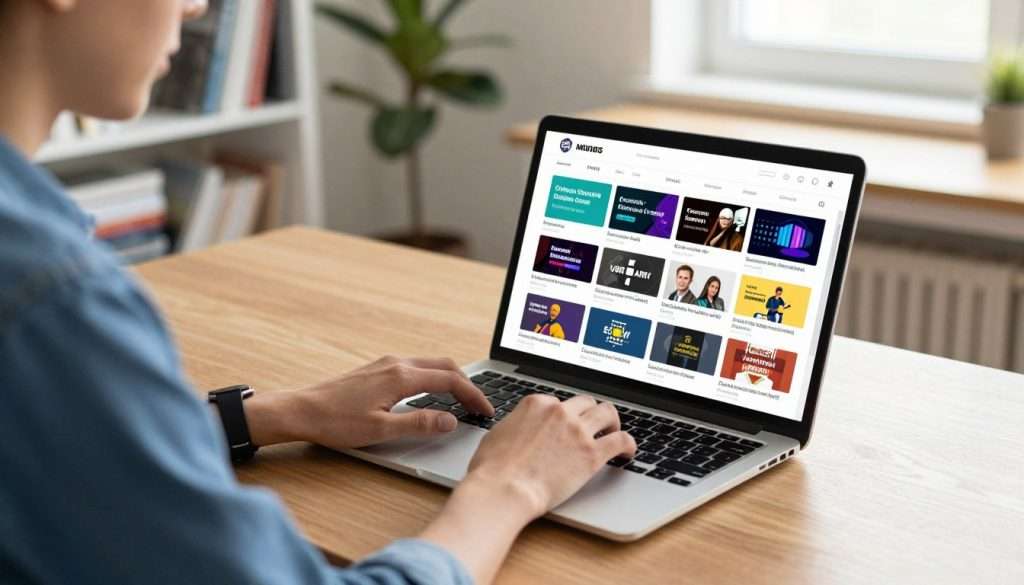
Free courses for new skills can start with a preview, a SkillUp course, or an eligible state program. Each option has different rules. This comparison shows what access may include.
| Option | Access or cost | Who can use it | Useful detail |
|---|---|---|---|
| Coursera free-course preview | No-cost first-module preview | Learners choosing a course | May include videos, readings, and graded assignments; 2026 catalog: 668 Computer Science, 425 Data Science, 145 Information Technology, 1,095 Business, 137 Personal Development, 338 Arts and Humanities, 150 Language Learning, and 70 Math and Logic courses |
| Coursera Plus | $59 monthly; cancel anytime; seven-day free trial on monthly plan | Subscribers; payment details collected at signup | No charge until trial ends; more than 10,000 courses, projects, specializations, and professional certificate programs; some offerings excluded |
| SkillUp by Simplilearn | Free | Learners using its course library | More than 500 courses, 13 categories, and 1,500 skills; listed examples include Python for Beginners, Power BI for Beginners, Introduction to Data Analytics, and Introduction to Front End Development; certificates for completers |
| New York State Coursera program | No cost | Eligible unemployed or underemployed New York residents over 18; also out-of-state residents receiving New York State unemployment insurance | Nearly 4,000 programs; funded by a $12,000,000 U.S. Department of Labor Employment and Training Administration award, with 0 percent from state or non-governmental sources |
| SkillUp NJ | More than 5,000 free Skillsoft courses and tracks | Employed or unemployed New Jersey workers | Tracks lead to more than 100 industry certifications, including information technology, business analysis, customer service, project management, and digital literacy |
Preview a course before paying
Coursera says many free courses offer a no-cost preview of the first module. The preview can include video lessons, readings, and graded assignments where available. Try a lesson before deciding whether its style suits you.
Coursera Plus costs $59 per month, can be canceled anytime, and has a seven-day free trial on its monthly plan. Payment information is collected at signup, with no charge until the trial ends. Coursera Plus includes more than 10,000 offerings, but some offerings are excluded.
The catalog has options across technology, business, arts, languages, math, and personal development. Coursera also lists Code Free Data Science for learners without programming skills. That may suit you if you want an introduction without starting with code.
Compare broad course libraries
SkillUp by Simplilearn lists more than 500 free courses across more than 13 categories and 1,500 skills. Its examples include beginner courses in Python, Power BI, data analytics, and front-end development. The platform says learners who complete courses receive certificates.
Look at the lesson format and first task, not just the course title. A data course should give you a chance to work with data, while a communication course should let you practice explaining an idea. A good fit is one you can use.
Check for state-funded learning access
New York State’s Department of Labor offers eligible unemployed or underemployed residents over 18 nearly 4,000 Coursera programs at no cost. The program also covers people who live outside New York but receive New York State unemployment insurance. The program’s $12 million award comes from the U.S. Department of Labor Employment and Training Administration, with zero percent from state or non-governmental sources.
SkillUp NJ gives employed or unemployed New Jersey workers access to more than 5,000 free Skillsoft courses and tracks. The tracks lead to more than 100 industry certifications in areas such as information technology, business analysis, customer service, project management, and digital literacy.
Check the current eligibility and terms before you build your study plan around a specific program.
How can you track progress and stay motivated?
A small record of what you actually practiced beats a vague feeling that you are getting nowhere. A practice log is a brief record of a learning session. Track the task, what worked, and what needs another attempt.
Keep the log simple enough to fill in before you close your notebook. Write the task you tried, one thing that worked, and one thing to try again. “Practiced a budget” is less useful than “sorted five costs and checked the total.”
Once a week, compare the practice you planned with the practice you completed. Look for evidence: a finished task, a clearer explanation, or fewer prompts needed. Those details can show progress even when the work still feels slow.
Try habit stacking, which links a new activity to a routine you already have. For example, review five vocabulary words after breakfast. The existing routine becomes a cue, so you do not need to invent a fresh time each day.
Adjust the task if it stays too easy or too hard. If you finish it without thinking, add a new step; if you cannot begin, make the first step smaller. A practical change can help more than trying to force the same task.
A missed day is a scheduling problem to solve, not proof that you lack discipline. Look at what got in the way, then choose a time that fits better. Busy days may call for a shorter session, not a perfect one.
Keep the next session small enough that you can start even on a busy day.
How do you turn a learning plan into a routine?
A workable plan has a small task, a repeatable time, and a way to see progress. Keep it flexible enough for your school, work, or personal life. This four-week plan is an example, not a deadline for mastery.
Use the stages in order, but scale the schedule to the time you have. Some weeks may need more than seven days. The point is to keep giving the skill a place in your routine.
Example four-week plan:
- Week 1: Choose the goal and make a baseline attempt.
- Week 2: Practice the most useful subskill.
- Week 3: Test yourself and use feedback to fix a gap.
- Week 4: Apply the skill in a different task or setting.
A student might explain a class concept from memory in Week 1, then practice explaining it in clear steps. In Week 3, a quick self-test can show which part needs work. In Week 4, the student could explain the concept to a classmate.
A lifelong learner could make a simple personal budget as a baseline task. Then they could practice sorting expenses, test their math, and use the budget with next month’s costs. That fresh example shows whether the skill works beyond a practice sheet.
If a week gets crowded, shrink the task rather than throwing out the plan. You might practice for ten minutes or complete just one part. A smaller session keeps the routine alive without pretending every day is wide open.
Use your practice log to see whether the plan fits. If you keep missing the same time, choose a better one. If the task feels too easy or too hard, adjust its size.
A routine works best when the next task is clear, small, and easy to begin.
Put the next practice session on your calendar, then make the first task easy to begin.
Conclusion
You do not need to learn everything at once; one useful ability, practiced steadily, is a real start. Focused practice and useful feedback matter more than waiting for ideal conditions. Choose one manageable task and schedule its first session.
If this article resonated with you, my free book How to Become the Smartest Student in the Classroom gives you a full system, memory techniques, study routines, and strategies that actually stick. No cost, no catch. Grab your free copy here: https://www.studyingmachine.com/free-books/.
Choose your first small task today, and grab your free copy of How to Become the Smartest Student in the Classroom at https://www.studyingmachine.com/free-books/.