

We’ve all been there. You’re staring at a dense textbook, feeling like your brain is a sieve. Every fact just slips right through. It’s frustrating, but you are not alone in this struggle.
The good news? Your brain is not a fixed vault. It’s a muscle waiting for the right training. By shifting your mindset, you can turn those long hours of reading into a fun, rewarding adventure.
Competitive memorizers don’t have magic powers. They use visualization to lock in massive amounts of data quickly. By mastering these proven memory techniques, you can stop relying on boring rote repetition. It’s time to discover how to remember what you study with ease and confidence.
Key Takeaways
- Memory is a skill you can develop, not a fixed trait.
- Visualization is a powerful tool for retaining complex information.
- Shifting your mindset makes learning feel like a game rather than a chore.
- Ditch rote memorization for more effective, active learning strategies.
- Consistent practice turns these methods into second nature.
Understanding the Science of Memory and Retention
To improve memory, you need to understand how your brain works. Think of your brain as a high-performance machine. It needs the right manual to operate at its best.
When you work with your brain instead of fighting it, learning becomes easier. This unlocks a smoother path to understanding new things.
How the Brain Encodes Information
Encoding is when your brain turns sensory input into a memory trace. It’s like typing data into a computer for later use. Your brain filters millions of bits of information, deciding what to keep and what to throw away.
To make information stick, your brain needs meaningful connections. Linking new facts to things you already know strengthens neural pathways. This is key to memory improvement, making abstract data something your brain can grasp.
The Difference Between Short-Term and Long-Term Memory
Your brain has two main storage systems. Short-term memory, or working memory, is like a mental scratchpad. Studies show it can hold about 7, plus or minus 2, items at once.
This space fills up quickly. If you don’t move information to long-term storage, it disappears. Long-term memory is like a huge library where your brain stores everything it has processed and rehearsed.
| Feature | Short-Term Memory | Long-Term Memory |
|---|---|---|
| Capacity | Very Limited (7 +/- 2 items) | Virtually Unlimited |
| Duration | Seconds to Minutes | Days to Decades |
| Primary Role | Active Processing | Permanent Storage |
| Access Speed | Instant | Requires Retrieval |
Knowing these limits helps you avoid overloading your brain. Focus on moving small chunks of data to your long-term memory for better memory improvement. It’s about being smart with how you feed your mind.
Preparing Your Environment for Optimal Focus
Creating the perfect environment is a key study tip today. Your surroundings can either help or hinder your focus. A calm and intentional space boosts your brain’s performance.
Eliminating Digital and Physical Distractions
A messy desk can mess with your mind. Clutter makes your brain work harder. A clean space lets you focus better.
Digital distractions are just as bad. Turn off non-essential notifications or use apps to block social media. These tips help you stay focused longer.
The Importance of Ergonomics and Lighting
Studying shouldn’t be tiring. Uncomfortable seating or poor lighting can make you want to stop early. A good chair and proper desk height are crucial.
Lighting affects your mental state. Sit near natural light to stay alert. A desk lamp can prevent eye strain and keep your mood up. These small changes make your study space better.
Active Recall: The Gold Standard of Learning
If you’re just re-reading your notes, you’re working too hard. Many students think highlighting or reading over and over is studying. But, these effective learning strategies just keep your brain busy without really learning.
Why Passive Reading Fails
Passive reading gives you a false sense of familiarity. When you see a page you’ve already read, your brain thinks you know it. This can lead to poor exam scores.
True retention comes from pulling information out of your brain. Using recall methods strengthens your neural pathways. This turns studying into mental challenges that help you remember.
Implementing Self-Testing Strategies
The best way to learn is to test yourself before you feel ready. Instead of reviewing, try to write down everything you remember on a blank sheet. This is where the real learning happens.
Using Flashcards Effectively
Flashcards are great, but only if used right. Don’t just flip through them. Try to answer the question out loud before checking the answer. If wrong, mark it for later review.
The Practice of Teaching Concepts to Others
Want to know if you really get a topic? Try explaining it to someone else. This is the Feynman Technique. If you struggle or use jargon, you know where to study more.
| Study Method | Effort Level | Retention Quality |
|---|---|---|
| Passive Reading | Low | Poor |
| Highlighting Text | Low | Low |
| Active Recall | High | Excellent |
| Self-Testing | High | Excellent |
By focusing on these recall methods, you’ll see big improvements in your grades. These effective learning strategies might be tough at first. But they’re the fastest way to learn any subject.
Mastering Spaced Repetition for Long-Term Recall
Ever felt like your brain is a sieve, losing all that hard-earned knowledge? It’s a common problem, but there’s an easy fix. By using smarter retention techniques, you can make information stick for good.
The Forgetting Curve Explained
In 1885, Hermann Ebbinghaus discovered something key about learning. He found the Forgetting Curve, showing how fast our memory fades after learning something new.
Without review, you might lose over half of what you studied in just a few days. This is why cramming doesn’t work well for deep learning. By reviewing at set times, you can keep your memory sharp.
Creating a Review Schedule
Creating a consistent plan is a top study tip. You don’t need to spend hours daily reviewing. Just be smart about when you check your notes again.
Follow this simple pattern to improve your recall:
- First review: Within 24 hours of your initial study session.
- Second review: Three days later.
- Third review: One week later.
- Final review: One month later.
Leveraging Digital Tools for Spaced Repetition
You don’t have to track intervals manually if you don’t want to. Digital tools can do it for you, using the best study tips.
Apps like Anki or Quizlet use smart algorithms to show you cards you’re likely to forget. These retention techniques make scheduling easy, so you can focus on learning.
How to Remember What You Study: Simple Memory Techniques That Actually Work
Learning can be fun if you know how to make your brain enjoy it. By using smart retention techniques, you can make complex info stick easily. Let’s explore how to turn studying into a game, not a chore.
The Method of Loci and Memory Palaces
The memory palace technique is a top trick for memory athletes. It involves visualizing a place you know well, like your home. Then, you “place” items to remember in specific spots. This makes recalling info a breeze.
Our brains remember places better than lists. By linking facts to specific spots, you create a vivid anchor. This makes remembering easy.
“Imagination is more important than knowledge. Knowledge is limited. Imagination encircles the world.”
Using Mnemonic Devices and Acronyms
Mnemonics are great for long lists or sequences. An acronym uses the first letter of each word to create a catchy word. For example, “PEMDAS” helps remember math order.
You can also make silly sentences where each word starts with the concept you need to learn. The sillier, the better it sticks in your memory. This is a top way to remember without feeling stressed.
The Power of Visualization and Mental Imagery
Your brain loves pictures, so turn notes into a movie. Visualize concepts as colorful scenes. For history, imagine events as a film with sounds and feelings.
Adding sensory details—like smells or textures—makes memories stronger. This creative method is a top retention technique for students. It turns boring facts into a story you’ll remember easily.
| Technique | Best Used For | Primary Benefit |
|---|---|---|
| Memory Palace | Lists and sequences | Spatial association |
| Acronyms | Short, ordered lists | Quick recall |
| Visualization | Complex concepts | Deep understanding |
Chunking Information to Reduce Cognitive Load
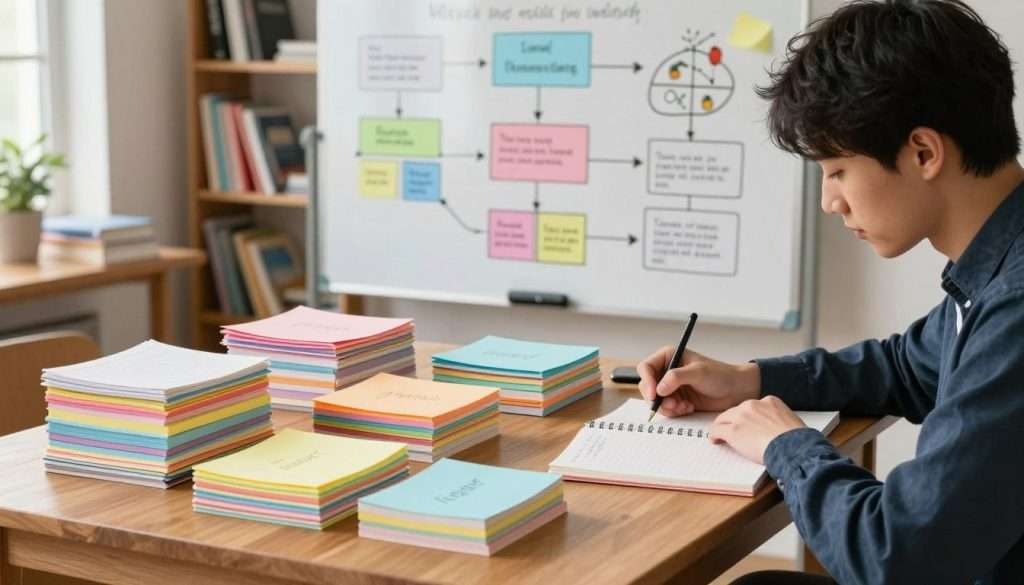
Trying to tackle a huge textbook can feel like eating a whole pizza by yourself. It’s messy, overwhelming, and not very effective. When you try to take in too much at once, your brain gets stuck.
Your working memory can only hold 3 to 4 units of information at a time. Going beyond that makes you lose focus and feel down. Using smart study hacks can help you avoid this and keep your brain happy.
Breaking Down Complex Subjects
The secret to mastering tough material is to break it down into smaller pieces. Instead of tackling a whole chapter, focus on one idea at a time. This makes the information less scary.
When you focus on one idea, your brain can process it better. You’ll remember more when you’re not rushing through a lot of text. Breaking down your goals helps you stay focused during long study sessions.
Organizing Data into Manageable Patterns
After breaking down the information, organize it into logical patterns. Your brain likes structure and looks for connections. Grouping related items together makes it easier to remember.
Try using mind maps, bulleted lists, or color-coded notes to organize your thoughts. These simple study hacks turn a mess of facts into a clear plan. Seeing the big picture through these groups boosts your confidence in remembering the information.
The Role of Interleaving in Skill Acquisition
Mixing up your study routine might seem chaotic, but it’s actually a brain booster. Instead of focusing on one topic until you’re an expert, try switching between different subjects. This method is one of the top effective learning strategies for students today.
Mixing Subjects to Enhance Neural Connections
Switching topics keeps your brain on its toes. It can’t rely on autopilot, so it must constantly retrieve and compare information. This active mental effort strengthens neural pathways, making your knowledge more lasting.
It’s like cross-training for your mind. By switching subjects, you keep your brain active and avoid boredom in long study sessions. These effective learning strategies help you understand how different ideas connect, not just memorize facts.
“Learning is not a spectator sport; it requires active engagement and the willingness to embrace the struggle of mixing up your practice.”
Avoiding the Trap of Blocked Practice
Many fall into the trap of “blocked practice,” studying one skill or subject for hours. This might make you feel like you’re making progress, but it’s often a false sense of mastery. You might remember the material for a short time, but it rarely lasts.
Interleaving breaks this cycle by making your brain work harder. Below is a comparison showing why mixing things up is better for your study habits.
| Feature | Blocked Practice | Interleaved Practice |
|---|---|---|
| Focus | Single subject | Multiple subjects |
| Difficulty | Feels easy | Feels challenging |
| Retention | Short-term | Long-term |
| Engagement | Low | High |
By avoiding blocked practice, you choose effective learning strategies that focus on long-term retention. It might be harder at first, but your future self will appreciate it when the information stays with you.
Optimizing Your Study Sessions with Pomodoro
Ever felt like your brain just stops working when you study too long? Staring at screens for hours doesn’t help you learn. It just makes you tired and upset. But, there’s a great study hack that works with your brain’s natural pace.
Structuring Time for Maximum Concentration
The Pomodoro technique is a big help for staying focused. It breaks your study into short, intense periods. You work for 25 minutes, then take a five-minute break.
This pattern keeps your focus sharp without a mid-study dip. After four cycles, you get a longer break to fully recharge. It makes big tasks feel smaller and easier to handle.
Managing Mental Fatigue Through Strategic Breaks
Short breaks are not lazy; they’re essential for learning. They let your brain consolidate new information. Without breaks, your brain gets too full, and you remember less.
Here’s why breaks are a top study hack:
- Prevents burnout: Regular breaks keep your energy up all day.
- Boosts creativity: Taking a break often helps you solve problems you were stuck on.
- Improves focus: Knowing a break is coming helps you stay focused during work.
- Enhances memory: Your brain processes and stores what you learned while resting.
Using these study hacks means you’ll get more done in less time. Your brain will appreciate the structure, and you’ll remember more. Try it next time you study and see the difference!
The Impact of Lifestyle on Cognitive Performance
Treating your body like a top athlete can boost your studies. Your brain needs the right food and rest to work best. Making small changes in your daily life can greatly improve memory and mental clarity.

Sleep Hygiene and Memory Consolidation
Sleep is when your brain saves all you learned during the day. Without enough sleep, your brain can’t move info from short-term to long-term memory. It is truly non-negotiable.
Experts say you need 7 to 10 hours of sleep each night. Cutting sleep short means losing your hard work. A consistent bedtime routine is key to improve memory and feeling sharp in the morning.
Nutrition and Hydration for Brain Health
Your brain uses a lot of energy, so eating right is crucial. Eat whole foods like berries, nuts, and leafy greens to stay focused. Don’t forget the water!
Even a little dehydration can cause brain fog and make it hard to focus. Keep water close while studying to keep your brain hydrated and ready to learn. Good nutrition is the premium fuel your mind needs to stay sharp.
Physical Exercise as a Cognitive Booster
Exercise is not just for your body; it boosts your brain too. It increases blood flow to the brain, helping create new connections. It is like giving your brain a fresh start.
You don’t need to run a marathon to see benefits. A 20-minute brisk walk or a quick dance can clear mental fatigue. Staying active is crucial for your academic success.
Overcoming Common Memory Blocks and Frustration
Ever stared at a textbook until the words blurred? We’ve all been there, feeling that sharp sting of frustration when a concept won’t click. But these moments are where you grow the most, if you use the right memory techniques.
Dealing with Procrastination and Anxiety
Procrastination and anxiety block learning. When overwhelmed, your brain tries to protect you by avoiding tasks. This cycle of stress makes learning new info hard.
To break this cycle, break your study into small chunks. Aim for just five minutes of focused work. You’ll find memory improvement easier without the pressure of perfection.
Reframing Difficult Material
When you hit a wall, your thoughts matter a lot. Instead of thinking a subject is too hard, see it as a puzzle. This simple change can make a hard task fun.
If stuck, take a deep breath and try a new approach. Explaining out loud or drawing a diagram can reveal what you missed. Remember, every expert was once a beginner who didn’t give up. Stay patient and use memory techniques to conquer tough topics with confidence.
Tracking Your Progress and Adjusting Strategies
Becoming a master of your own learning journey is not just about hard work. It also involves detective work. You’ve probably picked up many study tips along the way. But how do you know which ones really help your grades? The answer is to become a student of your own process.
Keeping a Study Journal
We highly recommend starting a simple study journal. It’s like your personal laboratory. Here, you record what you studied, how long it took, and how you felt about it afterward.
By writing down your observations, you create a clear map of your academic performance. You can easily spot patterns. For example, you might find that you’re more alert at certain times of day or that some subjects drain your energy faster.
Identifying Which Techniques Work Best for You
Not every strategy works for everyone, and that’s okay! You should try out different recall methods to see what works best for you.
When you review your journal, look for the techniques that consistently lead to better quiz scores or faster comprehension. If you find that flashcards are more helpful than re-reading notes, focus on that. You can then refine your approach by focusing on the tools that give you the biggest return on your time.
Consider these simple ways to evaluate your progress:
- Review your notes weekly to see if you actually remember the concepts.
- Compare your test results against the specific study tips you used for that unit.
- Be honest about which recall methods feel like a chore versus those that feel like a breakthrough.
Remember, the goal is to make small, consistent adjustments. Over time, these tiny tweaks lead to massive improvements in your overall academic success!
Conclusion
You now have a complete toolkit to change how you process information. Mastering these memory techniques takes time, so be patient as you experiment with your new skills.
Learning is a personal adventure. We want you to feel empowered to take control of your study sessions. Use these effective learning strategies to make every study hour enjoyable.
Start applying these study tips today to see real growth. You will soon discover how to remember what you study with much less effort. Consistent practice is the secret to lasting memory improvement.
Try out different recall methods to see what clicks for your unique brain. These study hacks are designed to make your life easier. Your mind is a high-performance machine waiting to be unlocked.
We encourage you to share your favorite retention techniques with friends. Building a community of learners makes the process even better. Keep pushing your limits and enjoy the process of becoming a smarter version of yourself.